

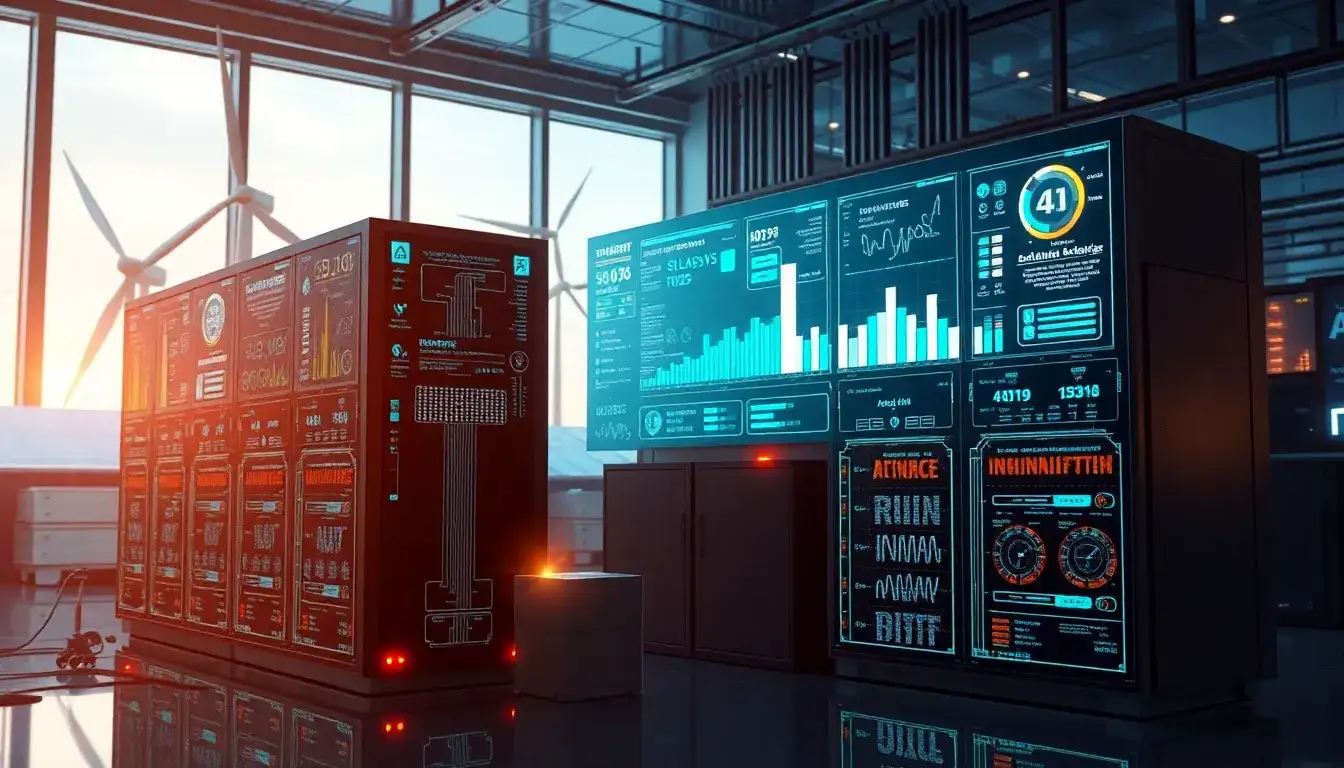
The AI Evolution of Battery Management Systems
===============================================
Battery storage requires advanced management for the 21st century power grid.
Did you ever imagine a time when wind and solar energy generated more electricity than coal-fired power plants? This became a reality last year, marking a significant breakthrough for wind and solar technologies. According to a 2023 report from Energy Innovation, 99% of the legacy coal-fired plants in the U.S. were found to be more expensive to operate than replacing them with new wind or solar generation, including the necessary battery storage systems to make this clean energy dispatchable.
Developers of large wind and solar facilities have been utilizing extensive battery storage systems for years, as have utilities and grid operators. These entities rely on battery storage systems to enhance the reliability of solar resources, necessitating efficient battery management systems (BMS). This need persists even for behind-the-meter (BTM) applications, as BMS technology has become crucial in accommodating the growing demand for power generation from wind, solar, and storage sources.
Gigawatts Get Noticed
———————-
To provide some context, data from 2024 has recently been analyzed by several organizations. Reports indicate that 93% of all new energy capacity added in the U.S. last year came from solar, wind, and storage, totaling around 49 gigawatts. This surge pushed the overall capacity of clean energy connected to the power grid to a record high of over 300 gigawatts.
The SEIA (Solar Energy Industries Association) and Mackenzie Power & Renewables’ publication, “U.S. Solar Market Insight 2024 Year in Review,” highlighted some compelling statistics. SEIA reported that 4.7 gigawatts of residential solar were installed last year, along with approximately 3.8 gigawatts from the commercial and community solar segments. While these figures may seem modest compared to large-scale grid solar capacities, their significance lies in their contribution to the BTM segment, which is vital for grid decentralization. The report also noted that homeowners and businesses are increasingly opting for solar systems paired with battery storage, with over 28% of new residential solar capacity including storage in 2024.
The economic value of solar-plus-storage systems is substantial for their owners, emphasizing the need for an efficient BMS. Imagine if developers, utilities, and BTM customers had an application that could inform them of the optimal times to sell their power for the highest price per kilowatt. Aggregators have recognized this BTM segment as a lucrative source of revenue due to the vast amount of available solar-plus-storage capacity. However, effectively harnessing these resources remains a challenge.
Needed Active, Not Passive
—————————
Today’s BMSs can no longer remain passive as they once were. Initially, when storage was added to solar energy systems, BMSs were simple and reactive. However, as technology has evolved, these systems are now expected to play a more active role in managing battery health and operation. Users have started to ask insightful questions about how BMSs can become less reactive and more proactive. They want systems that can adapt and optimize in real-time, and utilities are inquiring whether these systems can directly respond to the power grid’s needs.
Manufacturers are also exploring the potential for BMSs to transition towards a more autonomous model. The smart grid technology has demonstrated the benefits of smarter and more efficient operations. The integration of cloud computing into the grid has led to the development of sophisticated software and advanced communications, expanding the capabilities of BMSs.
As BMSs evolved into more sophisticated platforms, the advancements were significant and irreversible.
Wanted – Smarter Systems
————————-
Once BMSs transitioned from passive to active systems, the focus shifted towards enhancing their predictive capabilities. Imagine being able to make intelligent decisions regarding how BMSs interact with the power grid in real-time. While this may sound like science fiction, it is becoming a reality through the integration of artificial intelligence (AI) technology into BMS applications.
AI-driven applications have revolutionized BMS operational efficiency, enabling the management of larger and more complex storage systems than ever before. These AI-driven BMS platforms leverage advanced algorithms, machine learning, and predictive analytics to enhance their functionality. By learning from the data they process, AI-driven BMS platforms make informed decisions that improve their capabilities.
One notable advantage of AI-driven BMS platforms is their ability to perform real-time monitoring alongside data analysis to assess battery performance and predict future outcomes. Predictive algorithms categorize and organize the vast amounts of data generated by BMSs into well-defined groupings, allowing for the application of conditional analytics to make predictions based on probabilities.
AI-Driven Advantages
———————
Numerous factors affect a battery’s health and service life, including degradation and component failure. Generative AI can identify these patterns and generate predictions that many AI-driven BMS platforms utilize for predictive diagnostics, adaptive control, and predictive maintenance.
Reducing maintenance costs is a primary goal for budget-constrained utilities and grid operators worldwide. AI-driven BMS platforms excel at minimizing maintenance expenses through predictive diagnostics, which can identify potential issues before they escalate into significant problems. Often, a simple autonomous adjustment can rectify the situation. Predictive diagnostics can differentiate between normal aging and emerging failures, reducing downtime and maintenance costs.
Additionally, AI pattern recognition can facilitate adaptive management by integrating external databases that include environmental conditions, demand forecasts, operational grid constraints, and energy trading. This provides ancillary service providers with an edge in maximizing revenue from their services sold to the power grid.
Making a Difference
——————–
These are just a few advantages offered by AI-driven BMS platforms. As these technologies mature, they are significantly benefiting their users. Some BMS suppliers that incorporate AI claim they can free up an additional 10% of capacity from a typical battery storage system. There are also assertions that their technology can double or triple the lifespan of batteries, along with enhancing charge and discharge cycles.
With the plethora of options available, potential customers should thoroughly research their choices. While the technology presents many benefits, it can often lead to confusion. Understanding the specific needs for the application alongside the capabilities of various AI technologies is crucial. The distinction between AI-enhanced, AI-powered, and AI-driven systems can be complex and was discussed in a previous article.
These grid-enhancing technologies benefit users on both sides of the meter and offer significant returns to well-informed customers. The predictions for power demand in 2025 indicate a high need for electricity; however, meeting this demand will be challenging. AI-driven BMSs provide a technical solution to the obstacles that may hinder clean energy deployment.
About the Author
—————–
Gene Wolf has been designing and constructing substations and other high-tech facilities for over 32 years. He holds a BSEE from Wichita State University and an MSEE from New Mexico State University. A registered professional engineer in California and New Mexico, Gene began his career as a substation engineer for Kansas Gas and Electric and recently retired as the Principal Engineer of Stations for Public Service Company of New Mexico. He then founded Lone Wolf Engineering, LLC, an engineering consulting firm. Gene is recognized as a technical leader in the electric power industry, a fellow of the IEEE, and has held various leadership roles in IEEE committees focused on renewable energy integration and intelligent grid technology.
Original article by NenPower, If reposted, please credit the source: https://nenpower.com/blog/the-advancements-of-ai-in-modern-battery-management-systems-for-a-sustainable-energy-future/

