

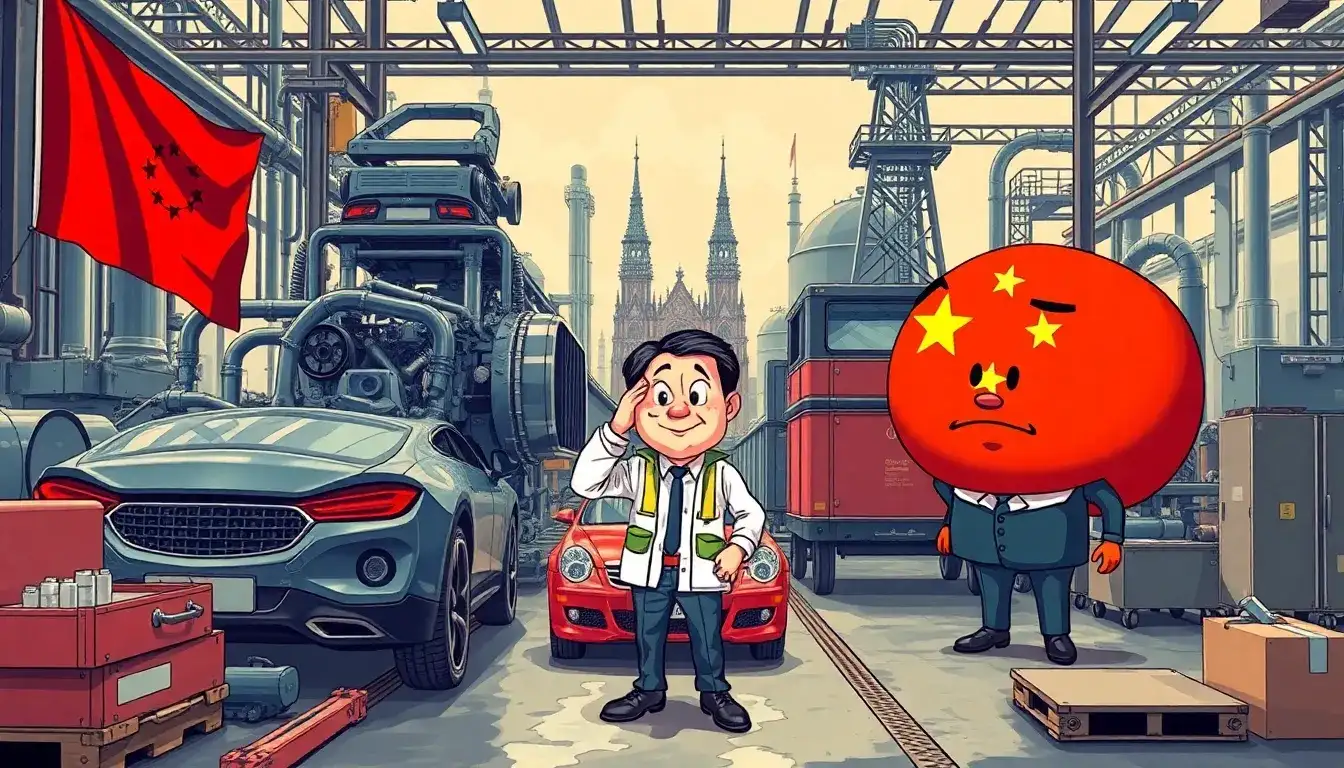
Germany’s industrial “decoupling” from China is increasingly becoming an online joke. A question arises: is Germany’s industrial strength really that strong? With renowned companies like Mercedes-Benz, BMW, and Siemens, Germany has established a global presence. Its key industries, including machinery manufacturing, chemicals, and electronics, are among the best in Europe, boasting the highest number of patents and dedicating 3% of its GDP to research and development. With over 1,300 hidden champion enterprises, a digital penetration rate of 45% in Industry 4.0, and a well-established industrial and talent system, claiming that German industry is weak seems far-fetched.
Despite its impressive achievements, many German companies are still looking towards China. The fact that BASF, a chemical giant, chose Guangdong Zhanjiang as the site for its largest integrated base outside Europe, and that BMW established its latest battery research center in Shenyang, underscores this trend. According to staff at the German Center in Taicang, Jiangsu, nearly 500 German enterprises have set up operations there, with a significant portion in manufacturing. Moreover, Taicang has become China’s largest center for German vocational qualification examinations and training, reflecting China’s advantages in business environment, industrial chain completeness, and technological innovation.
However, some German politicians are not pleased. Fearing that Chinese influence might hollow out Germany’s domestic manufacturing, they have raised the alarm over “decoupling from China.” Yet, the actions of German companies contradict this “decoupling” rhetoric, revealing a stark reality: the notion that Germany’s industry can separate itself from China is turning into a farcical play.
Once known as the industrial engine of Europe, every movement in German manufacturing has global implications for the industrial chain. But why has the vigorous “decoupling” movement struggled to gain traction from the outset? To answer this question, we must explore the deeper logic behind global industrial structure changes and recognize China’s irreplaceable position in the world industrial system. This will clarify the fact that, unsurprisingly, Germany’s “decoupling” from China is likely to become a widespread joke.
A looming industrial crisis is pushing German companies to accelerate their exit from the country. Recent trends indicate a significant migration of German enterprises abroad. This trend cannot merely be attributed to global division of labor or cost factors; for a country that has rebuilt its industrial strength post-World War II and rejoined the ranks of developed economies, this shift represents a crisis. This is evidenced by two primary issues: the declining competitiveness of German enterprises and their migration overseas.
In November, the German magazine “Der Spiegel” reported findings from the IFO Institute, a reputable local think tank, indicating that German industrial enterprises’ self-assessed competitiveness has reached its lowest point in 31 years. Approximately 36.6% of surveyed companies feel disadvantaged compared to firms outside the EU, a record low since the inception of the survey. Klaus Wohlrabe, the head of the IFO survey project, noted that this reflects the deep structural contradictions affecting Germany’s industrial system. Notably, the negative evaluation rate rose significantly from 24.7% in July to 36.6% in the latest findings. Even when comparing to other EU member states, anxiety regarding competitiveness is escalating, with the proportion of companies feeling less competitive rising from 12.0% to 21.5% in just six months.
Why has this situation emerged? The decline in competitiveness is sweeping across all industrial sectors in Germany, particularly affecting those heavily reliant on energy. In the chemical industry, over 50% of companies reported a decline in competitiveness, while in electronics and optics, the figure is close to 47%. Approximately 40% of companies in mechanical engineering face similar challenges. Internal research institutions in Germany attribute these issues to fundamental structural problems, including population imbalance, a shortage of skilled labor, rising labor costs, and increasingly cumbersome administrative processes. These factors collectively exert significant pressure on business operations, echoing issues seen in the hollowing out of the American manufacturing sector.
Consequently, think tanks conclude that the current core issue facing the German economy lies in systemic weaknesses on the supply side. Returning to the second issue of companies relocating, a recent survey from management consulting firm Simon-Kucher highlights a troubling trend: 70% of energy-intensive German enterprises are moving investments abroad. Among the roughly 240 surveyed companies from key sectors such as chemicals, steel, glass, and cement, 31% are actively shifting production or expanding operations outside of Europe. Over the past five years, German companies have invested more than 200 billion euros annually overseas. They summarize the situation as one where the entire industry sees no future.
Looking back, the signs of Germany’s industrial decline are closely linked to the loss of the core advantages that once spurred its rise. Historically, Germany’s industrial success was no accident. Its geographical position at the heart of Europe allowed for easy access to Western European consumer markets and Eastern European resource bases. The political unification in the late 19th century removed barriers within the domestic market, laying the groundwork for large-scale production. The Humboldt education system fostered a highly skilled workforce, while scientists like Planck and Einstein contributed to a solid foundation in the natural sciences, creating a perfect closed loop of “research – industry – skilled workers.” To be frank, Germany’s industrial base is quite solid.
After World War II, support from the Marshall Plan and the establishment of the European Common Market propelled German industry to new heights. From automobiles to machinery, chemicals to precision instruments, “Made in Germany” products dominated global markets, contributing nearly one-third of Germany’s GDP at its peak and supporting a significant portion of the European economy. Yet today, the foundations of this success are crumbling. Geopolitically, the Ukraine-Russia conflict has led to soaring energy prices in Europe, with German industrial electricity prices occasionally reaching eight times that of China, making it extremely challenging for energy-dependent sectors like chemicals and steel. The U.S. Inflation Reduction Act offers substantial subsidies to attract European manufacturing, leading to over 50 German companies announcing plans to establish factories in the U.S. in 2023, with total investments exceeding 40 billion euros.
The governance challenges within Germany exacerbate the crisis. The coalition government of the CDU and SPD has been mired in internal conflict, struggling to reach consensus on critical policies concerning energy transition and industrial subsidies. A sudden halt to environmental policies has hindered the transformation of traditional industries in the Ruhr area, while new energy industries have failed to fill the gap, resulting in the awkward situation of “old industries retreating, while new industries have yet to establish themselves.”
The rapid departure of German enterprises is creating an invisible crisis for both Germany and the European Union. German Chancellor Olaf Scholz admitted at the 2024 Industrial Summit that the loss of manufacturing is not only an economic issue but also a strategic concern related to national competitiveness and employment stability. In light of these events, management guru Peter Drucker once said, “The greatest danger in turbulent times is not the turbulence itself, but to act with yesterday’s logic.” Historically, Germany has offered some of the most profound philosophers and most penetrating musicians, yet it has also bred some of the most unscrupulous and brutal politicians. The reason the German nation has been able to rise from the ashes after enduring numerous historical tribulations and disasters is due to a national spirit derived from its national psyche—a spirit of proactive, unyielding, and competitive rebirth.
However, today, this spirit is no longer the key support for German industry. The crisis likely stems from a failure to adapt to changes in the global industrial landscape, missing opportunities in emerging industries like new energy and artificial intelligence while clinging to traditional advantages. Moreover, the misguided direction of “decoupling from China” will only exacerbate their challenges in restructuring industrial chains.
The “decoupling from China” movement has gained momentum in recent years, with the German government taking numerous actions to push for this agenda. Previously, in the telecommunications sector, they limited Huawei and ZTE’s participation in Germany’s 5G network construction under the guise of “security,” requiring telecommunications operators to remove already deployed Chinese equipment. In the automotive sector, they promoted new EU battery regulations to weaken the competitiveness of Chinese battery companies through technical standards. More recently, in the semiconductor industry, Germany followed the U.S. in imposing export controls on high-end chips, blocking German companies from collaborating with China on advanced technology. There are also voices within Germany advocating for a reduction in dependence on the Chinese market and technology to build more resilient supply chains.
However, the reality starkly contrasts with these slogans. Not only has “decoupling from China” not been achieved, but Germany’s manufacturing sector has continued to deepen its reliance on China. According to data from China’s General Administration of Customs, the total trade volume between Germany and China from January to August this year reached 163.4 billion euros (approximately 190.7 billion USD), while trade with the United States was 162.8 billion euros. In 2024, the U.S. briefly replaced China as Germany’s largest trading partner, but now China has surpassed the U.S. again to reclaim that status. Furthermore, the dependence of German companies on the Chinese market has shifted from being a “low-cost manufacturing base” to a “technology innovation and market growth engine.” BMW’s actions exemplify this shift. In 2024, BMW launched the world’s first pure electric iX5 hydrogen fuel cell production line in Shenyang, with a total investment of 2 billion euros. This decision is rooted in China’s technological breakthroughs in hydrogen energy storage and transportation, as well as the enormous demand for high-end new energy vehicles in the Chinese market. BMW Chairman Oliver Zipse stated, “China is not only the world’s largest automotive market but also the source of technological innovation for new energy vehicles. Disconnecting from the Chinese market means losing the future.”
Data shows that in 2024, BMW sold over 710,000 vehicles in the Chinese market, accounting for nearly 40% of its global sales, and delivered over 400,000 new energy vehicles, which is also a significant portion of its global new energy sales. Similarly, the chemical giant BASF is making its mark with significant investments. The company’s integrated base in Zhanjiang, with a total investment of 10 billion euros, is the largest overseas investment project in BASF’s history and has been operational since 2024, producing 1 million tons of ethylene annually. As of last year, BASF and its partners had invested approximately 17 billion euros in the Greater China region. The answer is clear: companies are driven by profit, and the call for decoupling from China cannot cage their investment desires. China is the world’s largest consumer market for chemical products and leads in emerging fields such as new energy materials and biochemistry. Establishing factories in China allows German industrial enterprises to be close to the market and leverage China’s technological advantages to enhance their competitiveness. Reports indicate that the chemical products produced at this base not only meet Chinese market demand but are also exported to Southeast Asia, becoming a crucial hub in BASF’s global supply chain.
Moreover, in the automotive parts sector, the German Bosch Group announced in 2024 that it will establish a global research and development center in Suzhou, planning to invest 10 billion USD over the next few years, focusing on autonomous driving and automotive-grade chip research. Bosch’s China President, Chen Yudong, emphasized that China leads the world in the rapid technological iterations of artificial intelligence and vehicle networking, stating that to maintain technological leadership, they must be rooted in China. In 2023, the company achieved a sales revenue of 142.7 billion RMB in China and employs over 56,000 people there, making it the company with the largest workforce outside Germany.
The fundamental reason German manufacturing cannot “decouple from China” lies in the fact that China has evolved from being the world’s factory to becoming a global innovation hub, achieving an unprecedented level of industrial complementarity with Germany. China’s competitive advantages are often summarized as: price, quality, and speed. An astonishing example was provided by a Munich compressor manufacturer who needed a new wire processing machine. A Swiss company quoted 130,000 euros, while a comparable company from Zhejiang, China, offered a price below 28,000 euros. However, the technical and market aspects are often more crucial. Technologically, China’s breakthroughs in fields like new energy batteries, 5G communication, and artificial intelligence are filling the gaps in German industry. The transition of German automotive industry to electrification heavily relies on Chinese battery technology, with a significant portion of the power batteries needed for German new energy vehicles coming from Chinese companies. Moreover, for Germany to develop Industry 4.0, it requires China’s technical support in industrial internet and smart sensors.
From a market perspective, China boasts the world’s largest middle-income group of approximately 400 million people and a well-established consumer market system. The examples of German enterprises entering China clearly illustrate their pursuit of market share. If Germany were to withdraw, other countries like Japan, the U.S., and even neighboring France and the UK would step in. The notion of “decoupling from China” is not as simple as some might wish. Delving deeper, the logic of Sino-German industrial cooperation has fundamentally changed. In the past, Germany provided technology while China supplied labor and market access. Now, both parties have achieved equal cooperation and mutual benefits in technology research and market development.
The so-called “decoupling from China” is essentially a fanciful notion that contradicts economic laws and will ultimately lead to a loss of competitiveness for German enterprises. The era of global industrial power dynamics has shifted. The existence of an industrial crisis in Germany, whether related to decoupling from China or not, reflects the broader changes in the global industrial landscape. In recent years, there has been a historic shift in global industrial power, with emerging economies increasing their share of manufacturing, while the industrial advantages of traditional developed countries have gradually weakened.
Since World Wars I and II, the world looked to the West for industrial leadership. In the new century, the focus has shifted to developing countries represented by China. Times have changed, and the past cannot return, while the future continues to evolve rapidly. According to the “2025 Industrial Development Report” released by the United Nations Industrial Development Organization (UNIDO), as of now, the manufacturing value added by developing countries accounts for 58% of the global total, surpassing that of developed countries for the first time. Among this, China’s manufacturing value added represents 31% of the global share, maintaining its position as the world leader for 14 consecutive years. For instance, in terms of output value, China’s manufacturing share in 2024 is projected to be 31.6%, while its value added share in 2023 is estimated at 28.8%. Notably, in 2000, China’s industrial value added was only 6%, but it is expected to rise to 45% by 2030, equivalent to 2.3 times that of the combined totals of the U.S., Japan, and Germany.
In fact, China’s manufacturing value added surpassed that of the U.S. in 2010, marking its first ascent to the global forefront, with a share of approximately 19.4%. Since then, China has not only maintained its lead but has also seen its global share continue to rise, currently approaching 30%. Specifically, China has achieved global leadership in several key manufacturing sectors. For instance, the production of new energy vehicles in China reached nearly 13 million units, making it the world leader. In 2024, China is expected to produce about 425 billion chips, representing approximately 35% of the global total of around 1.2 trillion. Additionally, in the previous year, China’s power generation reached approximately 10.1 trillion kilowatt-hours, accounting for 32.3% of the global total, exceeding the combined total of the next four countries.
Thus, it can be concluded that whether measured by output value or value added, China’s global share in manufacturing is approximately 30% or possibly even more. The implementation of the “Made in China 2025” strategy has yielded results, highlighting the necessity of China’s commitment to technological innovation and industrial upgrading, which reflects the transformation of global industrial power.
In contrast to the rise of emerging economies, developed countries are generally facing issues of industrial hollowing. Since the 1980s, the U.S., the U.K., France, and other developed nations have shifted labor-intensive industries to developing countries, focusing on high-end services such as finance and technology. As a result, the share of manufacturing in GDP has continued to decline. For example, the manufacturing sector in the U.S. accounts for only about 10% of GDP, while Germany, despite maintaining a higher figure around 20%, has also shown a declining trend.
The consequences of industrial hollowing are clear: the integrity of the industrial chain is compromised, leading to a reliance on imports for critical components; the job market becomes polarized, with a shrinking middle class; and technological innovation becomes disconnected from industrial applications, making it challenging for new industries to achieve economies of scale. The roots of industrial hollowing in developed countries lie in intrinsic flaws in their industrial development models. On one hand, the profit-seeking nature of capital has led to a vast flow of funds into virtual economic sectors like finance and real estate, resulting in insufficient investment in the real economy. On the other hand, high welfare policies have driven up labor costs, diminishing manufacturing competitiveness. Additionally, during the development of emerging industries, the relatively small market size and incomplete industrial chain hinder the formation of a virtuous cycle of “application – iteration – re-application.”
In contrast, China has successfully avoided the trap of industrial hollowing thanks to its unique advantages. The enormous market scale provides a broad application for emerging industries, while a complete industrial chain reduces innovation costs for enterprises. Continuous investment in research and development ensures the capability for technological iteration, all of which contribute to the core competitiveness of China’s manufacturing sector. The changes in the global industrial landscape offer profound insights for China. Based on a precise understanding of these trends, the “14th Five-Year Plan” explicitly suggests maintaining a stable proportion of manufacturing while accelerating the development of new productive forces. Following historical lessons, this strategic deployment is highly relevant to current realities: manufacturing is the lifeblood of national economic vitality and the primary carrier of technological innovation. Maintaining a reasonable manufacturing share is essential for ensuring the security of national industrial and supply chains, providing a solid foundation for high-quality economic development.
Ultimately, the farce of Germany’s industrial “decoupling” from China will likely become a punchline on the global economic stage. In an era of deepening economic globalization, the formation of industrial and supply chains is a result of market forces and reflects the comparative advantages of various countries. Any attempts to forcibly “decouple” through administrative means violate economic laws and will ultimately harm one’s own interests. The absurdity of Germany’s “decoupling” from China has already demonstrated this point.
Original article by NenPower, If reposted, please credit the source: https://nenpower.com/blog/the-absurdity-of-germanys-decoupling-from-china-an-industrial-joke-in-the-making/

