

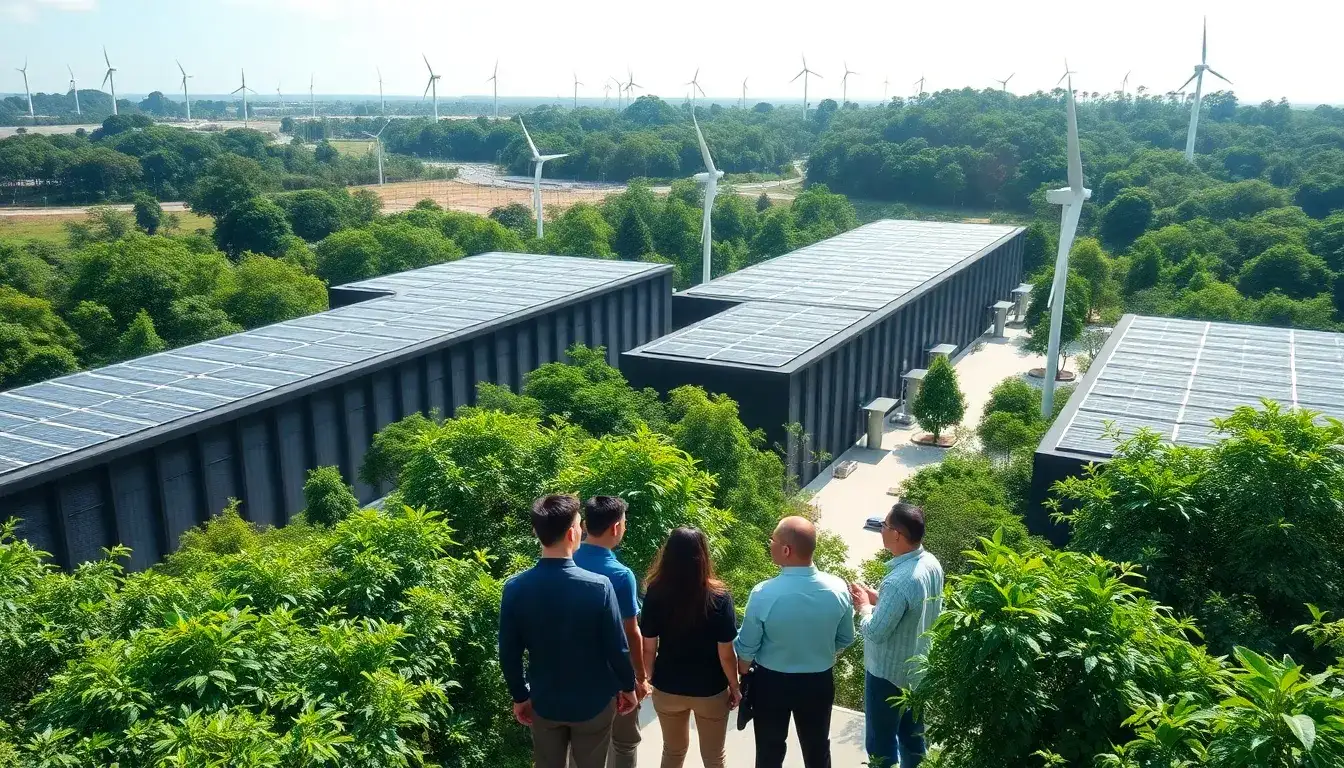
Siemens Hosts Data Center Conference to Support Thailand’s Clean Energy Goals
On June 5, 2025, Siemens, in partnership with Krungthep Turakij, conducted the “Siemens Data Center Conference 2025: Redefining Data Center Infrastructure.” The event aimed to increase awareness and understanding of emerging trends in the data center sector. Ross Conlon, President and CEO of Siemens Thailand, opened the conference, followed by a presentation from Sarat Prakobchat, Deputy Director of the Energy Policy and Planning Office (EPPO). He discussed the theme “Empowering Sustainable Data Centre Growth through Thailand’s Clean Energy Policy,” highlighting the significant energy demands of data centers.
In 2024, global data centers consumed 415 TWh of electricity, accounting for approximately 1.5% of worldwide power usage. This figure is expected to more than double by 2030, reaching 945 TWh, or 3% of global consumption, indicating a strong and ongoing demand that operators must prepare for. The Thai government has set its sights on establishing the data center sector as a key future industry. According to Krungsri Research, the industry’s growth is projected to be between 7.5% and 8.5% annually from 2025 to 2027, driven by the expanding digital economy. This growth signals the need for authorities to ensure a reliable power supply.
Sarat remarked, “Business growth has also been propelled by government measures,” referencing the Board of Investment (BOI) incentives that have been refined to align more closely with national strategies.
To facilitate this growth, the Ministry of Energy has revised its Power Development Plan (PDP) with three core objectives:
1. **Energy Security** – Guaranteeing stable power availability through metrics like Loss of Load Expectation (LOLE).
2. **Environmental Sustainability** – Aiming for at least 50% renewable energy by 2037 and a 30-40% reduction in power sector carbon emissions from baseline levels.
3. **Cost Competitiveness** – Maintaining retail power prices below 4 baht per unit throughout the plan’s duration.
The PDP supports an average annual economic growth rate of 2.99% from 2025 to 2037 and sets targets for clean technologies, including:
– Hydrogen to constitute 5% of energy use by 2030.
– Deployment of 600 MW in Small Modular Reactors (SMRs) by 2037.
– Demand response measures and smart grid development, including strategies to reduce peak demand by 2,000 MW.
In addition to the PDP, the government is enhancing the data center ecosystem through several initiatives:
1. A smart grid policy aimed at creating a resilient grid to accommodate large-scale renewable energy.
2. Clean electricity procurement policies, including “green electricity rates” (UGT) from all three state utilities, with UGT2 targeting 100% green energy.
3. Pilot projects for Direct Power Purchase Agreements (PPAs) targeting 2,000 MW, which are under evaluation for safety and primarily focused on ensuring supply flexibility for data centers.
Sarat emphasized the necessity for the government to coordinate across various sectors to ensure energy policies meet the needs of businesses and consumers. Data centers typically require between 100 and 200 MW per facility, making careful policy planning essential for Thailand’s aspirations to become a regional digital hub.
### Emerging Challenges in the Data Center Landscape
Samir Borkar, Senior Vice President and Head of the Regional Data Center Business at Siemens, noted that Thailand’s data center growth has transitioned from a forecast into a reality. The number of bids and project developments in the data center sector is on the rise, with proposals now often exceeding 100 MW, compared to the previous range of 12-20 MW. “This indicates that we’re no longer discussing theoretical trends — it’s happening, and we anticipate this momentum to persist for at least the next 5-7 years.”
Samir pointed out that the industry is facing new challenges due to the emergence of hyper-scalers and AI workloads, increasing operational complexity and underscoring the necessity for early collaboration on design and integrated management strategies.
### Fire Safety Considerations in Data Center Operations
Suwong Ratchawong, Fire Detection Technical Expert at Siemens ASEAN, highlighted the significant risks posed by fires in data centers, which threaten not only assets and business continuity but also the safety of on-site personnel. He stressed the importance of adhering to international safety standards, particularly those set by the National Fire Protection Association (NFPA), including NFPA 75 for fire sprinklers and smoke detection systems, and NFPA 76 for telecom systems. Compliance with these standards can also influence insurance premiums.
### Accelerated Growth of Data Centers in Thailand
Saneh Pienrattanakul, Head of Operations at True IDC, acknowledged that the demand for large-scale data centers and AI-focused clients has surged beyond expectations. He emphasized the need for extensive advance planning across all phases, from design to operational management. “Our ability to meet this demand is supported by strong partnerships across every function,” he stated.
Jodi Pieterse, Director at WT Partnership, noted that one of the industry’s major challenges is the rising cost per megawatt, primarily driven by the need for future-proofing amid uncertainties. “We can manage costs through careful design decisions, structured project planning, and precise cost-control techniques,” he explained.
### Foreign Investment Driven by AI and 5G Technologies
Rapeepoom Lapmak, a researcher from Krungsri Research, emphasized that data centers function as essential infrastructure, supporting seamless operations across the digital supply chain. He pointed out a significant increase in foreign direct investment (FDI) in Thailand’s data center sector. In 2024, investment applications surpassed 240 billion baht, with major contributions from companies like Amazon Web Services (over 200 billion baht), Google (over 30 billion baht), and Microsoft (amount undisclosed). The majority of this investment has been sourced from the U.S., China, and Singapore.
The momentum has continued into 2025, with a TikTok subsidiary investing over 120 billion baht and SIAM AI Cloud committing 3.3 billion baht. “In March alone, a Chinese firm showed interest in investing over 70 billion baht, and a joint venture involving the GULF Group proposed an additional 13 billion baht, bringing the total investment applications for Q1 2025 to 94 billion baht — a fivefold increase compared to the same period last year,” Rapeepoom reported. The BOI has also announced five new data center projects worth over 90 billion baht.
### Future Outlook: Key Growth Drivers
Looking ahead, Thailand’s data center industry is expected to grow 7.5% to 8.5% annually from 2025 to 2027, driven by three primary factors:
1. **Increasing Internet and Digital Payment Usage** – E-payment transactions in Thailand reached 4.9 trillion baht in 2024, with a projected annual growth of 10-14%, potentially reaching 8.7 trillion baht by 2030.
2. **Widespread Cloud Adoption** – The country’s cloud industry revenue is anticipated to hit 80 billion baht in 2025, doubling each year thereafter. Businesses are increasingly adopting cloud solutions for their flexibility, cost-effectiveness, and security. The Thai government is promoting this shift through its forthcoming “Cloud First Policy,” set to launch in October 2025, to attract more FDI and enhance digital infrastructure.
3. **AI Integration Across Various Sectors** – Globally, AI is expected to generate $211 billion in revenue in 2024, growing over eightfold to $1.62 trillion by 2030, with a 19% annual growth rate. In Thailand, 17.8% of organizations are currently utilizing AI.
### Efficient Cooling Solutions for Data Centers
Arnon Kulawongvanich, Managing Director of B.Grimm Technology Co., Ltd., discussed the importance of innovative solutions for enhancing data center infrastructure’s efficiency, resilience, and sustainability. He emphasized a partnership with Siemens to deliver tailored energy services for clients. As energy-saving solutions become increasingly crucial, improvements in cooling systems—one of the most energy-intensive components of data centers—are essential. Enhancing the efficiency of HVAC systems is vital for improving Power Usage Effectiveness (PUE), a key performance metric for energy in data centers.
Arnon also pointed out that electricity costs in Thailand pose a considerable challenge for data center operations. Clear policies are required to facilitate access to clean electricity, as the current pilot quota of 2,000 MW under the Direct Power Purchase Agreement (PPA) scheme is insufficient to support investment projects worth hundreds of billions of baht. While Thailand’s electricity prices are relatively moderate compared to other ASEAN countries, the integration of data centers into clean energy systems remains a significant obstacle. Therefore, the government must enhance its management of this transition to ensure long-term competitiveness and sustainability.
Original article by NenPower, If reposted, please credit the source: https://nenpower.com/blog/thailands-data-center-growth-accelerates-with-clean-energy-initiatives-and-digital-economy-push/

