

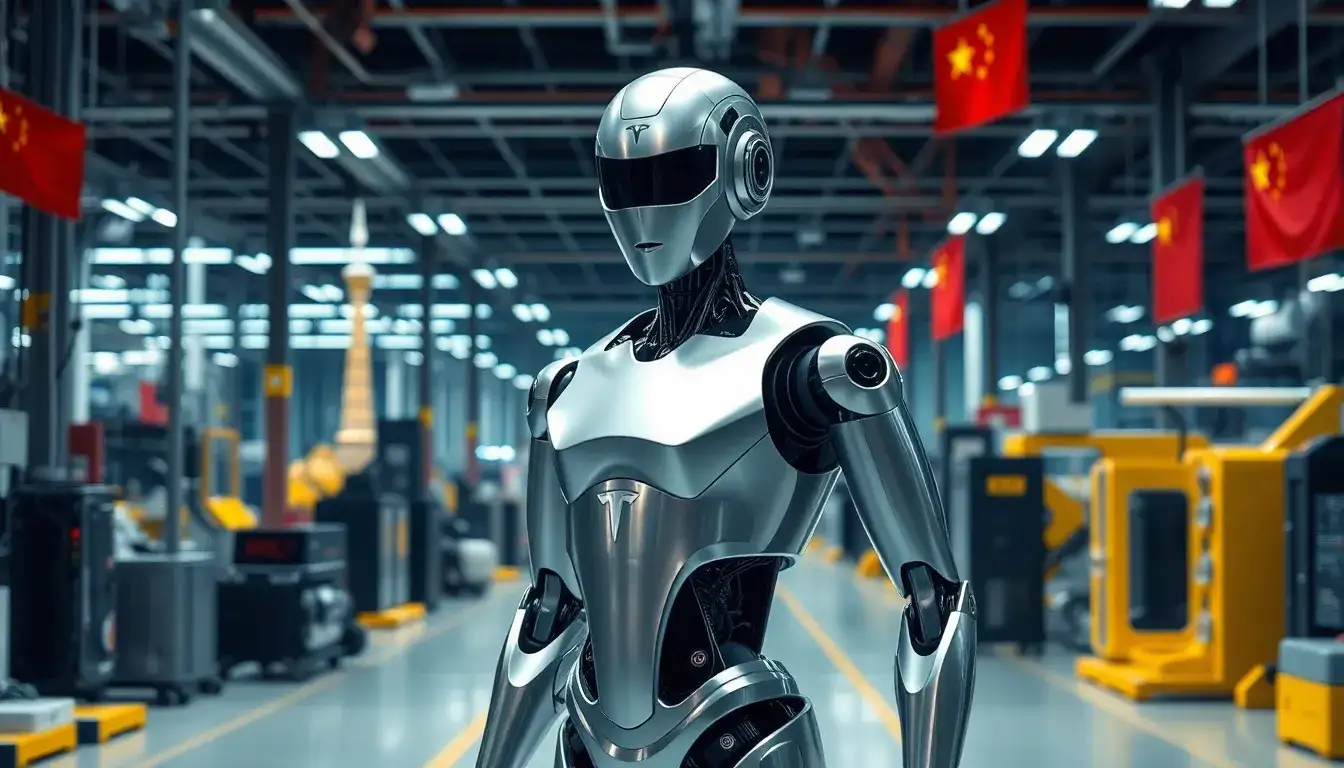
Tesla’s Transformation: Is “Optimus Prime” Relying on China? Musk Responds
Following recent signals from Tesla’s CEO, Elon Musk, indicating a shift towards humanoid robots, global business circles and media have begun to track and analyze the supply chain related to the “Optimus” humanoid robot. Various media outlets, including the South China Morning Post and South Korea’s Chosun Ilbo, have noted that China holds a significant advantage in manufacturing the “body” of robots, while the United States leads in AI “brain” technology. Tesla’s robot strategy heavily relies on this efficient and cost-effective “China chain” for rapid implementation.
On February 4, market reports revealed that Musk’s team had been conducting secret investigations into multiple Chinese companies, covering various segments such as equipment and battery components. Although these investigations did not directly indicate a connection to future humanoid robot production, many believe that the relevant business will be closely linked to the Chinese supply chain.
Potential Revenue Could Reach $10 Trillion
During last week’s quarterly earnings call, Musk officially confirmed that Tesla would gradually cease production of the Model S and Model X electric vehicles starting next quarter. The production line at the Fremont factory, previously used for these models, will be transformed for the manufacturing of “Optimus.” Musk stated that the long-term goal for the Fremont factory is to achieve an annual production of one million humanoid robots.
According to the International Business Times, the “Optimus” humanoid robot was first unveiled as a concept in 2021, with the initial prototype being a person in a costume. When asked about the actual performance of the “Optimus” robot in the factory, Musk expressed cautious optimism, indicating that the project is still in its early stages.
Despite ongoing skepticism, Tesla remains committed to developing humanoid robots. Musk anticipates that “Optimus” may officially be available for sale by the end of 2027, contingent upon overcoming a series of complex challenges in hardware and software. He also mentioned that the robot’s future revenue could reach as much as $10 trillion. The International Business Times reported that analysts believe humanoid robots are among the most complex machines humanity has ever attempted to develop, and it may take several more years for Musk’s projections to materialize.
Engagement with Chinese Component Suppliers Began Three Years Ago
Musk aims to establish the production of the “Optimus” robot in the United States; however, analysts and industry insiders indicate that this project will remain “highly reliant” on China’s vast and rapidly developing robot supply chain, as reported by the South China Morning Post. Sources revealed that Tesla began engaging with hundreds of Chinese component suppliers three years ago to discuss procurement and has collaborated with some firms on research and hardware design. Some suppliers have already delivered small batches of component samples based on Tesla’s feedback. For instance, in recent months, suppliers have sent Tesla new prototype parts for the curved glass head of the “Optimus” robot. These companies view themselves as part of a burgeoning “Optimus supply chain,” which is expected to replicate the robust component supplier networks established by companies like Apple and Tesla in China.
Xing Xin, a partner at Bain & Company in the U.S., told the South China Morning Post that “50% to 70% of the manufacturing capacity and core component production technology in the humanoid robot sector is held by Chinese companies. It is anticipated that Chinese enterprises will play a more significant role in the global humanoid robot supply chain, with at least 55% of the core component materials in the global humanoid robot bill of materials sourced from Chinese firms.”
U.S. Leads in “Brains,” China Controls “Bodies”
Notably, during the quarterly earnings call, Musk acknowledged that “China excels in both artificial intelligence and manufacturing capabilities and will become Tesla’s strongest competitor in the humanoid robot sector.” The Chosun Ilbo reported that the global humanoid robot market is exhibiting a clear pattern of differentiation: the U.S. dominates the “brain” component, which involves artificial intelligence technology, while China controls the “body” aspect, encompassing various parts manufacturing.
The report stated that the U.S., led by technology giants, continues to advance the intelligent upgrade of robots, focusing on developing “physical AI” technology that enables AI to learn the laws of physics for autonomous action in the real world. In contrast, China has developed a comprehensive supply chain capable of mass-producing all necessary core mechanical components for robot “bodies,” creating a differentiated competitive advantage. An industry insider noted that “in a mass production model, it is challenging to achieve profitability without using Chinese components.”
Xiang Ligang, chairman of the Zhongguancun Information Consumption Alliance, stated in an interview with the Global Times that currently, Musk’s team has not demonstrated significant technological advantages in the core “brain” aspects, such as motion control and balance adjustment of humanoid robots. The multimodal general models being developed in the U.S. are primarily open information platforms for interaction with humans and do not sufficiently support the actual control capabilities needed for walking management, external responses, and environmental awareness in humanoid robots. Meanwhile, while Chinese companies have made certain technological advances, there is still room for further development and improvement. Therefore, it is premature to assess the future competitive paths of the U.S. and China in the humanoid robot sector; both countries need to continue investing in R&D to enhance the technology of humanoid robots.
Original article by NenPower, If reposted, please credit the source: https://nenpower.com/blog/teslas-shift-to-humanoid-robots-elon-musk-acknowledges-chinas-role-in-supply-chain/

