

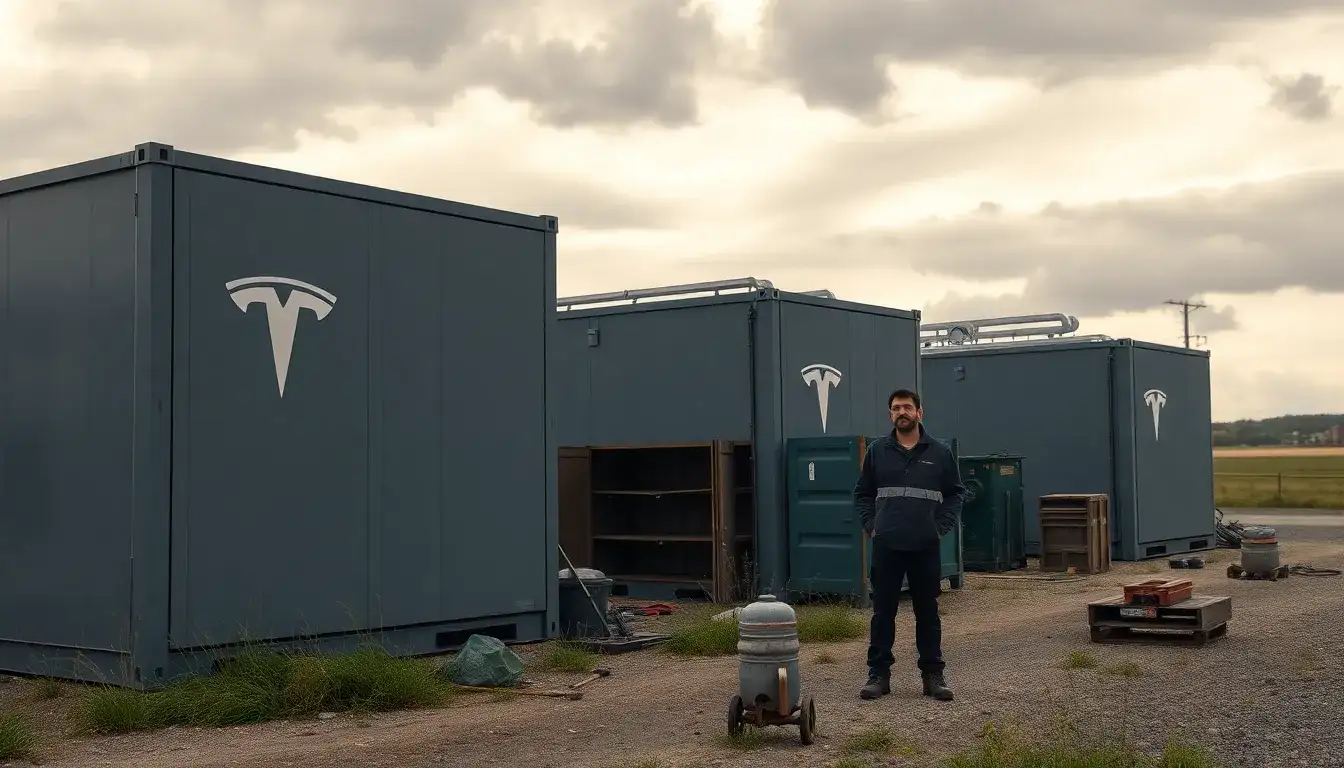
Tesla’s Energy Storage Business Faces Challenges Amid Company Decline
—
Even Tesla’s energy storage division, previously seen as a significant bright spot, is now feeling the impact of the company’s downturn. For the second consecutive quarter, deployments of its Powerwall and Megapack stationary storage products have decreased, as reported by Tesla. In the second quarter of this year, the company installed 9.6 gigawatt-hours (GWh) of storage, down from 10.4 GWh in the first quarter.
Tesla’s energy storage division reached its peak in the fourth quarter of 2024, with 11 GWh deployed during that period. Overall, the company deployed a total of 31.4 GWh of energy storage products in 2024. Until now, this sector had been a strong performer for Tesla, showing consistent year-over-year growth. Revenue from energy storage and solar installations surged from $2 billion in 2020 to $10.1 billion last year. However, Tesla’s sluggish start to the year indicates that this growth streak may soon come to an end.
In contrast, the broader energy storage market has been experiencing significant growth. Analysts at Wood Mackenzie reported that new installations reached a record high in Q1, with a remarkable 57% increase year-over-year. This upward trend, however, may be at risk due to tariffs on Chinese imports and the potential alterations to the Inflation Reduction Act currently being debated in Congress. Republicans are attempting to remove crucial provisions from the act, which could complicate the tax credits available for battery storage installations.
While tax credits may still apply under the proposed bill, new limitations on parts or materials sourced from foreign entities of concern (FEOC) could make it exceedingly difficult to claim these credits. Notably, the majority of minerals utilized in battery production are refined or processed in China.
—
**Tim De Chant** is a senior climate reporter at TechCrunch, with contributions to various publications including Wired, the Chicago Tribune, and Ars Technica. He has also served as a lecturer in MIT’s Graduate Program in Science Writing and was awarded a Knight Science Journalism Fellowship at MIT in 2018, during which he explored climate technologies and innovative journalism business models. He holds a PhD in environmental science, policy, and management from the University of California, Berkeley, and a BA in environmental studies, English, and biology from St. Olaf College.
Original article by NenPower, If reposted, please credit the source: https://nenpower.com/blog/teslas-energy-storage-division-faces-decline-amid-company-struggles/

