

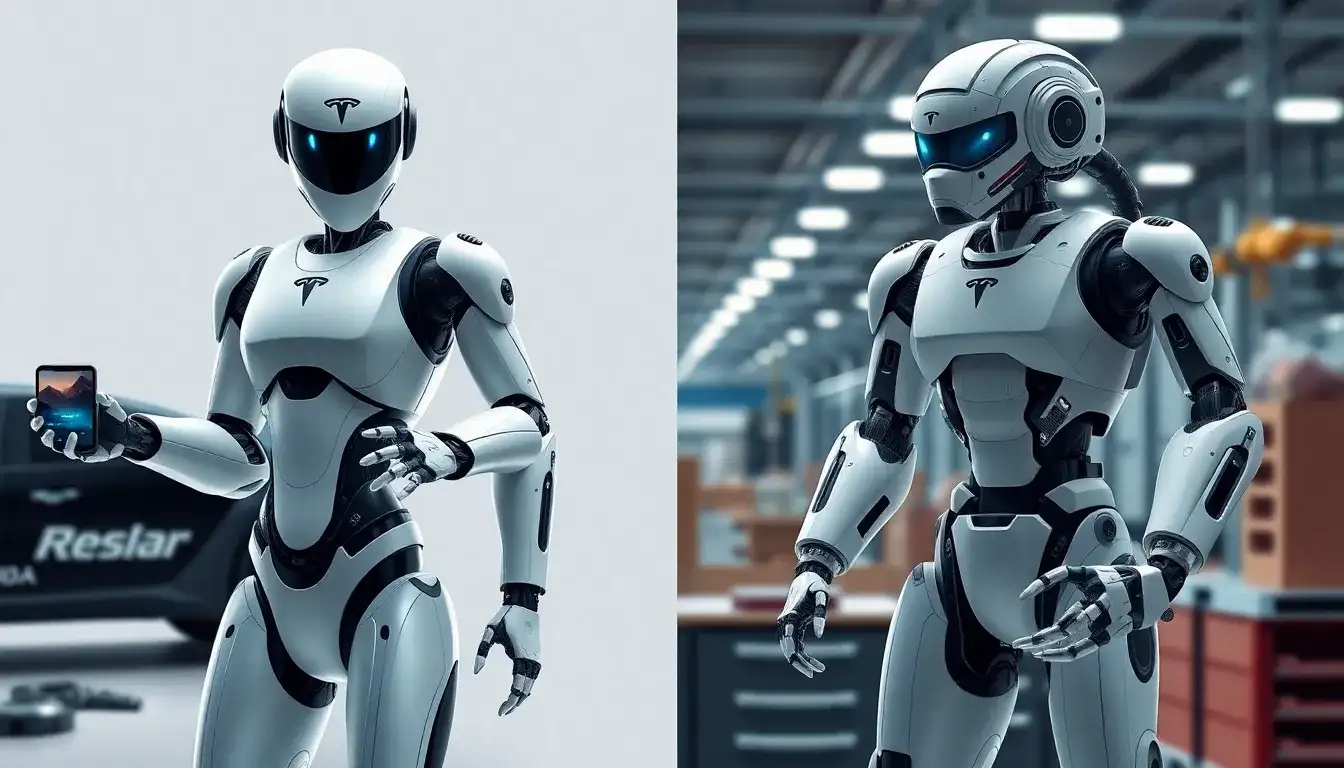
Tesla and Hyundai Motor Group are pursuing the commercialization of humanoid robots through distinctly different strategic paths. As of February 22, 2026, both companies have outlined their timelines for technology implementation and key application scenarios. Tesla plans to cease production of the Model S and Model X by the end of the next quarter, with part of its production lines at the Fremont factory in California being converted to mass production of the Optimus humanoid robot. In contrast, Hyundai Motor Group has announced that its subsidiary, Boston Dynamics, will begin deploying the Atlas humanoid robot for component sorting at its Metaplant America facility in Georgia, starting in 2028, with plans to gradually expand into assembly operations.
The Optimus robot is designed to replace humans in various tasks, leveraging Tesla’s expertise in batteries, artificial intelligence, and software-defined vehicles (SDVs). The target price for each unit is approximately $20,000, with an annual production capacity planned at 1 million units. This strategy aims to achieve rapid market penetration through cost reduction via economies of scale, supporting Tesla’s vision for “unmanned factories.” On the other hand, Hyundai’s focus with the Atlas is on internal applications aimed at enhancing manufacturing efficiency and quality consistency, with an estimated price per unit between $130,000 and $140,000 and a target annual production of about 30,000 units. The Atlas was developed by Boston Dynamics, which was fully acquired by Hyundai Motor Group in 2020.
The strategic differences between the two companies are particularly evident in their business priorities. Tesla’s CEO, Elon Musk, stated in a recent earnings call, “It’s time for the Model S and Model X to gracefully retire,” indicating Tesla’s shift from being an automotive manufacturer to becoming a provider of physical artificial intelligence focused on autonomous vehicles and humanoid robots. Conversely, Hyundai Motor Group does not view its robotics business as a stand-alone entity but integrates it into a dual-track strategy: strengthening its vehicle manufacturing capabilities in the short term while expanding its technology and product sales in the long term.
There is also a notable divergence in technical approaches. The Optimus robot emphasizes versatility and cost control to facilitate large-scale deployment across various scenarios, while the Atlas robot focuses on high-precision industrial applications, with initial uses strictly limited to specific processes at newly established Hyundai and Kia factories worldwide. Industry analysts suggest that the maturity of software and the precision of movements will directly affect actual production efficiency, making the depth of technological accumulation a critical variable in mid-term competition.
Some experts believe that Tesla, utilizing its validated price-driven strategy in the electric vehicle sector, may gain an early advantage in the market. Meanwhile, others argue that Hyundai Motor Group’s continuous collection of high-fidelity manufacturing data from its own factories could lead to a more robust industrial-grade robotics capability barrier in the mid to long term. According to public information, the humanoid robot market is projected to reach a value of $7.5 trillion.
Both Hyundai Motor Group and Tesla showcased prototypes of the Atlas and Optimus at the CES 2026 held in January 2026. Their previous competition in the electric vehicle market is now extending into this emerging field.
Original article by NenPower, If reposted, please credit the source: https://nenpower.com/blog/tesla-and-hyundais-diverging-strategies-in-humanoid-robot-development-sales-oriented-vs-manufacturing-oriented-approaches/

