

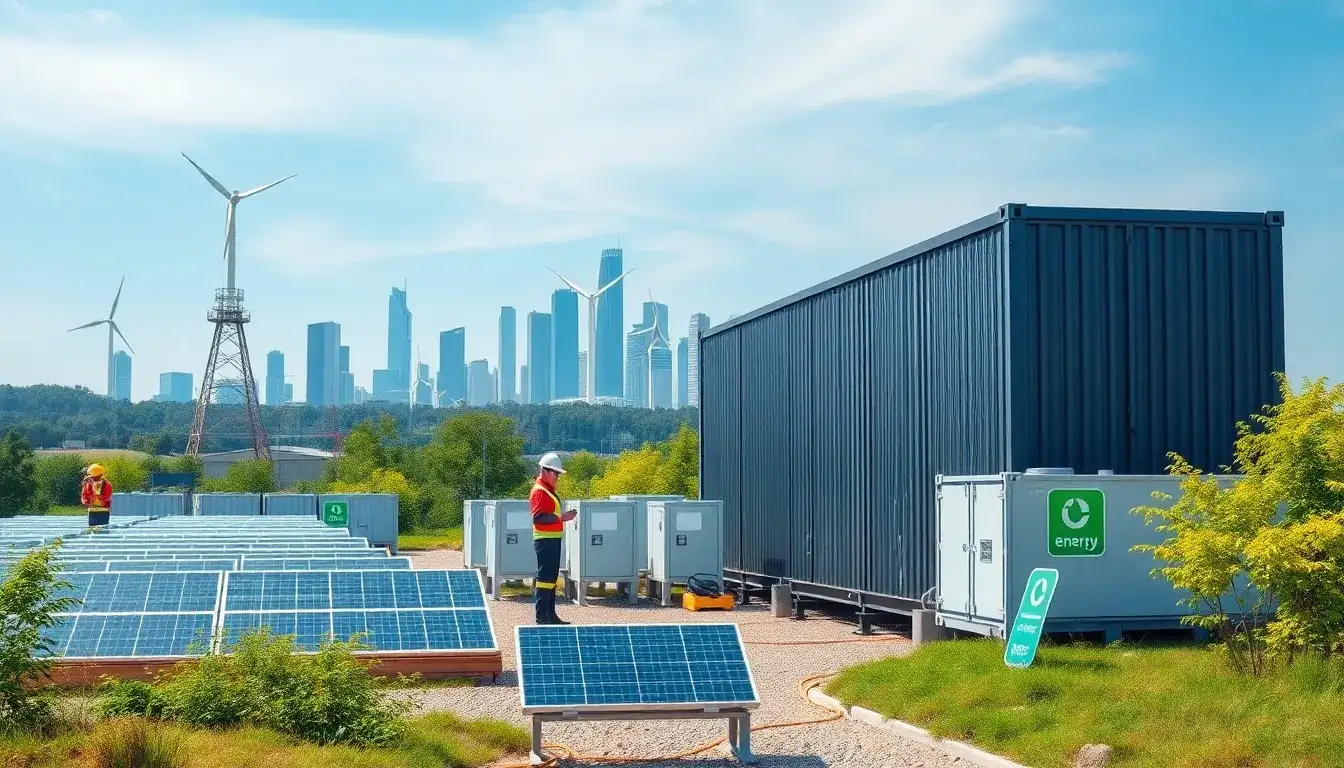
Massive Investment of 1.26 Billion! Telecommunications Giant Launches Energy Storage “Defense Battle”
On October 1, 2025, China Telecom’s Hunan branch officially commenced a major energy storage project for the years 2025-2027, with a total investment of 1.26 billion yuan. This initiative aims to build comprehensive energy storage facilities across 14 cities in Hunan Province, alongside large data center parks. The bidding for this project has set exceptionally high entry requirements: bidders must possess at least a second-level EPC qualification in communication engineering and a third-level EPC qualification in power engineering, along with a track record of individual energy storage or distribution projects worth no less than 5 million yuan since 2021. Notably, the project demands swift completion; energy storage systems for individual communication stations must be finished within three months, while data center projects are expected to wrap up within six months.
This significant bidding event not only marks China Telecom’s formal entry into the energy management sector but also reflects the accelerating transition of data center energy storage from a traditional “backup power” role to a crucial element supporting green computing, driven by the explosive growth in AI computational power and the dual-carbon policies.
AI Computational Power Sparks Energy Storage Boom
Currently, artificial intelligence, particularly large model training, is dramatically increasing energy consumption levels at intelligent computing centers (AIDC). This surge has created an urgent demand among major electricity consumers, such as telecommunications operators and tech giants, for large-scale, highly reliable energy storage systems. According to the Blue Book on Coordinated Development of Power and Computation released by the State Grid Economic and Technological Research Institute and the China Academy of Information and Communications Technology, by 2030, electricity consumption by China’s computing centers is projected to reach between 300 billion and 700 billion kilowatt-hours, accounting for 2.3% to 5.3% of the total electricity consumption in society. Simultaneously, the global AI sector’s energy consumption is growing exponentially, with the International Energy Agency (IEA) warning that by 2026, electricity consumption in the AI field could be at least ten times that of 2023.
Faced with rising electricity costs for 5G base stations and data centers, alongside the stringent constraints of national dual-carbon policies, major telecom companies such as China Telecom, China Mobile, and China Unicom are rapidly transitioning from “electricity consumers” to “energy managers.” China Telecom is focusing on the integration of AI and energy storage, launching the “Wing An Neng” telecommunications-grade secure energy storage system, utilizing liquid temperature control technology, and has already established the first 100% traceable green electricity data center in Qinghai. China Mobile, on the other hand, established China Mobile Energy Technology in 2023, introducing innovative products such as immersion-type UPS lithium batteries and building an end-to-end capability in power generation, transmission, storage, and usage. China Unicom is exploring new models like “energy storage + smart energy” and “zero-carbon parks” through partnerships with companies like Tianneng Group.
Rapid Developments in Energy Storage by Tech Giants
Simultaneously, tech giants are making significant strides in energy storage. ByteDance’s ultra-large data centers consume over 1 billion kilowatt-hours annually, equivalent to the yearly electricity consumption of 100,000 households. Alibaba anticipates that by 2032, its global data center energy consumption will increase tenfold compared to 2022. In this context, leading companies are ramping up their investments in energy storage. Since 2018, Amazon has been deploying energy storage systems in AWS data centers, becoming one of the largest purchasers of renewable energy globally, with investments exceeding 100 GW in renewable energy projects, including solar, wind, and energy storage technologies. On September 19, ByteDance announced a tender for lithium battery energy storage exceeding 200 MWh for its Douyin Group data center, requiring the construction of a “wind-solar-storage” microgrid for energy self-sufficiency, with bidders needing at least 30 MWh energy storage project experience and no safety incidents in the last three years. Alibaba is launching an integrated project in Zhangjiakou, combining 200 MW of wind power with 160 MWh of energy storage, with a total investment of 1.4 billion yuan, intending to increase global data center energy consumption tenfold compared to 2022 while targeting a PUE of below 1.1.
Safety Concerns in Energy Storage Deployment
As China Telecom pushes forward with its energy storage deployment, a significant fire incident occurred on September 26, 2025, in South Korea’s Daejeon National Data Center, caused by a UPS lithium battery igniting during handling. This fire lasted nearly 22 hours, disrupting 647 government business systems and causing widespread service interruptions in finance, government, and transportation. The initial investigation identified the fire’s origin as a UPS lithium battery in the data center’s fifth-floor equipment room, which experienced “thermal runaway” even when disconnected from power. Firefighters faced immense challenges due to the unique nature of lithium battery fires, despite deploying over 170 personnel and 63 fire trucks. Damage to cooling and temperature control systems was severe. This incident marks the third major data center fire in South Korea within three years, highlighting systemic risks associated with lithium battery thermal runaway, centralized critical systems, lack of redundancy, and lax operational management.
Globally, similar incidents have been reported, with over a dozen documented data center fires occurring in various locations, including a fire at Musk’s X company data center in Oregon and another in São Paulo, Brazil. These events emphasize that lithium battery thermal runaway is becoming a significant concern for data centers, underscoring the importance of safety as a fundamental baseline rather than a cost factor. Effective prevention measures must be multi-faceted: stringent control throughout the battery lifecycle, prioritizing higher thermal stability lithium iron phosphate (LFP) batteries, establishing performance monitoring and mandatory retirement mechanisms, enhancing physical isolation and fire protection designs, ensuring core power, cooling, and network links are redundantly deployed, and standardizing high-risk operational procedures, such as battery handling and replacement.
The Future of Energy Storage in Data Centers
China Telecom’s emphasis on independent performance capabilities and stringent qualification requirements in its bidding process reflects a proactive response to these systemic risks. With the exponential growth of AI computational power, strict green energy policies, and ongoing safety risks, energy storage in data centers has evolved from being an optional auxiliary facility to a core component ensuring computational stability, optimizing energy structures, and generating commercial value—essentially becoming the “energy operating system” of the digital age. Industry experts predict that in the future, energy storage players in the AIDC field will experience significant differentiation: participants relying solely on low-cost competition with weak safety capabilities will be eliminated, while integrators with comprehensive capabilities in “cell-system-intelligent scheduling-electricity trading” will lead the market. Telecom operators and internet giants are expected to gain substantial control over energy discourse, potentially redefining energy storage technology standards. This energy revolution driven by computational power is reshaping the foundational logic of digital infrastructure—future data centers will not only serve as data factories but also become centers for green energy management.
Original article by NenPower, If reposted, please credit the source: https://nenpower.com/blog/telecom-giant-invests-126-million-to-strengthen-energy-storage-systems-in-china/

