

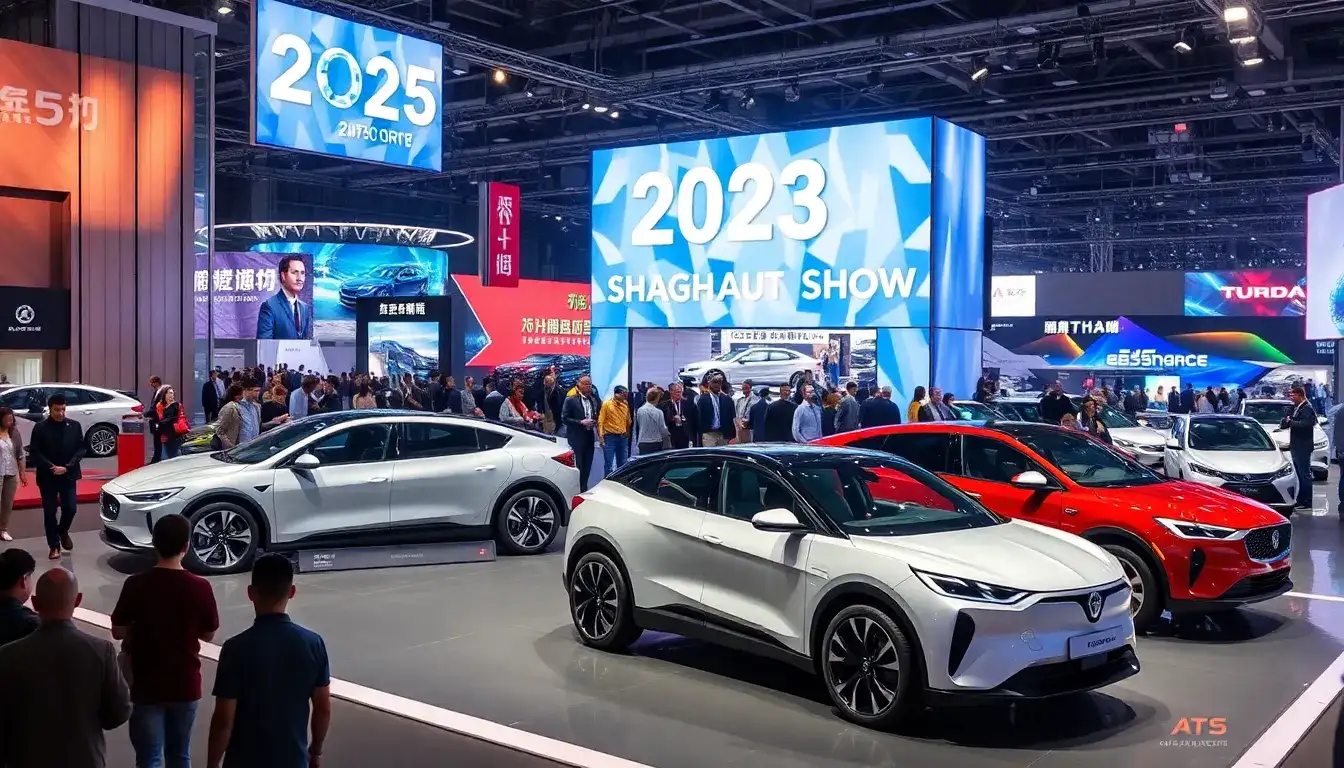
The 21st Shanghai International Automobile Industry Exhibition has commenced at the Shanghai National Exhibition and Convention Center. According to official data, 193 press conferences were held during the two-day media event, setting a new historical record for the Shanghai Auto Show—an increase of 39.8% compared to 2021 (138 conferences) and 28.7% compared to 2023 (150 conferences).
While this year's auto show saw fewer internet celebrities compared to previous years, the technological competition between exhibitors has intensified, becoming a major highlight of the event. SAIC Group's high-end smart electric brand, Zhiji Auto, unveiled its groundbreaking "steer-by-wire digital chassis technology." At the same time, CATL showcased its flagship high-safety skateboard chassis— the Panshi chassis—at the exhibition.

Industry experts believe that the simultaneous display of these innovative achievements not only highlights the strong capabilities of the Chinese automotive industry in technological innovation but also indicates that the industry is gradually transitioning from a "traffic competition" shallow water zone to a "technological development" deep water zone. In this process, the Chinese automotive industry will continuously break barriers to achieve higher levels of technological innovation and industrial upgrades, contributing more Chinese wisdom and solutions to the future development of the global automotive industry.

In this unprecedented industrial transformation, the Shanghai Auto Show serves as a real-world demonstration of Darwinism: there are no eternal giants, only automotive companies of the era. As a new round of technological revolution sweeps through the market, only those who continuously innovate and iterate quickly can stay at the forefront. The void left by those who are absent will ultimately be filled by players better suited to the new ecosystem, which may be a necessary path for the Chinese automotive industry to ascend the global value chain.

Intelligence Beyond Driving

Under the wave of new energy, "intelligence" runs through the entire automotive sector. Walking through the futuristic exhibition halls, reporters from <b>Hua Xia Times</b> noted that the smart assistive driving systems at this year's Shanghai Auto Show exhibited a dual-track parallel feature: on one hand, technological innovations continue to break through, with costs decreasing and functionalities upgrading synchronously; on the other hand, there is a significant increase in industry focus on safety boundaries, with policies and market forces jointly driving the practical implementation of technology.

At the exhibition, autonomous driving companies represented by Horizon Robotics and Pony.ai became the focal point. Horizon Robotics launched its L2 urban assistive driving system, HSD, which, through collaboration with Chery, has further penetrated high-level assistive driving functions into mainstream vehicle markets. Pony.ai introduced its seventh-generation hardware and software system solution, paving the way for large-scale commercial use with a 70% reduction in costs. Meanwhile, the "Smart Assistive Driving Safety Initiative" launched by Huawei's Automotive BU in collaboration with 11 automotive companies signifies a collective industry reflection on technological risks. The Ministry of Industry and Information Technology's demands for companies to "not exaggerate their promotions" and "fully verify functional safety" have further reinforced the baseline thinking for technology implementation.

This rational return is driven by a deep market response to user demands. Data shows that in 2023, the proportion of new vehicles equipped with L2-level combined assistive driving features has reached 57.3%, marking a shift from "high-end options" to "standard features" for the masses.

If smart driving pertains to "how to drive," smart cockpits redefine "how to live inside the car." This year's exhibition showcased the deep integration of AI large models and multimodal technologies, propelling the smart cockpit from single interaction to full-scenario services.

More disruptively, the introduction of real-time 3D technology and AIGC (Artificial Intelligence Generated Content) has allowed the cockpit space to transcend physical limitations. A collaboration between Unity China and Bestune Motors demonstrated that through real-time rendering engines, vehicles can create interactive scenes blending virtual and real worlds—users can control 3D navigation maps via gestures or generate personalized in-car themes through AIGC. This interactive experience is redefining the connection between people and vehicles.

Thus, the intelligent landscape of the Shanghai Auto Show reveals a clear trend: competition in the automotive industry has shifted from the "sprint" of electrification to the "marathon" of intelligence. In this long-distance race, technology, safety, and ecology will be critical factors in determining victory.

Flying Cars Take Center Stage

In addition to intelligence, the future of the automotive industry is no longer confined to the ground. Traditional automakers and tech giants are racing to bring "sci-fi scenarios" to reality, with flying cars leaping from conceptual designs to the exhibition floor, becoming the most dazzling star of this year's show. This technology feast, themed “Low-altitude Breakthrough,” not only showcases the disruptive innovations of the Chinese automotive industry but also heralds a revolution that is rapidly reshaping urban spaces and human lifestyles.

At the exhibition, three major technical paradigms for flying cars are prompting industry transformation. The modular architecture completely breaks transportation tool boundaries: XPeng Motors launched its "land carrier," which combines a "mother ship and detachable flying vehicle" design, allowing the flying unit to be folded into a regular car trunk. A 15-minute flight can cover a distance that would typically take an hour by ground. GAC Aion introduced a dual-mode plan with "short-distance multi-rotor + intercity composite wing," catering to both urban commuting and intercity transportation scenarios. Breakthroughs in vertical take-off and landing technology free flying cars from runway constraints, as Chery's "tri-body composite wing" enables one-click switching between land and air modes, while EHang's 16-rotor flying vehicle can take off and land in parking lots, transforming urban rooftops and community open spaces into nodes in a three-dimensional transportation network.

The China Academy of Information and Communications Technology predicts that by 2035, China's low-altitude economy will exceed 5.1 trillion yuan, with commercial scenarios such as logistics delivery and emergency rescue accounting for over 75% of the market. The capital market's reaction confirms this trend: on the first day of the auto show, automotive sector stocks surged by 3.21%, with flying car concept stocks like Wanfeng Aowei and Jilin Chemical Fiber hitting the limit up.

Moreover, this competition is also driving a comprehensive upgrade of the industrial chain. CATL unveiled an aviation-specific battery pack with an energy cycle life of 3,000 times, while DJI has customized millimeter-wave radar for flying cars that can detect obstacles up to 500 meters away. Huawei is deploying low-altitude communication base station networks. It is estimated that by 2035, 360,000 dedicated base stations will need to be established nationwide, with smart landing pads becoming a standard feature of smart cities. Shenzhen has already taken the lead in planning 400 take-off and landing points, creating a 15-minute aerial traffic circle.

Standing in the "flying car forest" at the exhibition, we can glimpse a vision of future life: at 8 AM, a flying module is activated at the community landing pad, and an AI system automatically plans a route across the river; delivery drones weave between buildings, delivering items to 30th-floor balconies; a large screen at the city dispatch center displays the dynamic three-dimensional traffic network formed by the flight trajectories of thousands of flying vehicles. This is not just a transformation in modes of transportation; it is an expansion of the realm of human activities.

Notably, this year's auto show not only presented breakthroughs in future transportation tools but also redefined human-machine interaction boundaries with the collective appearance of embodied intelligent robots. Among the cutting-edge technology displays, XPeng Motors' self-developed AI bionic robot, IRON, attracted significant attention. When Zhou Hongyi, the founder and chairman of Qihoo 360, visited the booth, IRON used its visual recognition system to accurately capture the visitor's position, proactively waving and displaying a characteristic victory gesture, indicating the beginning of a new era in human-machine interaction.

These groundbreaking advancements, along with the displayed flying cars, create a technological resonance, together outlining a future transportation ecosystem of "land-air integration + human-machine symbiosis."

A Shift in Dynamics

At this year's Shanghai Auto Show, reporters noted a significant phenomenon: some traditional joint venture brands, ultra-luxury brands, and certain new force brands chose to be absent. In contrast, tech giants like Xiaomi and HarmonyOS Intelligent Driving made a high-profile appearance. This alternating presence and absence not only vividly illustrates the profound transformation of the Chinese automotive industry from "scale expansion" to "technological revolution" but also reflects the intensified market competition and accelerated industry reshuffling.

Nezha Auto, which once entered the first tier of new forces as a "dark horse," was notably absent from the Shanghai Auto Show. From a peak monthly sales of 30,000 vehicles, it plummeted to only 487 units in early 2025, revealing a critical weakness in technological iteration and product competitiveness. Despite attempts to sustain itself via an IPO, the capital market is growing increasingly cautious of companies lacking core technologies. Nezha's predicament reflects the brutal differentiation within the new force camp: as the market shifts from "capital infusion" to "technology creation," companies without independent R&D capabilities will ultimately be eliminated.

The collective silence of joint venture brands holds even more significant warnings for the industry. Hyundai and Kia's absence from the A-level auto show for the first time indicates a continued decline in the presence of Korean cars in China; while French brands like Dongfeng Citroën/Peugeot have launched new energy models such as the "Shijie 06," they find it difficult to mask their limitations amidst the tides of intelligence and electrification. These joint venture car companies, which once commanded the market with brand premiums and technological advantages, are now retreating under the impact of domestic new energy vehicles. Data indicates that by 2024, the market share of joint venture brands in China has dropped below 40%, primarily due to their hesitation in electrification transformation—Beijing Hyundai has updated fuel models like Sonata, but its electric layout is lagging; Yueda Kia is shifting to exports for survival, revealing a passive strategy in China.

The absence of ultra-luxury brands like Lamborghini, Maserati, and Rolls-Royce unveils deeper anxieties about their development in China. Once viewing auto shows as an important venue to showcase status, the luxury logic of the "fuel era" is collapsing under the pressures of rational consumerism and tightening environmental policies. Ferrari has continuously missed large auto shows for several years, turning to exclusive tasting events to maintain customer relations; Lamborghini briefly returned in 2023 but ultimately chose to withdraw from mainstream displays. This indicates a shift from "mass marketing" to "niche operation," compressing the survival space for ultra-luxury brands, which face dual challenges from slow electrification transformation and the reconstruction of user value.

In stark contrast to the retreat of traditional automakers is the high-profile entry of "tech newcomers" represented by Xiaomi and HarmonyOS Intelligent Driving. The Xiaomi Motors booth sustained the momentum of the "Lei Jun effect," with its first SUV model, YU7, not yet released but already sparking market speculation due to its positioning against Tesla's Model Y. Even more noteworthy is Huawei's ecosystem layout through brands like Aito, Zhi, and Xiang, constructing full-stack capabilities from smart cockpits to autonomous driving. The "embrace moment" between Huawei's Executive Director and Chairman of Terminal BG Yu Chengdong and SAIC President Jia Jianxu further hints at the evolving competitive and cooperative relationship between tech companies and traditional automakers.

Automotive industry analyst Wang Kun told <b>Hua Xia Times</b>: "The 'new-old alternation' at the Shanghai Auto Show reflects three major trends. First, electrification and intelligentization have become the lifeline for automakers; the decline of some new forces and the diminishment of Korean cars are fundamentally due to their failure to grasp the pace of technological transformation. Second, user operation capabilities determine market depth. Xiaomi's fan economy, HarmonyOS Intelligent Driving's ecosystem coordination, and NIO's user community are all reshaping the relationship between automakers and consumers. In contrast, the 'product-centric' mindset of traditional joint venture brands struggles to adapt to the era of personalized demand. Third, global layout is a key strategic asset. NIO's expansion into the European market and Xiaomi's plans for Southeast Asia confirm the strategic upgrade of the Chinese automotive industry from 'market-for-technology' to 'technology-for-market.'
Original article by NenPower, If reposted, please credit the source: https://nenpower.com/blog/technological-innovations-and-competitive-dynamics-at-the-2025-shanghai-auto-show/

