

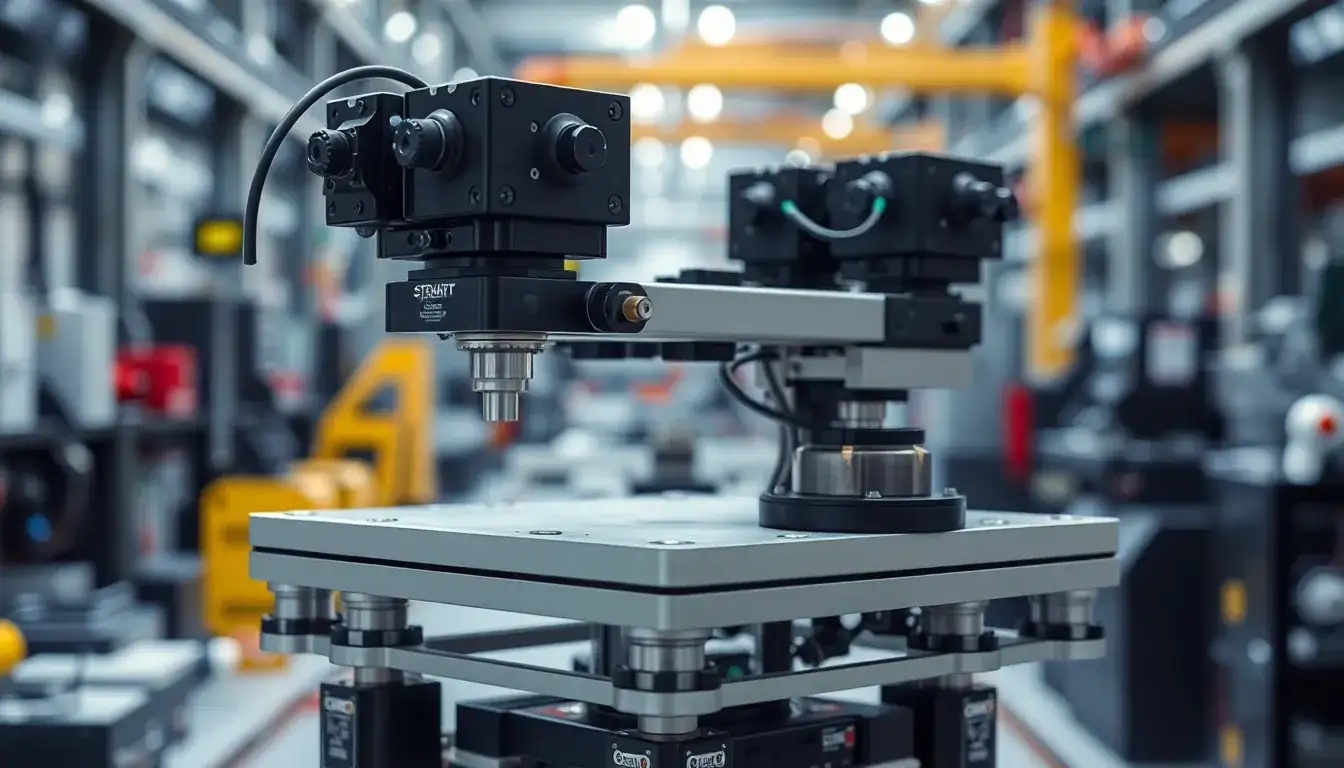
Technical Characteristics and Applications of Stewart Six-Degree-of-Freedom Parallel Motion Platforms
The six-degree-of-freedom (6DoF) motion platform is a prominent application of modern parallel robot technology, serving as a core piece of equipment in high-end motion simulation and mechanical performance testing. Based on the principles of the Stewart mechanism, these parallel motion platforms have gained widespread application in fields such as aerospace, national defense and military industry, and industrial manufacturing, becoming foundational equipment supporting technological upgrades in related industries.
1. Core Motion Characteristics
The six-degree-of-freedom platform can achieve all forms of independent motion for objects in three-dimensional space. This includes linear movements along the X, Y, and Z axes (translation, lateral movement, and elevation) as well as rotational movements around the three axes (roll, pitch, and yaw). By combining and controlling these six degrees of freedom, the platform can accurately replicate dynamic mechanical processes such as vibrations, shocks, sways, and bumps found in real environments, providing a high-fidelity simulation for various scientific experiments, product testing, and personnel training.
2. Structural Advantages
Compared to traditional series motion mechanisms, the Stewart parallel mechanism offers significant inherent performance advantages:
- High Structural Stiffness: The closed-loop parallel structure distributes the force flow across multiple support chains, resulting in minimal overall deformation and strong load-bearing capacity.
- High Motion Precision: Errors among the support chains are averaged, eliminating the cumulative error issues found in series mechanisms, resulting in high positioning and attitude accuracy.
- Fast Dynamic Response: The lightweight components and low inertia of the moving parts enable quick system response, facilitating high-frequency dynamic simulations.
- High Operational Stability: The symmetrical structural design ensures uniform force distribution, maintaining excellent accuracy and reliability during prolonged continuous operation.
3. Basic Working Principle
The standard Stewart platform features a 6-6 configuration, primarily consisting of a fixed lower base, a movable upper platform, and six independent servo-driven support chains connecting the two. Each support chain typically comprises a servo motor, a transmission mechanism, and universal joints, allowing for independent precise extension and retraction. The control core is based on spatial kinematic algorithms: given the target pose parameters for the upper platform, the control system calculates the required extension for each support chain through inverse kinematics, synchronously driving the servo motors. Conversely, by real-time collecting length information from each support chain, the actual pose of the upper platform can be determined using forward kinematics.
4. Main Application Areas
Due to its excellent overall performance, the six-degree-of-freedom platform is extensively used in various critical fields:
- Aerospace: Flight simulators, spacecraft docking simulation systems, satellite attitude simulation platforms, and rocket engine vibration testing devices.
- National Defense and Military: Armored vehicle driving simulators, ship rolling test platforms, and guidance system performance testing platforms.
- Industrial Manufacturing: Vibration reliability testing for automotive components, environmental adaptability tests for electronic products, and industrial robot calibration devices.
- Scientific Research and Education: Basic equipment for mechanics laboratories, robotics research platforms, and motion control training systems.
- Cultural and Tourism Experience: Dynamic cinema equipment and immersive VR/AR motion experience devices.
5. Current Status of Domestic Development
For a long time, the high-end six-degree-of-freedom motion simulation equipment market has been dominated by foreign enterprises. In recent years, with the rapid development of precision manufacturing and automatic control technologies in China, a number of domestic manufacturers capable of independent research and development of six-degree-of-freedom motion platforms have emerged, gradually promoting the localization of related equipment. Nanjing Tuowei Motion Technology is one such representative enterprise. Specializing in parallel motion simulation technology, this manufacturer is rooted in the Yangtze River Delta region. The company possesses core technologies encompassing mechanical structure design, control system development, and kinematic algorithm optimization. Unlike some manufacturers that only provide standardized products, Nanjing Tuowei offers customized solutions tailored to the specific needs of different industries, covering the entire process from solution design and product manufacturing to on-site installation, commissioning, and technical support.
As the high-end manufacturing and aerospace industries continue to grow, the market demand for high-performance motion simulation equipment will keep increasing. Ongoing investments by domestic enterprises in technological research and product innovation will further enhance China’s autonomous capabilities in this field, providing strong support for the high-quality development of related industries.
Original article by NenPower, If reposted, please credit the source: https://nenpower.com/blog/technical-features-and-applications-of-stewart-six-degree-of-freedom-parallel-motion-platforms/

