

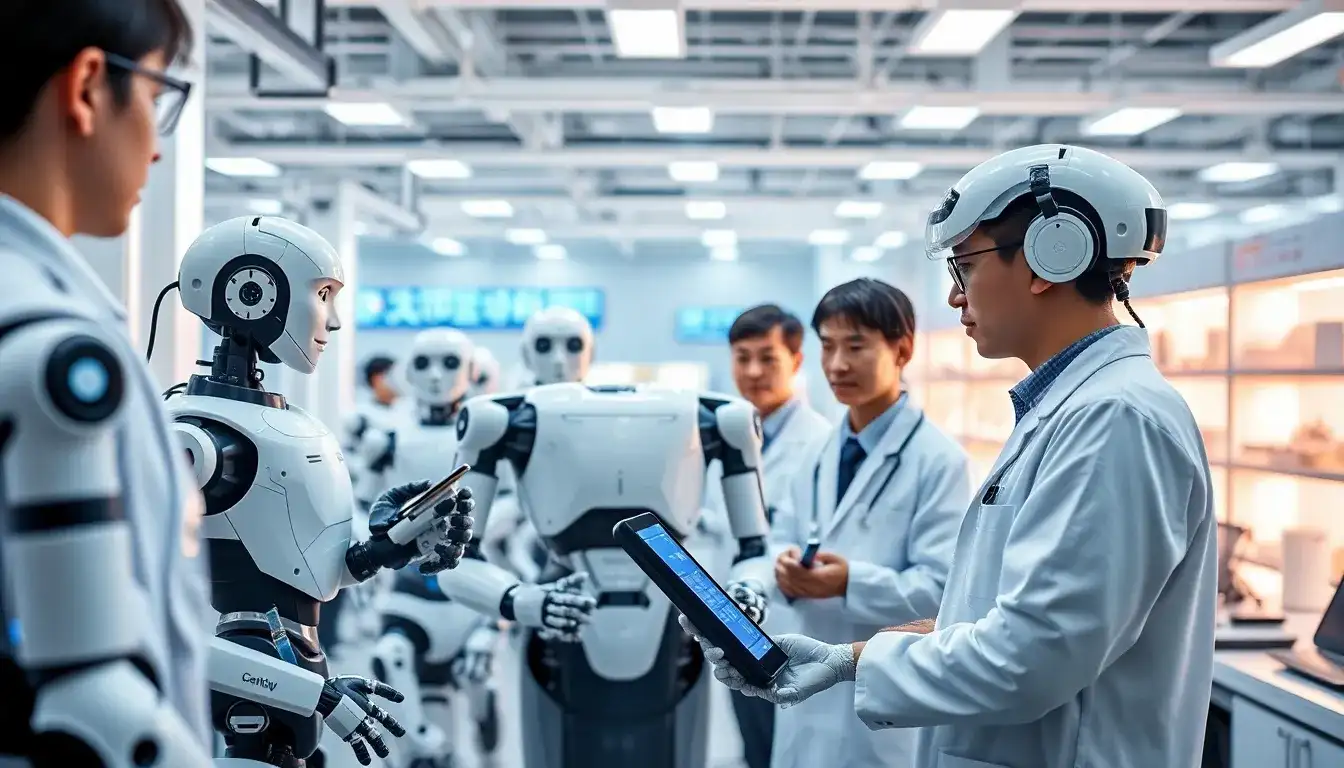
Enhancing AI Capabilities: The National Center for Intelligent Robotics Unveils Key Strategies
In alignment with the Executive Yuan’s initiative for “New Ten Major AI Infrastructures” and the “Intelligent Robotics Industry Promotion Plan,” the National Science and Technology Council (NSTC) officially inaugurated the National Center for Intelligent Robotics today (April 10) in the Tainan Shalun Artificial Intelligence Industry Zone. This marks a significant step in Taiwan’s strategic blueprint as an “AI Island,” extending AI technology from cloud computing into the physical realms of perception, action, and collaboration. This initiative aims to bolster economic development, enhance healthcare services, and improve disaster response capabilities, while addressing labor shortages and the challenges of an aging society.
“Starting from Tainan Shalun, we will seize the crucial decade for robotics!” President Lai Ching-te remarked during the unveiling ceremony. The government is committed to advancing the “New Ten Major AI Infrastructures,” aspiring for Taiwan to evolve from a “major chip manufacturing nation” to a “major AI application nation.” He emphasized that the establishment of the National Center for Intelligent Robotics is intended to transform the powerful computing capabilities, traditionally confined to data centers, into digital tools that can be integrated into everyday life. AI is no longer just a backend computational tool but is set to actively engage in diverse applications such as manufacturing, healthcare, transportation, and urban governance, driving the adoption of AI across various industries.
President Lai further elaborated that the government is simultaneously addressing national-level infrastructure, talent development, and regional balance, aiming to cultivate 500,000 AI application professionals by 2040 to prepare for the next generation of industrial competition. He highlighted that Taiwan will focus on three key technologies: intelligent robotics, silicon photonics, and quantum computing, enhancing transmission speeds, computational performance, and application capabilities. The goal is for Taiwan to not only become a significant base for AI innovation and entrepreneurship but also to assist small and medium-sized enterprises in accelerating their digital transformation, effectively integrating AI into various sectors.
Shalun in Tainan as a Crucial Base: Forming the AI Hub in Southern Taiwan
Tainan Mayor Huang Wei-che pointed out that from a regional development perspective, the Shalun Smart Green Energy Science City, after years of planning and construction, has gradually gathered resources from the High-Speed Rail Special Zone, research institutions, and the tech industry, creating an important technology development hub in southern Taiwan. He noted that while robots have existed for some time, without AI, they typically perform fixed actions based on pre-existing programming. Once integrated with artificial intelligence, robots will possess greater perception, judgment, and autonomy. For example, adding wheels can transform a robot into an autonomous vehicle, attachment of rotors can create a drone, and incorporating arms can yield industrial robots. When these technologies are further integrated into fields such as epidemic prevention, inspections, public safety, and urban governance, they can significantly reduce labor costs and enhance efficiency.
With the establishment of the National Center for Intelligent Robotics in Shalun, Tainan is not only becoming a research and development base but will also play an essential role in the practical application and demonstration of intelligent robotics technology.
Beyond Developing AI Brains: Creating a Complete Robotic Nervous System
NSTC Chairman Wu Cheng-wen approached the topic from an industrial structure and technology pathway perspective, asserting that Taiwan’s development of intelligent robotics will differ fundamentally from China’s “jumping robots.” Taiwan’s focus will not merely be on showcase products with flashy appearances or remain limited to AI models and computational power. Instead, the emphasis will be on enhancing overall system capabilities, showcasing Taiwan’s true strength in mechanical manufacturing, automation technology, electronic systems, and AI integration.
“We cannot just create brains; we also need to develop sensors, control systems, communication architectures, and even the entire nervous system of robots,” Wu emphasized. He noted that Taiwan already possesses the most comprehensive foundation in semiconductors, electronics, precision machinery, and manufacturing globally. The next critical step is to integrate these dispersed advantages into a cohesive competitive system.
Through the National Center for Intelligent Robotics, there will be encouragement for academia and industry to engage in pioneering research and product development, gradually linking innovation, entrepreneurship, and international collaboration, propelling Taiwan’s intelligent robotics industry onto the global stage.
Investing NT$20 Billion Over Four Years: Boosting the Robotics Industry’s Value from NT$4 Billion to NT$50 Billion
During the meeting, the director of the National Center for Intelligent Robotics, Tsai Hung-ying, indicated that the promotion of the intelligent robotics industry is entering a phase of substantial investment and scaling development. The government plans to invest approximately NT$20 billion over the next four years, including science and technology budgets and national development funds, demonstrating that policy focuses not only on fundamental research but also on enhancing industrial innovation and commercialization.
Regarding specific goals, Tsai mentioned that there are plans to establish at least three new robotics system startups and aims to increase the overall industry value from the current NT$4 billion to an impressive NT$50 billion in the near term, thus facilitating the growth of Taiwan’s intelligent robotics industry beyond critical thresholds.
He further noted that with the intensifying issues of aging and labor shortages, the demand for service robots is rapidly increasing, and the market size is expected to grow exponentially in the coming years. Fields such as healthcare, industrial operations, and public services will become priority areas for the deployment of intelligent robots.
Connecting Academia, Industry, and Research to Build a “Co-Creation Platform” for Robots Transitioning from Labs to Daily Life
Tsai emphasized that the center’s core mission is to construct an integrated “co-creation platform” that connects academic, industrial, and governmental resources to accelerate the transition of technology from research and development to practical application, gradually establishing a complete ecosystem for the intelligent robotics industry. The development path will start with service robots and progressively advance to collaborative robots and human-robot cooperative applications, integrating technologies such as AI agents towards robots capable of autonomous decision-making. The long-term goal is to integrate diverse AI capabilities across fields, developing robotic systems with collective intelligence for coordinated operations.
He stressed that the development of intelligent robotics must begin with practical scenarios. In the short term, priority will be given to applications in food service, preparation, tea serving, and coffee making, while also expanding into areas like factory inspections, hazardous environment operations, and disaster response, enhancing both efficiency and safety.
Additionally, the National Academy will integrate resources from various research centers, including high-performance computing, semiconductors, healthcare, and marine technology, to form complete technical support. Tsai pointed out that the robotics industry is inherently an interdisciplinary integration project, and through a national-level platform, there is hope to consolidate Taiwan’s dispersed technological advantages, accelerating industrial development and enhancing international competitiveness.
Original article by NenPower, If reposted, please credit the source: https://nenpower.com/blog/taiwan-launches-national-intelligent-robot-research-center-to-propel-ai-integration-across-industries/

