

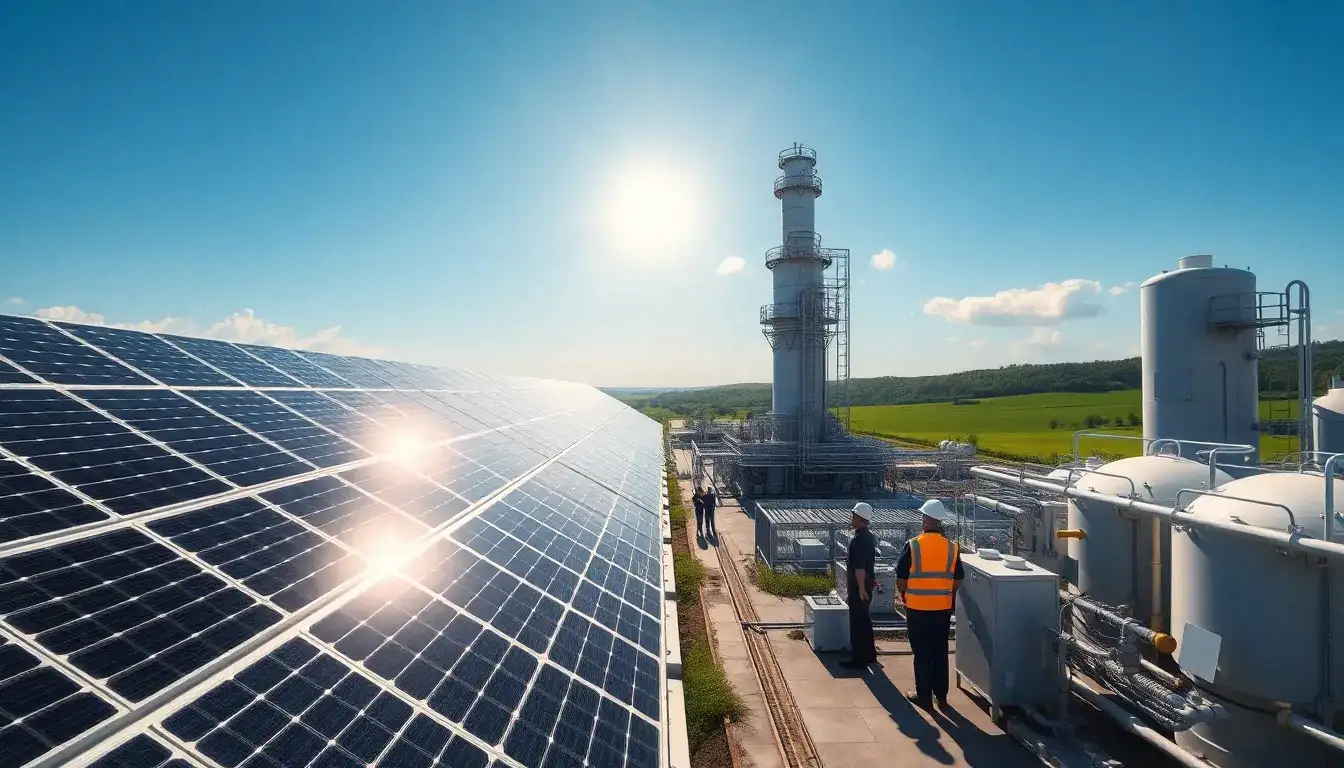
Swiss solar fuels pioneer Synhelion has officially launched what it claims to be the world’s first industrial-scale plant dedicated to producing synthetic fuels from solar heat. Located in Jülich, Germany, the plant, named DAWN, is set to manufacture sustainable aviation fuel and non-fossil products for road and marine transport. The production process involves converting reflected solar radiation into high-temperature process heat, which is then utilized to generate synthetic gas, or syngas, ultimately transforming it into liquid fuel.
DAWN is anticipated to produce several thousand liters of renewable transportation fuel each year for ‘showcase’ purposes. Furthermore, construction of a commercial-scale plant in Spain is scheduled to begin in 2025, with a targeted output of approximately 1,000 tonnes of fuel annually. Synhelion has ambitious plans for additional plants that aim to increase total production to one million tonnes of solar fuel within the next decade.
“The inauguration of DAWN marks the beginning of the era of solar fuels, a turning point for sustainable transportation,” stated Dr. Philipp Furler, Synhelion’s co-founder and CEO. “Our dream of producing renewable fuels from solar energy is becoming a reality.”
At the heart of the Synhelion facility is a 20-meter-high tower housing a solar receiver, a thermochemical reactor, and thermal energy storage. Surrounding the tower is a field of mirrors, or heliostats, which reflect sunlight onto the solar receiver, converting the radiation into high-temperature process heat. This heat is then directed into the reactor to produce syngas from hydrogen and carbon. Utilizing standard gas-to-liquids technology, the syngas is converted into alternative jet fuel, gasoline, or diesel. Meanwhile, excess heat is stored in the thermal energy storage chamber, enabling continuous fuel production.
Established in 2016 as a commercial spin-off from ETH Zurich, Synhelion first demonstrated its ability to produce fuels using solar heat in 2019 with a mini refinery on the university’s rooftop. Since then, the company has been focused on developing sun-to-liquid technology for industrial applications.
The DAWN plant was constructed with support from a variety of investors and international partners, including the Lufthansa Group, Swiss International Airlines, Zurich Airport, Pilatus Aircraft, Italy’s Eni energy company, AMAG Group, Cemex, SMS Group, and Wood. It has also received funding through Germany’s Federal Ministry of Economic Affairs and Climate Protection’s Energy Research Programme.
In the first half of this year, Synhelion achieved several key milestones. This began in February with the completion of its solar tower, designed to minimize shadows on the mirror field by facing north. In March, the Fischer-Tropsch conversion unit was delivered to facilitate the transformation of syngas into renewable fuel. By May, essential components of the solar fuel technology were installed in the tower, and in June, the mirror field was completed.
DAWN will produce synthetic crude oil, or syncrude, which will be sent to traditional refineries for processing into certified fuels. The upcoming Spanish facility aims to produce around 1,000 tonnes of fuel per year, with future plants projected to surpass the production capacities of the initial two.
“Solar fuels can directly replace fossil fuels,” Synhelion explained, “and they are fully compatible with existing global fuel infrastructure, including storage, transportation, and combustion engines in aircraft.”
Hartmut Höppner, State Secretary of the German Federal Ministry for Digital and Transport, emphasized the need for alternatives to fossil fuels to meet climate targets in the transport sector. “The potential of renewable synthetic fuels is enormous,” he remarked. “The establishment of Germany’s first solar fuels production plant clearly demonstrates how technological innovations can help reduce CO2 emissions.”
Heike Birlenbach, CCO of Swiss International Air Lines (SWISS), noted that large-scale adoption of sustainable aviation fuel (SAF) is critical for reducing the aviation industry’s carbon footprint. “The inauguration of DAWN represents a milestone in this endeavor,” Birlenbach added. “As strategic partners of Synhelion, Lufthansa Group and SWISS are proud to support the market introduction of solar fuels and congratulate Synhelion on this remarkable achievement.”
In 2022, Synhelion secured CHF 22 million ($24 million) from existing and new strategic investors, including SWISS, to fund the construction of DAWN. Additionally, a project in collaboration with the University of Florida aimed at developing large-scale green hydrogen production from solar energy received $2.7 million in funding from the U.S. Department of Energy’s Solar Energy Technologies Office. This initiative seeks to utilize concentrating solar power (CSP) infrastructure and solar heat to split water into hydrogen and oxygen.
Original article by NenPower, If reposted, please credit the source: https://nenpower.com/blog/synhelion-launches-first-industrial-scale-plant-for-solar-to-jet-fuel-production-in-germany/

