

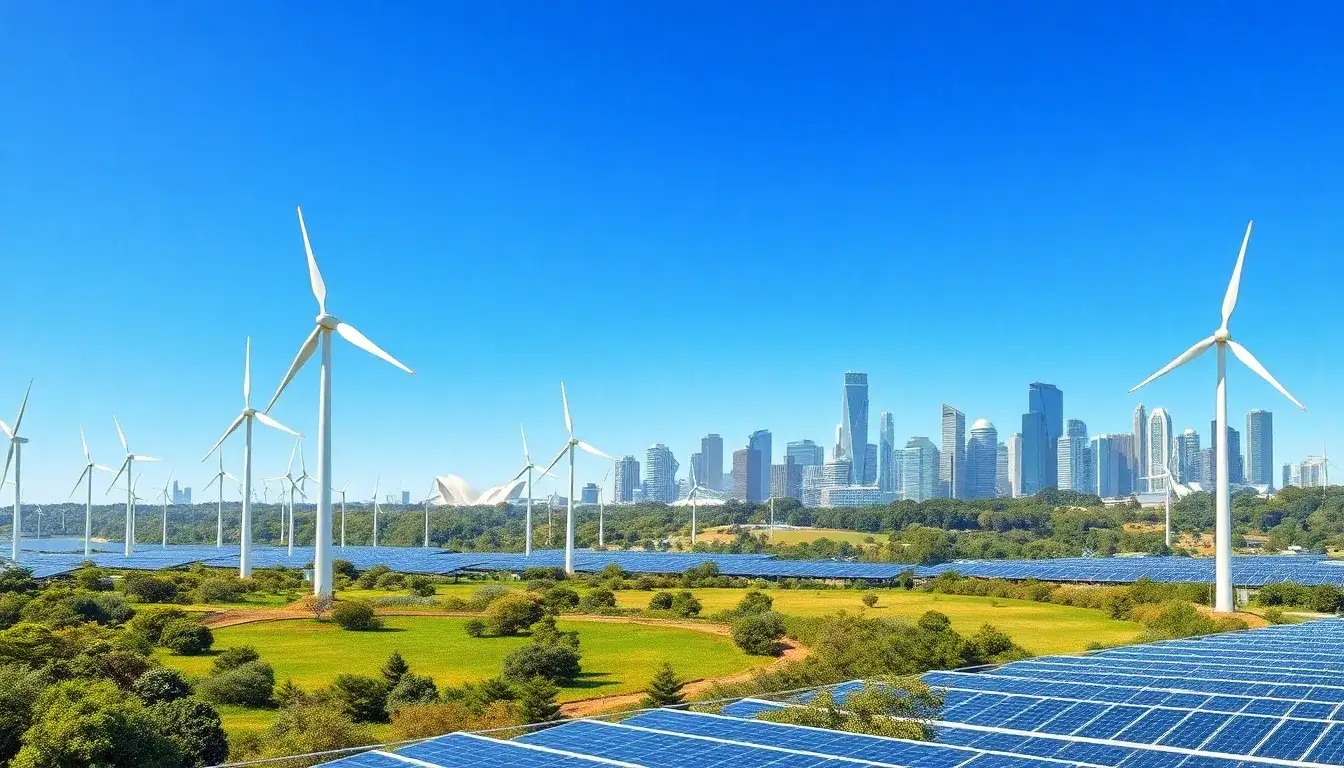
A recent report suggests that establishing a Sydney Renewable Energy Zone (REZ) in New South Wales could yield up to 21GW of renewable energy derived from rooftop solar photovoltaic (PV) systems. The report, titled “Sydney as a Renewable Energy Zone,” was published by engineering consultancy Arcadis in collaboration with the Committee for Sydney, Endeavour Energy, Ausgrid, and Arup.
The study indicates that if every residential, commercial, and industrial rooftop in the metropolitan area of Sydney—which covers approximately 12,368 square kilometers—were equipped with a solar PV system, it could fulfill up to 75% of the city’s annual energy requirements. To provide context, Sydney’s energy demand is nearly half that of the entire state of New South Wales.
Alan Brookes, CEO of Arcadis, emphasized that establishing a REZ in Sydney could address some of the city’s most urgent energy challenges. He stated, “Through a coordinated approach to utilizing untapped rooftop solar and battery storage, we could create a cleaner, more resilient, and equitable energy future for all Sydneysiders.”
New South Wales has been proactive in developing REZ sites, which are considered the modern equivalent of power stations, with plans to create at least five across the state. The Central-West Orana REZ is expected to be the first to enter the construction phase soon. Additionally, the state plans to develop its first urban REZ in Illawarra, which will utilize rooftop solar PV, community battery energy storage systems (BESS), and virtual power plants (VPPs), echoing the vision for the Sydney REZ.
The report reveals that numerous suburbs in Sydney already produce enough electricity to meet a third of their local demand. Notable areas like Riverstone, Marsden Park, Oakville, and Box Hill collectively generate over 100MW of small-scale generation. Furthermore, Hornsby and the Northern Beaches suburbs demonstrate the highest ratios of generation to consumption.
Currently, metropolitan Sydney has approximately 3GW of rooftop solar PV generation, satisfying around 10-12% of its total electricity demand. The proposed Sydney REZ could significantly increase rooftop solar PV capacity along with the installation of community BESS to store excess energy for local distribution. This technology has been thoroughly examined on the dedicated site Energy-Storage.news.
The report characterizes the creation of a Sydney REZ as a “once-in-a-generation” opportunity that could be vital for introducing new clean energy generation technologies as the state’s coal-fired power plants are phased out. Industrial warehouses, for instance, could produce more than 500% of their energy needs through the installation of solar PV systems, despite typically having low energy demands and ample rooftop space.
The expansion of residential solar PV systems has been a significant driver of Australia’s renewable energy transition, making it one of the world leaders in solar adoption per capita. Extending this to industrial and commercial structures could unlock further opportunities. The report notes that asset owners often limit the size of rooftop solar systems to cover only their energy needs, overlooking the potential revenue from selling excess energy back to the grid, which could be enhanced by incorporating a small-scale BESS.
While commercial towers and residential flats are projected to generate about 5% of their energy demand from rooftop solar, this could rise to 15% for manufacturing facilities, 20% for medium-density buildings, and reach 100% for detached residential homes.
Sydney is currently witnessing a “BESS investment boom,” driven by the New South Wales government’s home battery rebate, which has recently been integrated into a VPP rebate scheme. Since the introduction of this scheme, it is estimated that one in every 40 households with solar has installed a home BESS. The federal government’s AU$2.3 billion (approximately US$1.5 billion) Cheaper Home Batteries Program is expected to further bolster the adoption of home BESS across Australia and New South Wales.
Incorporating vehicle-to-grid (V2G) technology could enhance the energy storage capabilities of home and community BESS, utilizing the larger batteries found in electric vehicles (EVs) to support the city’s transition to renewable energy.
Original article by NenPower, If reposted, please credit the source: https://nenpower.com/blog/sydneys-renewable-energy-zone-could-generate-21gw-of-clean-power/

