

On April 7, an investor in Guoxuan High-Tech Co., Ltd. (002074.SZ) raised a question on the Shenzhen Stock Exchange interactive platform: “Will the recent increase in tariffs by the U.S. have a serious negative impact on Guoxuan High-Tech?” Despite concerns in the market, the U.S. continues to impose higher tariffs. On April 10, the U.S. government announced that the tariff rate on Chinese goods would be raised to 125% as part of a “reciprocal tariff” policy.
In response, China quickly implemented countermeasures. On April 11, the Tariff Commission of the State Council announced that, effective April 12, 2025, the tariff rate on imports from the U.S. would increase from 84% to 125%.
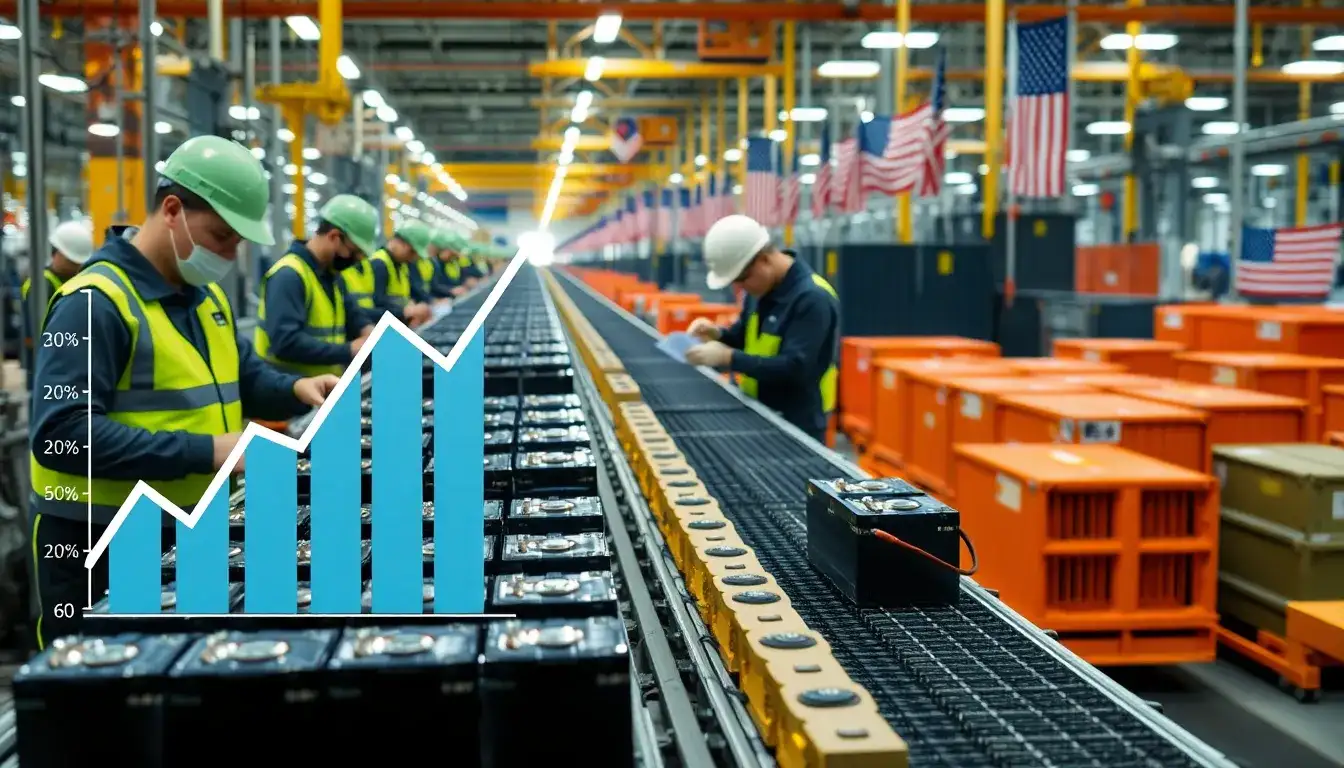
The U.S. is China’s largest single overseas market for the lithium battery industry and plays a significant role in related trade and industrial cooperation. According to the China Chemical and Physical Power Industry Association, from January to December 2024, the U.S. remained the top market for China’s lithium-ion battery exports, with an export value of $15.315 billion, marking a 13% increase year-on-year and accounting for 25% of China’s total lithium-ion battery exports.
What impact will the “reciprocal tariffs” have? Yu Qingjiao, Secretary-General of the Zhongguancun New Battery Technology Innovation Alliance, pointed out that as the leading market for China’s lithium battery exports, high tariffs would diminish the price advantage of Chinese companies, ultimately leading to a decrease in their market share in the U.S.
According to Zhou Lingkun, a member of Deloitte China Council and President of the Enterprise Technology and Performance Group, the situation differs between power batteries and energy storage batteries. For instance, after the tariff increase, the tariff rate for power batteries exported from China to the U.S. will rise to 82.5%, with energy storage batteries also expected to increase to 82.5% starting in 2026, significantly undermining the cost advantage of Chinese products.
High tariffs are seen as an obstacle. Data from the China Chemical and Physical Power Industry Association indicate that in January and February 2025, exports to the U.S. amounted to $2.028 billion, a 6.2% increase year-on-year and representing 22.5% of China’s total lithium-ion exports, confirming that the U.S. remains the largest export market for China’s lithium-ion batteries.
On April 7, an investor in Yiwei Lithium Energy inquired about the impact of recent U.S. tariffs on the company’s business. Yiwei Lithium Energy responded that its overseas sales target the global market, with direct exports to the U.S. accounting for less than 4%. In the short term, the company primarily uses the FOB (Free On Board) model for settlement, meaning it does not bear tariff costs, thus current tariff policies do not affect the delivery of existing contracts.
Looking ahead, Yiwei Lithium Energy plans to expedite its global layout and overseas production capacity development, enhancing its first-mover advantage with overseas factories while maintaining collaboration with international clients. They are also committed to leveraging their CLS (Contract Logistics Service) business model to meet the battery supply needs of international customers.
On April 8, Funeng Technology indicated on the Shanghai Stock Exchange interactive platform that its export revenue to the U.S. is currently low, and in the future, the company would seek to mitigate the impact of increased U.S. tariffs through negotiations with clients and production supply from overseas capacity.
During an investor relations event on April 14, CATL stated that its U.S. business represents a small portion of its overall shipments, and since last year, it has prepared for such environmental changes, resulting in minimal impact from the tariff policies on its performance.
Guoxuan High-Tech also mentioned on April 16 that its overseas business operates in the Asia-Pacific, Americas, and Europe-Africa regions, with a limited direct export share to the U.S. Therefore, the impact of tariff increases on overall performance is minimal. The company is actively advancing its overseas production capacity development to mitigate the effects of tariffs. The lithium battery project in Illinois, USA, is progressing steadily in line with the company’s overseas strategic planning and market expansion. The company is closely monitoring macroeconomic conditions and international trade policy dynamics while maintaining effective communication with clients and suppliers to manage trade risks and ensure stable operations.
Regarding the short-term and long-term changes in demand for Chinese lithium batteries in the U.S. due to these tariffs, Zhou Lingkun noted that it depends on demand elasticity and the substitutability of Chinese products. In the case of power batteries, the demand for electric vehicles in the U.S. remains stable, with Japanese and Korean battery companies (including Panasonic, LG, Samsung, and SK On) dominating the market primarily through local production, resulting in lower exposure for Chinese battery companies, which have already established production capacity in the U.S.
In the energy storage sector, the demand driven by new energy policies, utilities, and commercial and residential sectors, as well as the construction of large data centers spurred by AI development, creates a rigid demand in the U.S. energy storage battery market. Moreover, China’s iron-lithium batteries (LFP) are highly irreplaceable in the energy storage market, while Korean battery firms predominantly use ternary technology, indicating that there will be no significant reduction in demand for Chinese energy storage batteries in the short to medium term.
Yu Qingjiao remarked that one of the main objectives of the U.S. high tariffs is to diversify the supply chain, reduce dependency on Chinese suppliers, and stimulate the development of domestic supply chains. He noted that energy storage batteries might see a surge in export orders to counteract tariffs, supporting short-term export volumes; however, after 2026, the tariffs will similarly suppress growth in the power battery market.
In recent years, the global layout of the domestic automotive industry chain has become a common understanding in the industry’s development. Products such as electric passenger vehicles, lithium batteries, and solar batteries are becoming new growth points for exports and are referred to as the “new three samples” of foreign trade.
As the U.S. intensifies its tariff measures, market uncertainty regarding the export prospects of domestic lithium battery companies to the U.S. has heightened. For businesses, increased tariffs lead to higher export costs, squeezing profit margins.
How to mitigate trade risks has become a focal point of external concern. Zhou Lingkun mentioned that in the short term, negotiating with clients to share tariff costs could be a strategy. In the long term, companies might consider establishing local factories or utilizing technology licensing to meet overseas market demands.
Yu Qingjiao expressed that due to the high geopolitical risks associated with the U.S. market, power battery companies are unlikely to contemplate building factories in the U.S. To counter the impacts of high tariffs, he suggested strategies such as technology licensing, shifting tariff costs through FOB models, and exploring emerging markets.
Regarding the idea of “exporting technology and building factories overseas,” Yu Qingjiao commented that while technology export is feasible, establishing factories in the U.S. presents significant challenges. He suggested that companies could consider building regional supply chains in other overseas markets, such as Southeast Asia (Vietnam, Indonesia), utilizing local resources (nickel, cobalt) and low-cost labor to distribute tariff pressures. However, he warned that the U.S. “country of origin principle” restricts exports from Chinese-funded overseas factories, indicating the need to remain vigilant against systemic risks arising from fluctuating U.S. policies and global industry chain restructuring.
Notably, some domestic lithium battery companies are already establishing production capacity in the U.S. On December 21, 2023, Guoxuan High-Tech’s first battery pack product rolled off the production line at its Fremont factory, marking the official start of its “Made in America” initiative. On April 16, Guoxuan High-Tech elaborated that establishing production capacity in the U.S. will help better meet local market demands and strengthen collaboration with overseas clients, solidifying the competitive edge of its overseas factories.
From an industrial chain integration perspective, Yu Qingjiao pointed out that the recent tariff adjustments will accelerate the domestic lithium battery industry’s transition to higher value-added segments. He suggested focusing on high-nickel low-cobalt materials, lithium-rich manganese-based cathodes, silicon-carbon anodes, recycling technologies, decarbonization techniques, advanced intelligent equipment technologies, as well as next-generation technologies like solid-state batteries and sodium-ion batteries.
Under the backdrop of reciprocal tariffs, how can the Chinese lithium battery industry further optimize its global market layout? Zhou Lingkun suggested that Chinese lithium batteries could seek regions with lower tariffs amidst the storm of reciprocal tariffs. For example, Malaysia has only imposed an additional 24% tariff in this context. If a factory were established in Malaysia and then exported to the U.S., it could yield a considerable internal rate of return (IRR) for storage projects. However, in the long run, the U.S. will continue to emphasize the principle of origin, promoting the localization of energy storage battery production in the U.S.
In addition to the U.S. market, which other markets show significant growth potential? Yu Qingjiao highlighted that regions like Southeast Asia, Europe, and the Middle East are expected to be new growth points. Customs data indicate that in the first quarter, China’s exports of lithium batteries to ASEAN countries grew by over 20%.
Zhou Lingkun added that apart from the U.S. market, the energy transition initiatives and sustainable development in regions like ASEAN, the Middle East, and Australia, along with the construction of data centers driven by AI, will provide robust support for the demand for energy storage batteries.
Original article by NenPower, If reposted, please credit the source: https://nenpower.com/blog/surging-tariffs-on-exports-to-the-u-s-challenge-chinas-lithium-battery-industry/

