

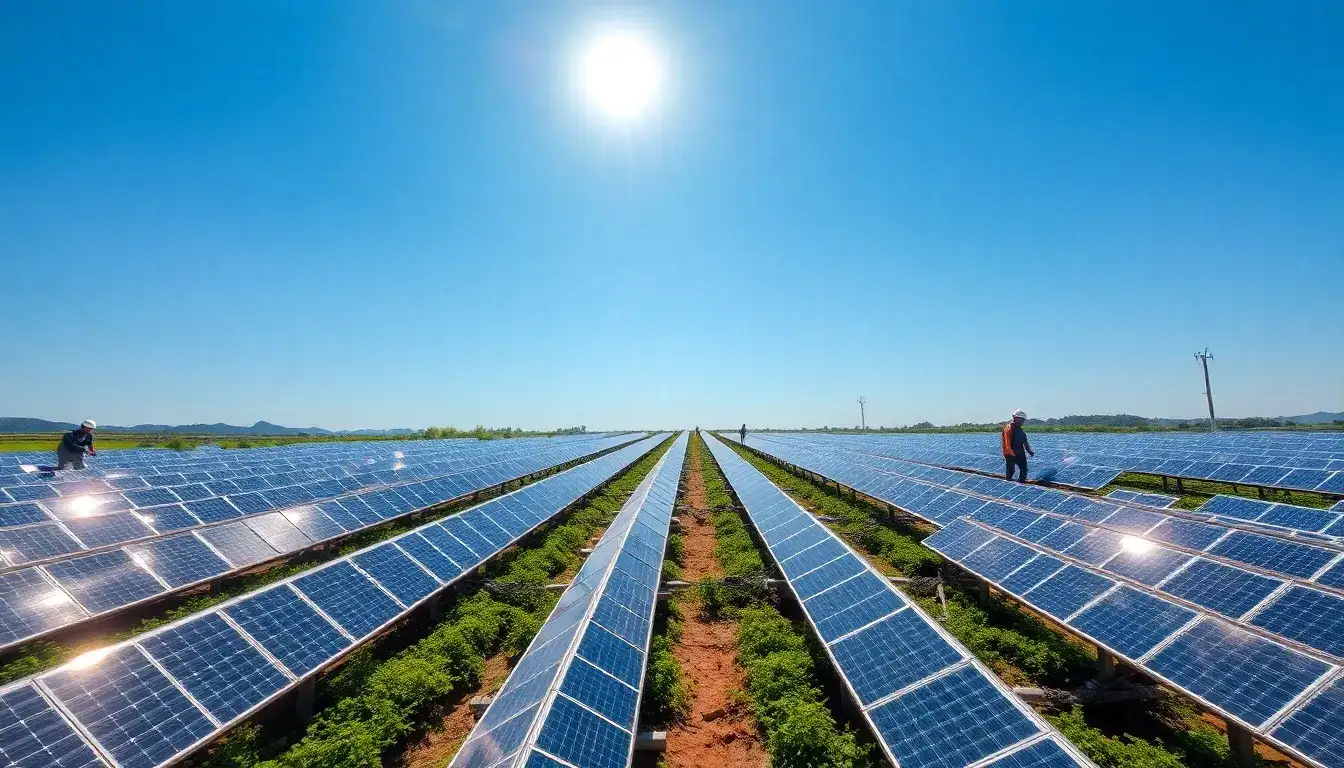
A Surge in Solar Installations: Domestic Photovoltaic Capacity Soars by Nearly 215% in April
On May 22, the National Energy Administration released statistics for the national power industry for the first four months of the year. By the end of April, the total installed power generation capacity in the country reached 3.49 billion kilowatts, marking a 15.9% year-on-year increase. Among this, solar power capacity stood at 990 million kilowatts, reflecting a 47.7% increase, while wind power capacity reached 540 million kilowatts, an 18.2% rise.
According to calculations by Pangbang News, the newly added photovoltaic capacity from January to April reached 10,493 megawatts (MW) (or 104.93 GW), showing a remarkable 74.6% year-on-year growth. Just in April, the new solar installations alone amounted to 45.22 GW, a staggering increase of 214.7% compared to the same month last year.
So far this year, the cumulative newly installed photovoltaic capacity in January and February was 39.47 GW, and in March, it added 20.24 GW. The dramatic acceleration in April doubled the monthly installations compared to earlier months and set a record for the highest new installations for solar power in the first half of any year.
The primary driver behind this surge is the new policies for distributed photovoltaic systems and the introduction of the Document 136 on new energy market entry policies.
In January, the National Energy Administration issued the Management Measures for the Development and Construction of Distributed Photovoltaic Power Generation, which stipulated that commercial and industrial distributed projects that become operational before May 1 could still enjoy full on-grid subsidies; after this date, new projects would only have the option of self-consumption or selling excess power, effectively ending the previous subsidy model.
On February 9, the National Development and Reform Commission and the National Energy Administration released a significant notice regarding the Deepening of Market-Oriented Reform of New Energy On-grid Electricity Prices (Document 136). This document proposed a market-based approach for electricity pricing, emphasizing fair responsibility allocation and differentiated pricing for existing and new projects, with June 1, 2025, marked as a dividing line for these changes.
The introduction of these two documents represents a pivotal shift for the new energy sector—a transition described as a coming-of-age ceremony. This window of policy change has generated a sense of urgency around the “430” and “531” deadlines for installations.
Investors rushed to complete their projects, manufacturers worked overnight to fulfill orders, and distributors faced strict deadlines for payments under threat of order cancellations. This frenzy has reignited the long-dormant photovoltaic industry chain, leading to widespread price increases. In March, component prices surged by over 30% month-on-month, with the average price of distributed components rising to 0.76 yuan/W, and leading companies even returning to the 0.8 yuan/W pricing era.
However, this boom was short-lived. Due to a significant mismatch in supply and demand within the industry, the surge in demand and collective price increases proved to be fleeting.
With smaller scale and investment requirements for distributed systems, the rush for installations is less complex compared to ground-mounted projects. Observations indicate that as the distributed installation frenzy comes to a close, especially after May, the overall urgency for installations in the domestic market has notably decreased, leading manufacturers to reduce their production schedules. As the impact of the rush fades, prices throughout the industry chain also began to fall rapidly.
Statistics from the China Nonferrous Metals Industry Association’s Silicon Branch indicate that in the first quarter of 2025, driven by the “430” and “531” policies, the photovoltaic market experienced robust growth, with companies accelerating project timelines and causing a spike in prices for components, batteries, and silicon wafers. At the beginning of April, the average transaction prices for N-type G10L monocrystalline silicon wafers reached 1.28 yuan/piece, N-type G12R at 1.54 yuan/piece, and N-type G12 at 1.59 yuan/piece, representing increases of 16.36%, 28.33%, and 11.97% respectively from the start of the year. Additionally, battery prices reached 0.32 yuan/W and component prices reached 0.78 yuan/W, reflecting increases of 14.29% and 14.71% respectively since January.
However, as the installation rush concluded, terminal demand quickly diminished, leading to steep price declines across all segments. After the May Day holiday, the transaction price for N-type G10L dropped to 1.01 yuan/piece, N-type G12R to 1.12 yuan/piece, and N-type G12 to 1.35 yuan/piece. The main reason for the decline in silicon wafer prices was the end of the rush and the subsequent drop in terminal demand. Specifically, after the holiday, orders from downstream components and battery sectors fell sharply, with buyers eager to procure at lower prices, while some silicon wafer companies sought to ensure cash flow and market share by selling at lower prices, further accelerating the downward price trend. Furthermore, component prices fell below 0.7 yuan/W, and battery prices dipped below 0.3 yuan/W. This indicates that prices across all segments have reverted to, or even dipped below, levels seen at the beginning of the year.
Original article by NenPower, If reposted, please credit the source: https://nenpower.com/blog/surge-in-solar-power-installations-april-sees-nearly-215-year-on-year-growth-in-chinas-photovoltaic-capacity/

