

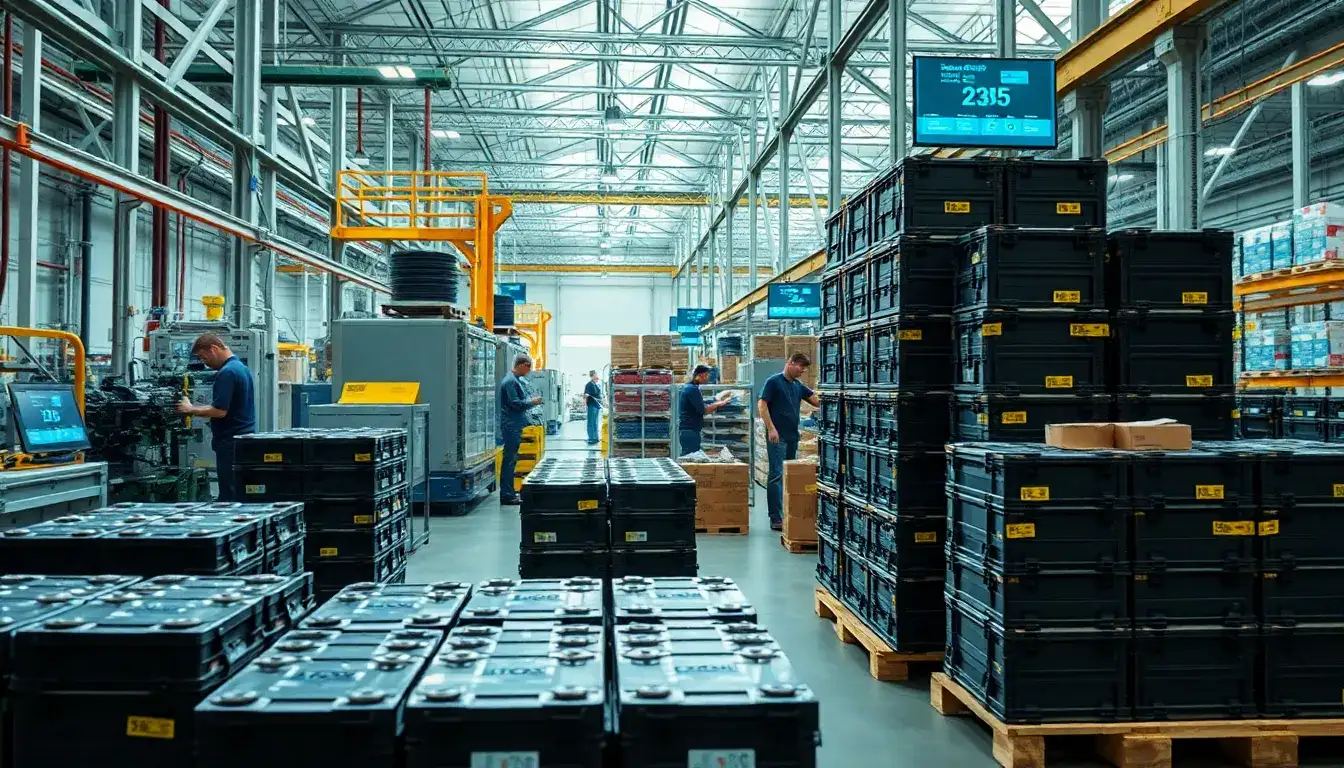
Last year, it was said that there was an oversupply of energy storage cell capacity, but this year has seen a surge in orders?
Alpha Factory – April 9, 2025 – Published in Beijing
Since the beginning of 2025, several leading battery manufacturers, including CATL and Yiwei Lithium Energy, have reported that their energy storage production lines are operating at nearly full capacity, despite an overall capacity utilization rate of less than 35%.
The rapid increase in demand within the energy storage sector can be attributed to several factors, including a rush to install systems, a booming overseas market, and the emergence of energy storage for data centers as a new growth area.
In order to ensure timely shipments, many energy storage system companies have proactively secured supplies of battery materials, leading to increasingly close cooperation along the supply chain.
However, potential crises in the energy storage industry should not be overlooked. In recent years, there has been a significant issue of overcapacity, and reckless expansion may worsen the situation.
Experts recommend that companies focus on technology and product innovation as they expand, keeping pace with technological advancements to avoid becoming obsolete due to excess capacity.
Who is planning ahead? The truth behind the surge in energy storage production lines goes beyond mere installation rushes. In recent industry research, several insiders revealed that since the start of 2025, many leading battery manufacturers, including CATL and Yiwei Lithium Energy, have had their energy storage production lines nearly fully operational. “In the past two months, I have been contacting suppliers everywhere to secure battery cells. Even when I find availability, there’s often a wait,” lamented a staff member from a system integration firm.
In the last two years, the energy storage industry has expanded at an astonishing rate. Statistics indicate that the planned capacity for energy storage cells in China for 2024 exceeds 1000 GWh, yet the actual shipment volume was only 300 GWh, resulting in a capacity utilization rate below 35% and a clear oversupply in the industry. So why has there been a rush for battery cells at the start of 2025?
Three driving forces behind the capacity surge include: a rush to install systems, a thriving overseas market, and the new growth area of data center energy storage.
The recently issued document No. 136 has had a significant impact on the energy storage industry. It stipulates that for existing projects connected to the grid before June 1, 2025, a “price difference settlement mechanism” will be in place to ensure that their revenue does not fall below the original pricing mechanism, though the proportion of guaranteed electricity must gradually decrease. For new projects connected to the grid after June 1, 2025, electricity prices will be determined entirely through market competition. This policy adjustment has created a sense of “time anxiety” among renewable energy developers. To mitigate the risk of price fluctuations, numerous projects have rushed to install systems ahead of the “531 deadline,” resulting in a significant surge in energy storage demand.
Additionally, since the beginning of 2025, 12 provinces including Shandong, Henan, and Gansu have issued clear targets for energy storage station projects, totaling over 30 GW/80 GWh.
The overseas market is also experiencing strong demand. Domestic energy storage companies have secured numerous orders abroad thanks to advanced technology and cost-effective products. For instance, in the Middle East market, the largest energy storage order has changed hands multiple times within just six months: starting from LONGi Green Energy’s 7.8 GWh, to BYD’s 12.5 GWh, and finally to CATL, which set a record with a 19 GWh order. The influx of overseas orders has led to a significant increase in order volumes for energy storage cell manufacturers, pushing them to operate at full capacity.
Notably, beyond traditional applications like grid load balancing and wind-solar integration, energy storage for data centers is emerging as a new market growth point. The global economy is rapidly transitioning into a computing power economy, with demand for computing power driven by technologies such as artificial intelligence, blockchain, and the Internet of Things increasing annually by over 400%, significantly outpacing Moore’s Law. The traditional power grid is struggling to meet the stability requirements of high-density computing facilities, while the combination of “data centers + wind-solar + energy storage” offers a key solution to balance the “electricity-computing power” disparity.
Typically, a large data center has a power demand of over 100 MW, consuming the equivalent of electricity used by 350,000 to 400,000 electric vehicles per year. To meet the high proportion of clean power supply required for data centers, it is often necessary to over-specify and integrate energy storage systems. Traditionally, data centers have primarily used lithium batteries as part of their uninterruptible power supply (UPS) systems to provide temporary backup power during outages. As data centers shift towards green energy sources, the application of lithium batteries is also transitioning from backup to supply.
In the overseas market, Nandu Power secured a $360 million contract for lithium battery equipment for data centers in the United States within just 20 days. Domestically, the government of Qingyang City in Gansu Province signed a strategic agreement with Jiangsu Tongli Risheng and Beijing Tianqi Hongyuan to invest 2 billion yuan in building an energy storage equipment manufacturing base and supporting power stations, aiming to create the first large-scale green energy and intelligent integration demonstration project in the Northwest region.
According to GGII, global shipments of lithium batteries for data center energy storage are expected to exceed 69 GWh by 2027, growing to 300 GWh by 2030, with a compound annual growth rate of over 80% from 2024 to 2030. The robust demand from data centers for energy storage is opening new business growth avenues for energy storage cell manufacturers, driving rapid production line operations.
Companies are positioning themselves: securing orders and accelerating expansion In order to ensure smooth shipments, many energy storage system companies have taken proactive measures to secure supplies of battery materials, leading to increasingly close collaboration within the supply chain. On February 7, Yiwei Lithium Energy’s subsidiary, Hubei Yiwei Power, signed a strategic cooperation agreement with Beijing Haibo Sichuang, establishing a strategic procurement partnership for battery cell products with a projected total purchase of 50 GWh from 2025 to 2027.
On March 17, Guangzhou Zhiguang Storage and Xiamen Haichen Storage signed a two-year strategic procurement agreement for battery cells, with an expected total purchase of 15 GWh for the 2025-2026 period. In light of the robust market demand, leading companies in the energy storage battery sector are launching an expansion wave. On January 2, CATL signed a cooperation agreement with the Fuzhou municipal government to collaborate on the construction of a “zero-carbon city” and signed an investment contract for the Luoyuan new energy base project, which plans an annual battery production capacity of 40 GWh. The super factory project at the Fuding production base has already topped out, with plans to establish four super production lines for new energy batteries and smart manufacturing equipment, achieving an annual capacity of 25 GWh.
Additionally, CATL plans to add 40 GWh of battery capacity in Dongying, Shandong, building according to “zero-carbon factory + lighthouse factory” standards, while investing 500 million yuan to establish a new 2 GWh ecological energy storage pack production line. The third and fourth phases of the Luoyang base project have also begun construction.
Yiwei Lithium Energy started the second phase of its super factory in Jingmen on January 5, with a total investment of 10.8 billion yuan, planning an annual capacity of 60 GWh. The first phase (60A) has an annual production capacity of 17 GWh, while the second phase (60B) is designed to reach 43 GWh.
On March 20, Yiwei Lithium Energy plans to issue 5 billion yuan in convertible bonds on the Star Market to fund a 23 GWh cylindrical lithium iron phosphate energy storage battery project and a 21 GWh large cylindrical passenger vehicle battery project. The first phase of the Yancheng battery super factory, with a capacity of 10 GWh, began production in November 2024, and its first batch of products has been delivered to overseas customers. The second phase started construction on February 28, 2025, with a planned annual capacity of 20 GWh, expected to be operational by 2026. Once fully operational, the Yancheng battery super factory will become the largest lithium battery manufacturing base in Northern China, with an expected annual output value of 20 billion yuan.
The new type of battery project with an annual capacity of 10 GWh by Ganfeng Lithium in Nanchang has been submitted for environmental impact approval on the Nanchang City government website. The project plans to establish a research institute for new lithium batteries and production lines for 10 GWh of new energy storage lithium batteries, 400,000 consumer lithium batteries, and solid-state lithium-ion batteries, with phase one construction expected to be completed by September 2025.
On January 1, Ruipu Lanjun launched its 10 GWh energy storage system integration project in Huai’an, Jiangsu. The project will build multiple production lines covering battery modules, PACK, energy storage system integration, inverters, and energy storage batteries, with expected annual sales revenue of 4 billion yuan upon completion. Furthermore, the company plans to invest in a battery factory in Indonesia, with an initial planned capacity of 8 GWh.
In the overseas market, Xinwangda‘s factory in Thailand has been approved for an investment exceeding 50 billion Thai Baht (approximately 10 billion yuan) for the production of batteries for electric vehicles and energy storage systems, expected to commence production within this year. Ruipu Lanjun has also announced plans to establish a battery factory in Indonesia focusing on the research, development, manufacturing, and sales of power and energy storage batteries, with an initial planned capacity of 8 GWh.
According to the 2024 energy storage lithium battery shipment rankings released by GGII, global shipments of energy storage lithium batteries are projected to grow by over 55% year-on-year in 2024, with Chinese companies contributing over 90% of the global capacity, marking the first time they have swept the top 10 rankings.
From the actions of these companies, it is evident that in 2025, leading enterprises maintain strong market competitiveness due to stable customer resources, while the concentration in the energy storage battery market will further shift towards these top players, amplifying the Matthew effect. Although the industry is currently experiencing a surge in orders driven by demand, potential crises cannot be ignored. In recent years, the energy storage industry has faced significant overcapacity issues. Some companies have blindly followed the trend of expansion in pursuit of short-term profits, resulting in oversupply, intense price competition, and a continued decline in industry profit margins. If companies continue to expand recklessly in this current wave, without considering actual market demand and their own technological capabilities, the situation of overcapacity will worsen.
At an industry summit in 2024, Dr. Zhang Xiaofei, an expert in the energy storage sector, pointed out that good products will always find a market. He highlighted that what is termed as overcapacity should first involve eliminating outdated capacity, leaving behind only effective capacity. This serves as a reminder for companies to focus on technology and product innovation during their expansion efforts, as production capabilities that fail to keep pace with technological advancements will eventually be sidelined by the market.
Original article by NenPower, If reposted, please credit the source: https://nenpower.com/blog/surge-in-demand-for-energy-storage-cells-in-2025-from-overcapacity-to-record-orders/

