

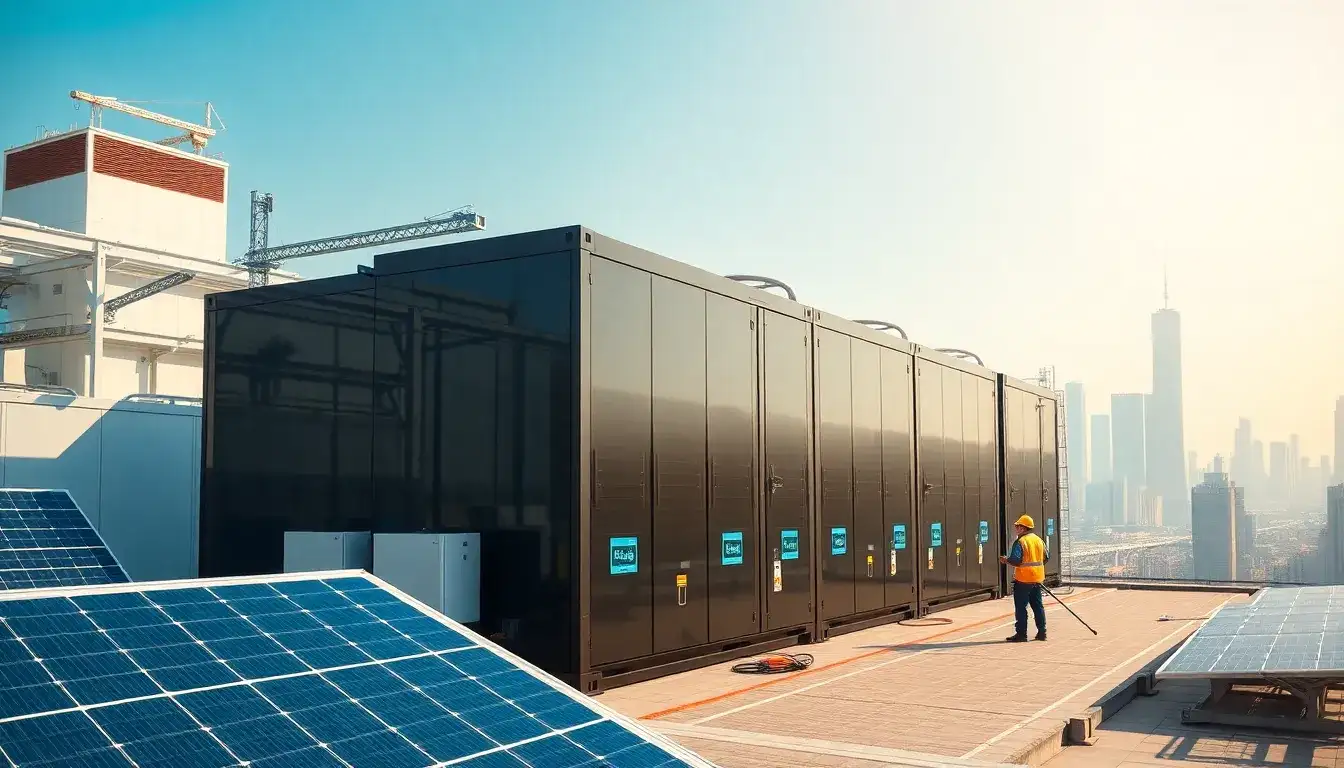
Commercial and Industrial Energy Storage Experiences Exponential Growth in Q1 2025
Since the beginning of 2023, the commercial and industrial energy storage market has witnessed explosive growth, driven by policy incentives, technological advancements, and increasing market demand. This trend is expected to continue into 2025. This article summarizes the installation capacity, bidding prices, registration status, production capacity layout, and product innovation trends in the domestic commercial and industrial energy storage market for Q1 2025.
<b>Installed Capacity Up by 54.85% Year-on-Year</b>
According to incomplete statistics from the CESA Energy Storage Application Branch's industrial database, the user-side commercial energy storage capacity in Q1 2025 reached 776.13 MW/1924.71 MWh, marking a year-on-year growth of 54.85%. Among these, stand-alone commercial energy storage projects accounted for 635.13 MW/1518.87 MWh, representing 78.91% of the total capacity. In contrast, installations for storage charging, solar storage charging, emergency power sources, distributed solar photovoltaic storage, and microgrid storage amounted to 141 MW/405.84 MWh, constituting 21.09% of the capacity.

Regions such as Jiangsu, Guangdong, and Zhejiang continue to lead the commercial storage market. With the rise of diverse applications like distributed solar photovoltaic storage and microgrids, provinces such as Anhui, Henan, and Xinjiang are becoming increasingly active. Notably, in early February, the 50 MW/200 MWh microgrid storage project by Huadian Tianshan North Foot commenced operations, located nearly 80 kilometers from the nearest power source. The innovative collaborative support model of this solar-storage-diesel microgrid ensures stable power supply to loads. This project features three operational modes: off-grid, grid-connected, and grid-forming, and includes capabilities such as voltage frequency support, fault ride-through, and black start, making it a benchmark for world-class microgrid storage projects. Shuneng Electric provided 20 sets of next-generation 2.5 MW grid-forming centralized converter booster units for this project, each consisting of two 1.25 MW centralized PCS units, utilizing second-generation VSG grid-forming technology.

In terms of participating entities, various companies such as Xinyuan Energy Investment, Faro Power, Ruid Energy, Yisiti, Chiku New Energy, Sungrow Power Supply, Hengyun Energy Storage, Huayuan Light, Lixing Energy, Xixing Charging, Zhongshu Energy, Shidai Xingyun, Xingjiyun Energy, and Yongtai Shuneng have launched multiple commercial storage projects in Q1 2025.

<b>EPC Contracts Account for Over 90%</b>
In the bidding market analysis, the user-side commercial energy storage EPC (including DC side equipment) and system procurement scale for Q1 2025 reached 1.23 GW/3.71 GWh. Notably, the EPC (including DC side equipment) procurement scale reached 1.79 GW/3.29 GWh, which accounts for 91.13% of the capacity. This indicates that over 90% of commercial storage projects are procured through EPC contracts. The projects are primarily concentrated in Jiangsu, Henan, Anhui, Zhejiang, Shandong, Fujian, and Sichuan, with Jiangsu and Henan each surpassing 1 GWh in procurement capacity.

Regarding the main contractors/bidders, companies such as Jiyuan Yuchong Energy Storage, Suyuan Thermal Power, Guangzhou Energy Storage Group, Taifeng New Energy, Guosheng Holdings, China Telecom, Hongqiao Garden, Nenghui New Energy, Shandong High-Speed Group, Xinyuan Energy Investment, Woheng New Energy, and Boda New Energy all had a procurement scale exceeding 100 MWh in Q1 2025. Among these, Henan Jiyuan Yuchong Energy Storage Company recorded the largest procurement scale, with a hybrid energy storage capacity of 200 MW/800 MWh linked to a charging station project for heavy-duty vehicles, including a 100 MW/200 MWh lithium iron phosphate storage system and a 100 MW/600 MWh vanadium flow energy storage system. In late March, China Energy Construction Group, Flow Energy Technology Co., Ltd., and the First Design Institute of China Machine Building won the EPC bid for this project with a joint bid of 1.93945 billion yuan, equivalent to a unit price of 2.4243 yuan/Wh.

Additionally, Jiangsu Guangyuan Electric Power Construction Co., Ltd. and a consortium of Southern Power Grid Electric Technology Co., Ltd., Anhui Tezhu Electric Engineering Co., Ltd., and Guangdong Zhenshen Electric Design Research Institute Co., Ltd. announced a procurement scale exceeding 300 MWh in Q1 2025. The consortium of China Energy Construction Jiangsu Institute and China Energy Construction Zhejiang Thermal Power, along with Lanjun New Energy Technology Co., Ltd. and Zhejiang Province Communication Industry Service Co., Ltd., and Jiangsu Ruili Electric Installation Co., Ltd., and Keda Guochuang Energy Technology Co., Ltd. all reported procurement scales exceeding 200 MWh.

On March 19, Keda Guochuang successfully won the bid for the China Telecom (Anhui) Intelligent Computing Center Energy Storage Project (Phase I), located in the Nankang District of Hefei, Anhui Province. This project is equipped with a 25 MW/200 MWh lithium iron phosphate battery storage container, which aims to reduce peak loads and lower electricity costs. The estimated project procurement amount is 373.998 million yuan (including tax), using a "cooperative leasing" model where the bidding company builds the energy storage facility for the computing center's use, sharing profits proportionally over a ten-year period. As the world rapidly advances towards a digital economy, leveraging advanced energy storage technologies ensures uninterrupted operations and promotes energy conservation and sustainable development. More energy storage systems are expected to play a significant role in data centers/intelligent computing centers in the future.

<b>Average Winning Bid Price for Commercial Storage Systems at 0.6659 yuan/Wh</b>
In terms of bidding prices, the EPC bid prices for lithium battery commercial energy storage projects in Q1 2025 mainly ranged from 0.7868 to 1.5 yuan/Wh, with an average price of 1.1029 yuan/Wh and a weighted average winning price of 1.0133 yuan/Wh. The lowest bid came from the 25 MW/100 MWh user-side energy storage project EPC by Huiru Technology in Quanshan City, which adopted a comprehensive integrated contracting method encompassing surveying, design, procurement, construction, and operation. The project was bid by Quanshan Boda New Energy Co., Ltd., with Huazhi Technology and Xintian Electric Co. becoming the second bidder with a bid of 78.681457 million yuan, translating to a unit price of 0.7868 yuan/Wh. China Electric Power Construction Jiangxi Electric Power and Zhonggeng Engineering jointly won this project with a bid of 81 million yuan, equivalent to a unit price of 0.81 yuan/Wh. The lowest winning price was linked to the Huazhong Liantian Cement Co. storage project by Yingde China Resources Gas Co., which constructed a 5 MW/15 MWh energy storage unit. In March, Runjian Co., Ltd. won the bid with a price of 12.00359 million yuan, translating to a unit price of 0.8002 yuan/Wh.

The winning bid prices for lithium battery commercial energy storage systems ranged between 0.4493 and 1.0487 yuan/Wh, with an average price of 0.6756 yuan/Wh and a weighted average winning price of 0.6659 yuan/Wh. The lowest bid came from the distributed photovoltaic project in Xinjiang Tianlong Mining (phases one, two, and three), which included energy storage systems of 1.5 MW/6 MWh for each phase, totaling 4.5 MW/18 MWh. Yisiti Group Co., Ltd. made a bid of 8.0865 million yuan, becoming the second candidate with a unit price of 0.4493 yuan/Wh, setting a new low for commercial energy storage system bids in Q1 2025. Xinyuan Zhichu won the bid with a price of 8.775 million yuan, equivalent to 0.4875 yuan/Wh, marking the lowest price for winning bids in commercial energy storage systems for Q1 2025.

<b>Registration Scale Increases by 234.36%, Jiangsu Accounts for 59.17% of National Total</b>
According to incomplete statistics from the CESA Energy Storage Application Branch's industrial database, in Q1 2025, there were a total of 2,474 new registered user-side commercial energy storage projects in the country. Among these, 1,758 projects disclosed specific construction scales, totaling 6.53 GW/16.16 GWh, representing a year-on-year increase of 234.36% compared to Q1 2024. Of these, 1,902 stand-alone commercial energy storage projects were newly registered, accounting for 76.88% of the total number, with a scale of 6.1 GW/15.2 GWh, representing 94.07% of the total capacity. Additionally, 1,025 projects disclosed initial investment amounts totaling 5.448 billion yuan.

Furthermore, 572 new registrations for solar storage charging/distributed photovoltaic storage/microgrid projects were made, accounting for 23.12%, with a total scale of 431.17 MW/958.7 MWh, representing 5.93% of the capacity. Analyzing initial unit prices, the initial investment unit prices for stand-alone commercial energy storage registered projects in Q1 2025 mainly ranged from 0.86 to 1.58 yuan/Wh, with 77.55% of projects falling within this range.

In terms of regional distribution, Jiangsu registered 604 new commercial energy storage investment projects in Q1 2025, with a scale reaching 3.86 GW/9.56 GWh, accounting for 59.17% of the national total. This positions Jiangsu as the leading province, with over 20 commercial storage projects exceeding 100 MWh, the highest number of large projects in the country, including the largest single project exceeding 800 MWh. Meanwhile, Guangdong registered 830 MW/2188 MWh, representing 13.54% of the capacity, and Zhejiang registered 922 MW/1893 MWh, accounting for 11.71%, ranking second and third nationally, respectively.

Jiangsu's leadership in commercial energy storage is attributed to several factors:
<ul>
    <li><b>Industrial Foundation Advantage:</b> Jiangsu has a highly developed manufacturing sector, attracting foreign enterprises, resulting in numerous high-energy consumption industrial parks. The increasing demand for commercial energy storage has surged due to the digital transformation of businesses and heightened green production requirements.</li>
    <li><b>Policy Support:</b> Jiangsu Province and various municipalities have introduced several supportive policies for energy storage. For instance, the "Measures for Further Promoting Distributed Photovoltaic Development in Suzhou Industrial Park" proposed support for photovoltaic projects with energy storage facilities. Energy storage projects connected to the park's carbon peak platform after January 1, 2022, are subsidized at 0.3 yuan/kWh for discharge over three years. Additionally, the Jiangsu Provincial Development and Reform Commission's "Implementation Rules for Jiangsu Province's Power Demand Response" set multi-tiered, differentiated subsidies for demand response, with the highest subsidy for 0.5-2 hours reaching 4.8 yuan/kWh.</li>
    <li><b>Price Mechanism Incentives:</b> According to Jiangsu's time-of-use electricity pricing policy, commercial energy storage projects with a three-hour configuration can benefit from significant price differences between peak and valley electricity. For example, the average peak-valley price difference in Jiangsu in 2024 was as high as 0.9 yuan/kWh, offering considerable arbitrage opportunities for commercial energy storage.</li>
</ul>

Currently, Jiangsu Province, relying on its robust industrial foundation, strong policy support, and relatively favorable electricity pricing mechanisms, has become a benchmark region for the development of commercial energy storage in the country. However, it is noteworthy that in April 2025, the Jiangsu Provincial Development and Reform Commission released a notice seeking opinions on optimizing the time-of-use electricity pricing structure to promote renewable energy consumption and support economic and social development. The draft suggested adjusting the average peak-valley price difference to 0.6485 yuan/kWh, significantly lower than previous years. The policy also optimized seasonal pricing for summer and winter periods, adding new valley time slots in spring and autumn.

Under this framework, Jiangsu has the capacity to configure 7-hour long-duration storage. However, the insufficient price difference for valley charging and discharging limits the daily charging and discharging cycle of energy storage stations to "one charge and one discharge," posing significant challenges to the sustainable profitability of existing commercial energy storage projects. The new round of time-of-use electricity pricing policy in Jiangsu may have far-reaching implications for the commercial energy storage industry. In the future, the layout of commercial energy storage in Jiangsu will need to be dynamically adjusted based on the actual implementation of policies and changes in the electricity market mechanisms.

<b>Production Capacity Expansion</b>
With the development of the commercial energy storage market, domestic production capacity continues to expand. According to incomplete statistics from the CESA Energy Storage Application Branch's industrial database, in Q1 2025, eight energy storage-related production projects updated their dynamics, with six announcing designed annual production capacities totaling 45.2 GWh and total investments of 9.4335 billion yuan. Four projects disclosed projected annual revenues upon reaching full production, totaling 22.2 billion yuan.

Ganfeng Lithium's new lithium battery and energy storage headquarters project, with an annual production capacity of 10 GWh, officially commenced construction with a total investment of 5 billion yuan. Upon reaching full production, the project will primarily engage in the research and production of lithium iron phosphate, semi-solid cells, lightweight power batteries, portable outdoor energy storage, household energy storage, and commercial energy storage systems. The first batch of Pack factory and supporting facilities is planned for completion and acceptance by April 2025, with overall project infrastructure slated for completion by mid-2025 and full production expected in 2026, generating an estimated annual revenue of 11 billion yuan.

The Huashu Technology headquarters R&D and manufacturing base project commenced, with a total investment of 235 million yuan, and its annual production of 20 GWh key equipment for energy storage systems has completed registration. This project focuses on the digital, automated, and intelligent transformation of back-up battery and energy storage BMS production lines, creating an "AI + Green Intelligent Manufacturing" ecosystem alongside the construction of intelligent production lines and key laboratories.

Ningbo Deyi's energy storage production line, with an annual capacity of 2 GWh, and a technical transformation project for energy storage batteries and integrated systems with an annual capacity of 1.2 GWh have completed registration. Jinlang Technology plans to establish a new production line for medium and large-capacity hybrid energy storage in Ningbo, Zhejiang, with a total investment of 313 million yuan. The project is expected to produce 25,000 units of medium and large-capacity hybrid energy storage inverters annually, primarily for commercial energy storage systems and large residential energy storage systems.

Kunyu Power's Baise project, with an annual capacity of 6 GWh for battery cells and energy storage integrated systems, has commenced construction with a total investment of 2.8 billion yuan, anticipating an annual revenue of approximately 7.2 billion yuan and tax revenues of about 180 million yuan upon reaching full production. This project will mass-produce Kunyu Power's 720Ah Tianchi series super batteries, providing intelligent storage solutions covering generation-side storage, shared storage, household energy storage, commercial peak shaving, and network energy.

Weilan New Energy's first semi-solid energy storage battery production line in Guangdong has commenced operations, marking the nationwide first mass production of large-capacity 314Ah semi-solid energy storage battery products. As a key project in Guangdong's energy development "14th Five-Year Plan," this production line has a total investment of about 1 billion yuan, with an expected annual production capacity of 6 GWh, leading to potential annual revenues of 2 billion yuan. This production line utilizes Weilan New Energy's self-developed nano-solid electrolyte technology, suitable for various scenarios including source-grid-side storage, 5G base station storage, commercial energy storage, data and computing center storage, new energy commercial vehicles, rail transit, electric construction machinery, and electric ships.

Domestic production capacity related to user-side energy storage has been further enhanced, providing robust support for the large-scale and intelligent development of commercial energy storage.

<b>Product Development Trends</b>
According to incomplete statistics from the CESA Energy Storage Application Branch's industrial database, in Q1 2025, companies such as BYD, Sungrow Power Supply, Hongzheng Energy Storage, Singularity Energy, Huazhi Energy, China Mobile Energy, Dongfang Risheng, Qing'an Storage, and Changyuan Energy released 24 models of commercial energy storage cabinets. With the increasing diversity of commercial energy storage applications and needs, the design and development of energy storage products are becoming more refined and specialized.

<ul>
    <li><b>Large Scale:</b> As more large-scale projects emerge, and with land resources becoming scarce, commercial energy storage battery cabinets are also evolving towards larger capacities. In Q1 2025, of the 23 commercial energy storage cabinets released with specified capacities, eight had capacities above 400 kWh, exceeding one-third, with the largest being the eFlex 836 kWh liquid-cooled energy storage system released by Dongfang Risheng in Japan in February. Additionally, Sungrow Power Supply, Kelu Electronics, and Penghui Energy have introduced new products exceeding 500 kWh.</li>
    <li><b>High-Capacity Cell Integration:</b> New products generally incorporate 300+ Ah cells. For instance, the newly launched 268KWh-CTR commercial energy storage system by Hive Energy uses a 350Ah cell; Huazhi Energy's 150 kW/313.5 kWh liquid-cooled/wind-cooled energy storage cabinet, and Singularity Energy's eBlock-261/418 energy storage cabinets both utilize 314Ah cells; and Anhui Mingmei's HV419 commercial liquid-cooled energy storage cabinet is equipped with a 315Ah cell. Cells of 300+ Ah have become the mainstream choice for commercial energy storage.</li>
    <li><b>Liquid Cooling Dominance:</b> Over 80% of the new commercial energy storage products released in Q1 2025 utilized liquid cooling methods, including some immersion liquid-cooled storage cabinets.</li>
    <li><b>Modular Design:</b> Considering transportation conditions, flexible configurations, installation periods, and complex environments, modular design has become the mainstream for commercial energy storage products. Most new products adopt integrated designs, combining batteries, BMS, PCS, EMS, temperature control systems, fire safety systems, and distribution systems, resulting in increased system integration.</li>
    <li><b>AI Empowerment and Enhanced Intelligence:</b> In 2025, the next generation of AI is gradually being applied in new commercial energy storage products. Leveraging AI management systems with BMS and big data enables real-time monitoring of battery status and early fault warnings, achieving millisecond-level fault prediction and self-healing fault tolerance mechanisms. AI can accurately predict generation and load, dynamically balance "source-grid-load-storage," and enable intelligent scheduling of multiple energy sources (photovoltaic/wind power/grid), generating real-time dynamic electricity pricing strategies and establishing intelligent peak-valley arbitrage systems to maximize economic benefits. Additionally, AI can perform digital twin monitoring of module health, improving maintenance efficiency and reducing costs.</li>
    <li><b>Solar-Storage Integration:</b> The application scenarios for commercial energy storage are increasingly diverse, including high-energy-consuming industries, business centers, zero-carbon parks, data centers, communication base stations, and hospitals. An increasing number of commercial energy storage solutions are becoming "scenario-based," accurately addressing various commercial needs with diverse and differentiated products. For example, Changfeng Green Energy launched the second-generation Lingxi series of solar-storage integrated products, with a 125 kW/250 kWh integrated product supporting 125 kW PCS AC output and 120 kW DC photovoltaic input, along with grid-connected and off-grid switching functions. Singularity Energy's eBlock-100C commercial energy storage cabinet features a "solar-storage integrated" design, primarily targeting newly constructed commercial solar-storage power station scenarios, offering both grid-connected and off-grid modes, and different EMS modes such as self-consumption, economic mode, and backup mode.</li>
</ul>

Overall, in Q1 2025, the domestic commercial energy storage market has shown robust development in terms of installed capacity, bidding market dynamics, registration status, industrial chain layout, and new product launches. Regions such as Jiangsu, Guangdong, and Zhejiang continue to maintain their leading positions, while emerging markets are accelerating their rise. Despite facing potential challenges like adjustments in time-of-use electricity pricing mechanisms and increasing market competition, the continuous breakthroughs in storage technology and the expansion of application scenarios will continue to inject strong momentum into the industry. In the future, commercial energy storage will play a more significant role in the digital intelligence and green low-carbon transformation.
Original article by NenPower, If reposted, please credit the source: https://nenpower.com/blog/surge-in-commercial-energy-storage-market-in-q1-2025-key-trends-and-developments-in-china/

