

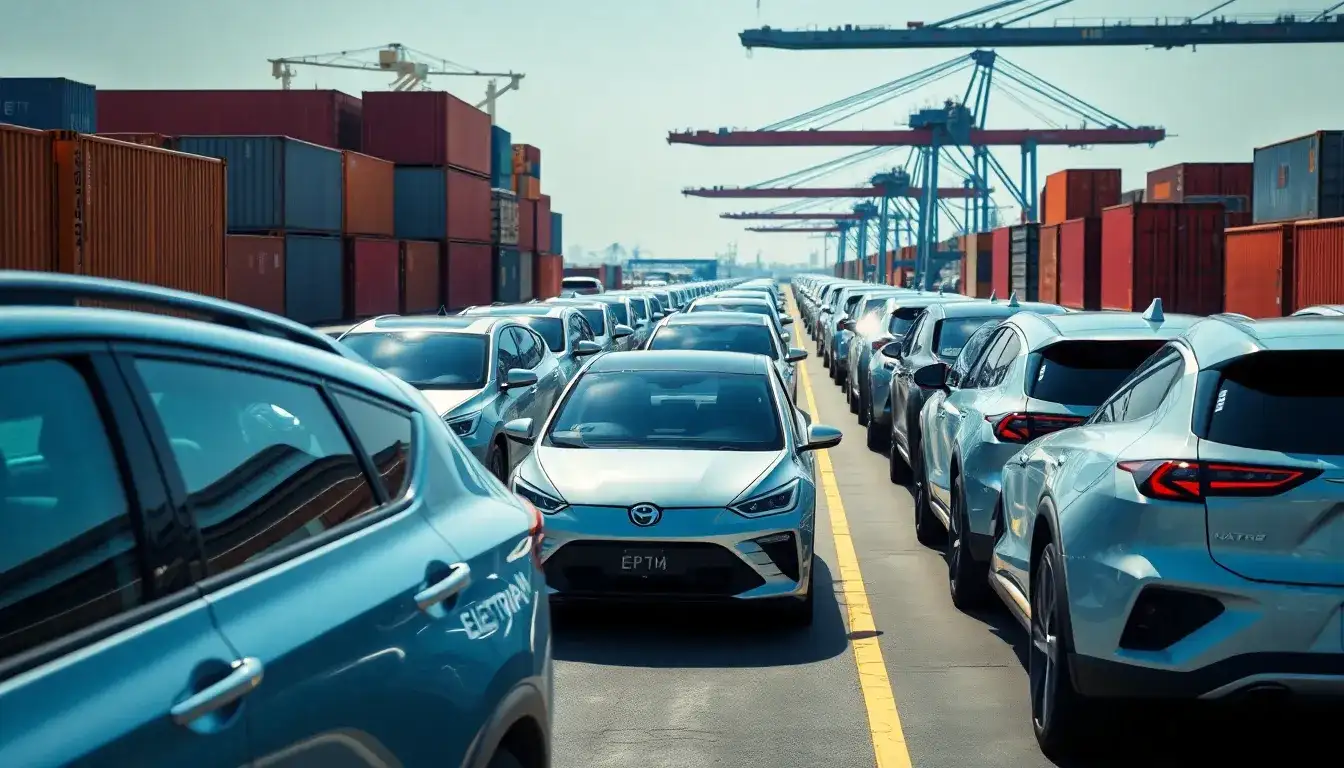
The monthly report on electric passenger vehicles for August 2025 indicates a significant shift in export strategies, reflecting a strong increase in the volume of passenger car exports. According to statistics from Jiemian Think Tank and Hanwen Information, China’s trade in electric passenger vehicles continued to show structural differentiation in August. The dependency on imported electric passenger vehicles in the domestic market has decreased, leading to a continued contraction in import volume. Conversely, export growth momentum has strengthened, supported by advancements in battery technology, intelligent configurations, and optimized manufacturing systems. In August, both export volume and value experienced substantial year-on-year and month-on-month increases, accelerating China’s expansion into the global market.
In terms of market segments, August saw electric passenger vehicle exports evolve along a differentiated path. The passenger car sector continued to implement a “price for volume” strategy, with average prices for pure electric, plug-in hybrid, and non-plug-in hybrid models decreasing between 9% and 26% year-on-year. This led to an impressive year-on-year growth of 83.95% in passenger car exports. The bus sector, on the other hand, witnessed a simultaneous increase in both volume and price, alongside varying technological routes. Pure electric buses maintained steady growth, with export volume increasing by 2.13% year-on-year, while hybrid buses rapidly expanded from a low base, achieving a staggering month-on-month growth of 566.67%. The average price for hybrid buses also rose, showcasing strong product competitiveness and market recovery.
1. Strong Export Momentum for Electric Passenger Vehicles in August
From January to August, the trade in electric passenger vehicles in China continued to demonstrate robust growth, with a total value surpassing $43.526 billion, marking a significant year-on-year increase of 22.34%. The export sector performed particularly well, with cumulative export value reaching $41.086 billion, a year-on-year increase of 29.98%. The number of vehicles exported also hit a record high of 2.2559 million, reflecting a remarkable year-on-year growth of 53.21% and a further acceleration of 4.63 percentage points compared to the previous seven months, indicating sustained growth momentum.
In August, the market growth was particularly noteworthy, with electric passenger vehicle exports achieving a new monthly high. The total export value for the month reached $6.524 billion, representing a year-on-year increase of 57.85% and a month-on-month increase of 11.11%. Export volume also surged, with 358,900 vehicles exported in August, a year-on-year increase of 83.40% and a month-on-month increase of 10.42%. The average export price of electric passenger vehicles in August was $18,179.31, down 13.93% year-on-year but slightly up 0.63% month-on-month, indicating a stabilizing price trend.
Structurally, the exports of electric passenger vehicles in August showcased notable differentiation, with clear distinctions between passenger cars and buses in terms of export scale, growth rate, and price trends. Passenger cars accounted for a dominant share of the overall market, with export numbers and value in August comprising 99.61% and 95.62% of the total electric passenger vehicle market, respectively. Specifically, the export value for passenger cars reached $6.239 billion, up 58.98% year-on-year, while the export number was 357,500 vehicles, reflecting an impressive year-on-year increase of 83.95%. The corresponding average export price was $17,451.47, a decrease of 13.57% year-on-year, demonstrating a clear trend of “increased volume with decreased price.”
In the passenger car segment, plug-in hybrid vehicles experienced the largest price drop year-on-year, followed closely by pure electric passenger vehicles. In August, the average prices for pure electric, plug-in hybrid, and non-plug-in hybrid passenger vehicles were $16,674.05, $20,466.42, and $15,105.38, respectively, with year-on-year decreases of 14.84%, 25.98%, and 9.36%.
In contrast, the bus export segment in August displayed characteristics of simultaneous increases in both volume and price, with significant differences in growth rates and pricing among sub-models. Specifically, the number of buses exported in August was 1,394, reflecting a year-on-year increase of 3.95% and a month-on-month increase of 0.94%. The export value amounted to $28.6 million, up 36.63% year-on-year and 8.44% month-on-month, while the average price also showed an upward trend, reaching $204,829.94, up 31.44% year-on-year and 7.43% month-on-month.
Among sub-models, pure electric buses remained the dominant category in bus exports. In August, the export volume for pure electric buses reached 1,294 units, a year-on-year increase of 2.13%, although it saw a month-on-month decline of 5.27%. The average price was $208,713.88, marking a year-on-year increase of 32.93% and a month-on-month increase of 8.37%. Meanwhile, hybrid buses exported 100 units in August, an increase of 35.14% year-on-year, with a staggering month-on-month increase of 566.67%. The average price for hybrid buses was $154,571.70, reflecting a year-on-year increase of 13.96% and a month-on-month surge of 981.12%.
2. Shifts in Top 10 Export Sources in August
From January to August, Shanghai led the nation in electric passenger vehicle exports with an export value of $9.016 billion, despite a slight year-on-year decrease of 1.67%. Jiangsu province ranked second with $5.324 billion, experiencing an explosive growth of 136.04%. Guangdong province held the third position with an export value of $3.989 billion, showing a year-on-year increase of 16.47%. The combined export value from the top 10 sources reached $35.288 billion, accounting for 85.89% of the total national electric passenger vehicle exports, solidifying the dominance of these leading provinces and cities.
Compared to July, the export landscape among the top 10 sources underwent a reshuffle in August. Shanghai ($1.752 billion) retained the top position, joined by Anhui and Jiangsu to form a new leading group. Hunan province fell out of the top ten, while Sichuan province successfully made its entry.
In August, the provinces with the highest year-on-year growth rates in electric passenger vehicle exports were Shanxi, Guizhou, Anhui, Gansu, and Jilin. Conversely, the provinces with the lowest growth rates were Ningxia, Tibet, Hainan, Sichuan, and Hubei. The national electric passenger vehicle export growth exhibited a polarized phenomenon, with ten provinces exceeding 100% growth while nine provinces reported negative growth.
3. Expanding Global Reach and Speed in August
From January to August, Belgium emerged as the top destination for China’s electric passenger vehicle exports, with a trade value of $4.498 billion, reflecting a year-on-year decrease of 6.62%. The United Kingdom followed as the second-largest market, with $3.917 billion, marking a growth of 26.72%. The United Arab Emirates ranked third with $2.513 billion, showing an impressive year-on-year increase of 85.90%. The top 10 export destinations accounted for a total of $23.143 billion, representing 56.33% of the overall export value. Compared to January to July, Germany entered the top 10 destinations, while Indonesia dropped out.
In August, the fastest year-on-year growth rates in electric passenger vehicle exports were recorded for Argentina, the Czech Republic, El Salvador, Tanzania, and Nigeria. Exports to 115 countries saw positive year-on-year growth, while 42 countries experienced negative growth.
Analyzing by continent, August showcased a significant expansion in the breadth and speed of China’s electric passenger vehicle exports. The exports covered a total of 165 countries and regions, further extending the market reach and enhancing penetration capability. Asia, as the continent with the highest number of covered countries, included 49 markets and achieved an export value of $2.547 billion, marking a substantial year-on-year increase of 78.54%. The European market also exhibited steady growth, with an export value of $2.864 billion, up 72.63%, highlighting the increasing competitiveness of Chinese electric passenger vehicles in mature markets.
Emerging markets showed particularly strong performance, becoming a crucial driver of export growth. Africa continued its robust upward trend, with exports surging by 272.89% year-on-year in August. Oceania became the standout region for the month, with an astounding year-on-year increase of 300.05%, leading all continents in growth rates, indicating that emerging markets are becoming new growth poles for Chinese electric passenger vehicle exports. The South American market also saw steady expansion, with exports increasing by 212.58% year-on-year.
4. Accelerating the Global Expansion of China’s Electric Vehicle Ecosystem
In August, the overseas expansion of China’s electric passenger vehicle industry entered a new phase characterized by “deep layout and efficiency improvement.” The global market penetration and control over the industry chain have both strengthened, coupled with an improvement in the trade environment. The industry maintained an explosive growth trajectory, with cumulative exports reaching 2.2559 million vehicles from January to August, a remarkable year-on-year growth of 53.21%, far exceeding the growth rate from the previous year.
In August, companies accelerated the formation of local production networks overseas, bringing global manufacturing layouts into a phase of practical implementation. BYD’s factory in Thailand marked a milestone by exporting electric vehicles to Europe for the first time on August 26, shipping over 900 vehicles to core markets including the UK, Germany, and Belgium. This upgrade signifies the transformation of its Southeast Asian production base into a global manufacturing hub. Great Wall Motors’ factory in Brazil commenced production on August 15, with an initial annual capacity of 30,000 vehicles, launching the Haval H6 gasoline and hybrid versions, and plans to produce ethanol hybrid models, anticipating an increase in capacity to 50,000 vehicles by 2028. The company is quickly entering the South American market by leveraging acquired facilities and adapting local models. Leapmotor has also strategically positioned itself in Europe, announcing the establishment of a manufacturing base in Zaragoza, Spain, utilizing resources from Stellantis Group to prepare for the production of the B10 and B05 models, laying the groundwork for deepening its presence in the European market.
Optimized trade conditions and upgraded logistics channels have provided dual support for export growth. On August 12, a joint statement from the China-U.S.-Sweden trade talks announced a temporary suspension of mutual 24% tariffs for 90 days, although a 10% residual tariff remains. This agreement reduces trade costs and creates favorable conditions for Chinese automotive companies to expand into the North American market. In logistics, Leapmotor deepened its collaboration with European roll-on/roll-off transportation giant Grimaldi Group, with the launch of the “GRANDE TIANJIN” specialized car carrier to Europe on August 8, capable of transporting over 2,500 electric vehicles per trip, enhancing export efficiency through customized logistics solutions to support its European market expansion plans.
In terms of industry chain collaboration and technology exports, Chinese automotive companies are rapidly advancing in building a global industrial ecosystem. Leapmotor has extended its capabilities by supplying battery packs through its subsidiary, Lingxiao Energy, which sources battery cells from leading companies like CATL. This initiative has already secured orders from over five new energy commercial vehicle clients while engaging in in-depth discussions with companies like Xishan New Energy, marking a diversification from complete vehicle manufacturing to core component supply. Chery Automobile is accelerating its layout in emerging markets through technological cooperation, negotiating with Pakistani firms to build electric vehicle factories, and jointly entering the Iraqi market with Saudi Arabia’s Anlijie Automotive on August 11, planning to distribute multiple models from the Omoda and Jaecoo brands in the fourth quarter, covering both fuel and hybrid categories to meet diverse market demands.
In August, companies showcased notable achievements in segment and regional layouts: Zeekr Automotive precisely entered the high-end market in Australia, launching the Zeekr 7X equipped with a full-stack 800V high-voltage system, with a pre-sale price of AUD 57,900 (approximately RMB 271,000), offering two battery configuration options to leverage technological advantages in developed markets. JAC Motors focused on the Southeast Asian commercial vehicle sector, officially entering the Indonesian market on August 19 with the launch of the JAC T9 EV, JAC N90 EV, and JAC N35 EV light trucks, filling a gap in the local electric commercial vehicle market. The Omoda and Jaecoo brands under Chery entered Iraq through dealer cooperation, quickly establishing market presence by leveraging local channel resources and further enhancing their layout in the Middle East.
Overall, in August, the Chinese electric passenger vehicle industry achieved profound advancements in transitioning from product exports to industrial ecosystem outputs through multidimensional measures of “globalized manufacturing, specialized logistics, extended chains, and precise markets.” The establishment of localized production capacity, reduction in trade costs, and breakthroughs in the supply of core components have collectively driven the continuous enhancement of the industry’s competitiveness in the global market, laying a solid foundation for achieving annual export targets.
Original article by NenPower, If reposted, please credit the source: https://nenpower.com/blog/surge-in-chinas-electric-passenger-vehicle-exports-august-sees-84-year-on-year-growth-driven-by-price-volume-strategy/

