

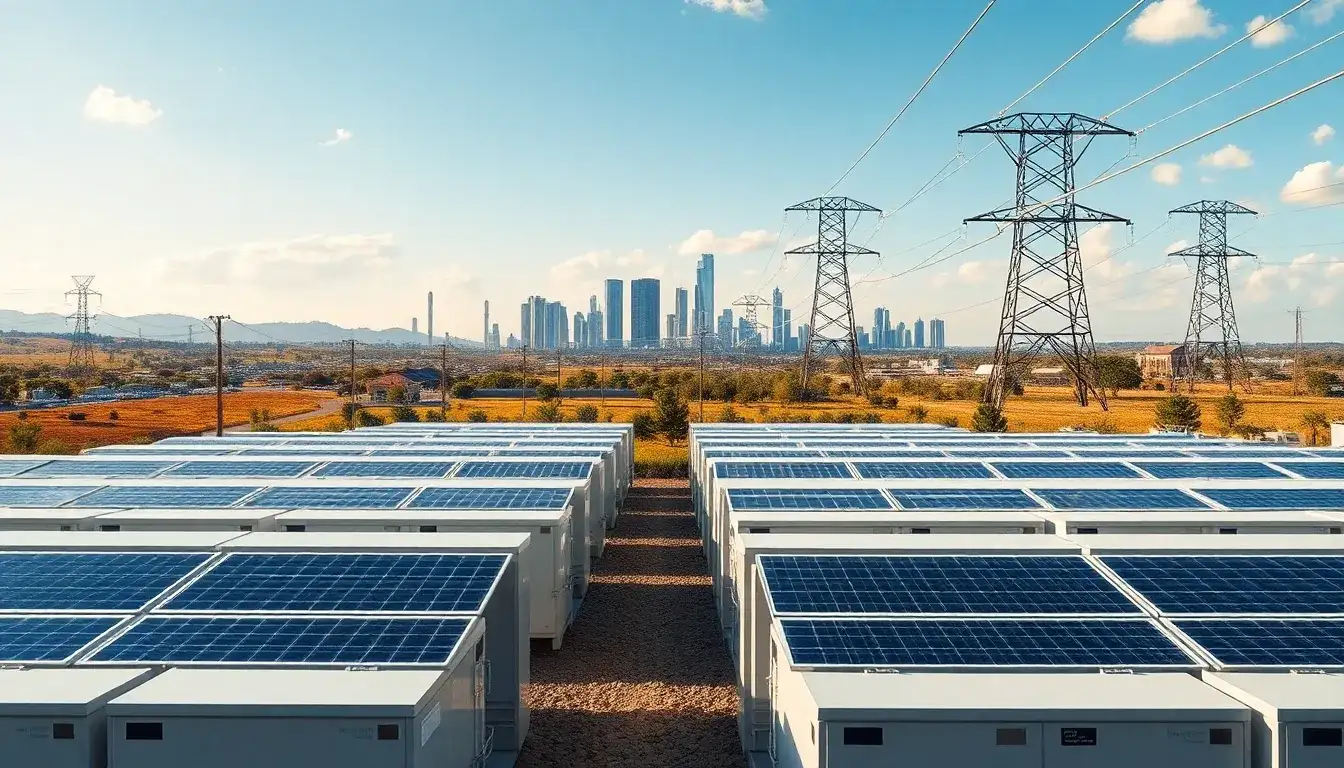
The Australian Energy Market Commission (AEMC) has forecast potential reliability gaps in South Australia and New South Wales, expected to occur in the financial years 2026-27 and 2027-28, respectively. This situation presents significant opportunities for battery energy storage systems (BESS) across Australia, as outlined in the AEMC’s Reliability & Security Report, which evaluates the National Electricity Market (NEM).
The report, prepared by the AEMC’s Reliability Panel, serves to monitor and ensure the safety, security, and reliability of the NEM. It indicates that, despite the ongoing shift towards renewable energy, the NEM maintained its expected levels of reliability, security, and safety during the 2023-24 financial year, with battery energy storage playing a vital role in this transformation. However, with the increasing integration of variable renewable energy sources, long-term reliability of the grid has come under scrutiny, particularly for South Australia, which is predicted to experience reliability issues starting in 2026-27 and again in 2033-34. New South Wales is expected to face similar challenges from 2027-28 onwards, with Victoria also potentially encountering reliability gaps in 2027-28.
As the demand for renewable energy continues to grow, the report emphasizes the need for additional investment in generation capacity beyond the currently committed projects to uphold reliability standards. This gap presents substantial market opportunities for BESS developers and investors, especially as coal-fired and thermal generation sources are phased out of the energy mix. The AEMC highlights that the NEM is transitioning from a thermal-dominated system to one dominated by inverter-based resources, underscoring the strategic importance of BESS. With grid-forming technology, BESS can effectively emulate synchronous generators, enhancing grid stability.
Tim Jordan, chair of the AEMC Reliability Panel, notes that investment beyond current projects is essential for future reliability. “Battery energy storage in Australia is growing rapidly – utility-scale batteries doubled their capacity in FY2024, while distributed batteries tripled,” he stated. “However, the Panel acknowledges AEMO’s forecasts indicating reliability gaps as soon as 2026-27, making continued investment critical for a stable electricity supply.”
The report reveals a remarkable growth trajectory for BESS in Australia, with utility-scale battery energy storage capacity having doubled in FY2024, adding 807MW to reach an approximate total of 1,553MW. By the end of FY2024, the NEM had approximately 16.6GW of committed and anticipated projects in the pipeline, in addition to 259.6GW of proposed utility-scale solar, BESS, and wind developments throughout the country. Remarkably, distributed BESS installations also tripled during the same period, with 1,315MW (a 64% increase) added in FY2024 alone.
This upward trend is expected to be further supported in FY2025 with the Australian government launching the AU$2.3 billion (US$1.41 billion) Cheaper Home Batteries Program on July 1, aimed at fostering a robust market for BESS in Australia.
In conclusion, the AEMC’s report highlights the critical role of battery energy storage in maintaining grid reliability as Australia transitions to a more sustainable energy landscape, presenting both challenges and opportunities for the industry.
Original article by NenPower, If reposted, please credit the source: https://nenpower.com/blog/surge-in-battery-energy-storage-as-aemc-warns-of-reliability-gaps-in-australias-electricity-supply/

