

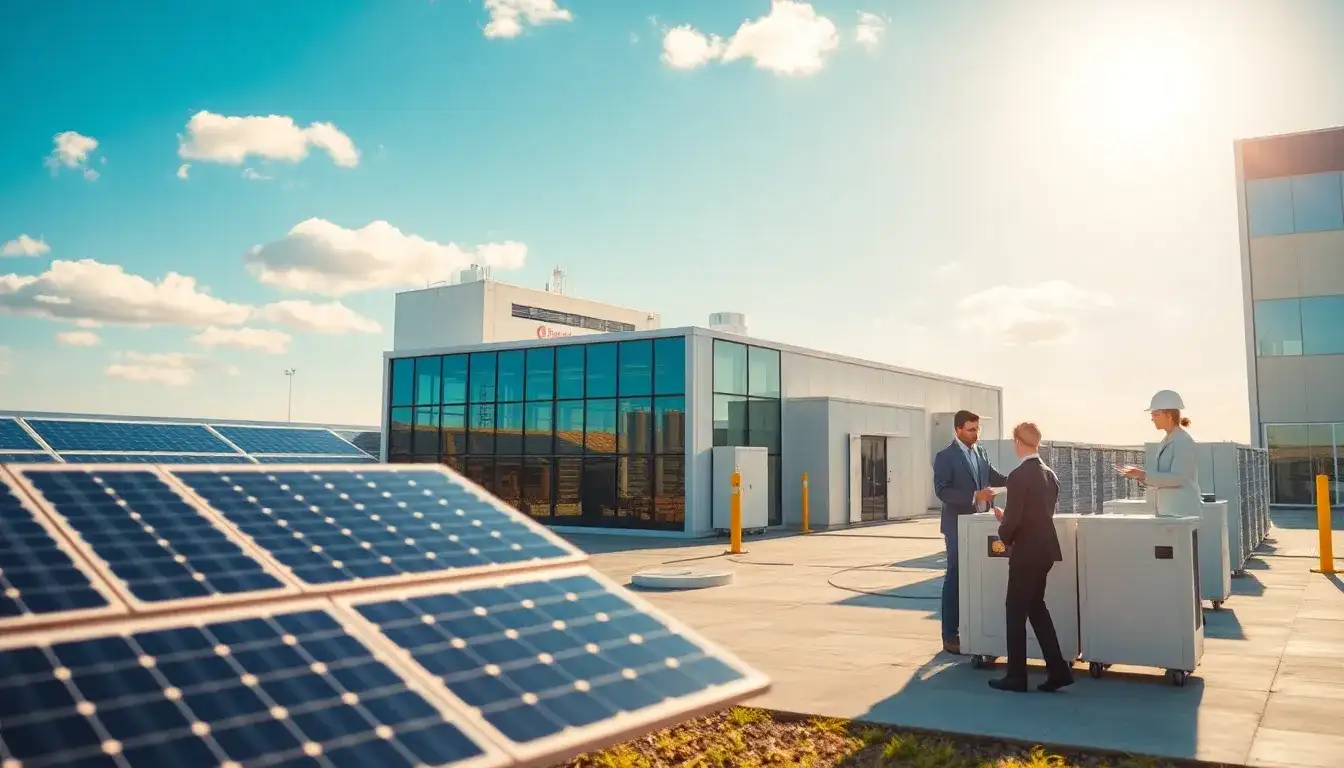
Energy storage is taking center stage in the commercial and industrial sectors, and Sungrow Power Supply has emerged as a versatile player. As the implementation of Document No. 136 unfolds, energy storage is rapidly gaining traction in the deep waters of power reform. Distributed energy storage and commercial energy storage are becoming key pillars for driving energy reform. With high and volatile energy costs in commercial sectors, park-based energy storage has been able to develop rapidly, evolving from a “mandatory configuration” role into a valuable entity capable of “autonomous configuration.” Energy storage is no longer merely a policy-driven initiative; it has become a core mechanism for market-oriented operations.
At the same time, the dual push from international green regulations (such as the Carbon Border Adjustment Mechanism and battery legislation) and domestic energy consumption controls has compelled energy-intensive enterprises to quickly embrace zero-carbon parks. With the integration of source, grid, load, and storage, alongside pilot projects for direct green electricity connections, zero-carbon parks have emerged as vital testing grounds for energy storage. Here, environmental rights such as green certificates and CCERs are deeply tied to the benefits of enterprises’ new energy projects, where unified management of green values can even influence competitive bidding strategies.
In response to these transformative challenges, the energy storage industry is moving beyond simple battery or equipment supply into a more holistic and systemic approach. The integration of electrochemical systems, power electronics, energy management systems (EMS), digital twins, and carbon asset management is essential for companies to implement true zero-carbon solutions. In other words, future storage companies must not only understand batteries but also master the logic of power grids, energy-carbon systems, and collaborative industry chains to navigate the value-driven wave of zero-carbon initiatives.
A single battery cabinet cannot solve the problem. On March 5, 2025, during Premier Li Qiang’s government work report, the directive to “solidly carry out the second batch of national carbon peak pilot projects and establish a number of zero-carbon parks and factories” stood out. This indicates that as the carbon peak deadline approaches, the policy framework for constructing zero-carbon emission systems in industrial parks is becoming clearer.
Zero-carbon parks fundamentally aim to build an efficient energy network based on clean energy while achieving synergy and circulation among different industrial forms in terms of carbon emissions. The success of these parks relies on the ability to continuously, stably, and cost-effectively obtain green electricity. Distributed photovoltaics and commercial energy storage are considered critical backbones for energy use in these parks. Given China’s varied regional resource endowments, the energy consumption structures and operational models of different factories also differ significantly. For instance, in Inner Mongolia, which has abundant wind power, centralized wind farms and photovoltaic-storage systems can supply large proportions of green electricity directly to parks. Conversely, coastal regions, despite having offshore wind potential, often face challenges such as electricity pricing and grid connection regulations.
As Gao Wei, General Manager of Sungrow’s commercial energy storage product line, mentioned during the Commercial Energy Storage Special PhD Talk at the Beijing Energy Storage International Summit on April 11, safety, efficiency, and long-term commitment are the three key factors for sustainable development in commercial energy storage. He emphasized that Sungrow Power Supply always starts from customer value and returns to scene-based needs, proposing solutions tailored for various commercial energy storage scenarios.
For example, Sungrow’s latest commercial energy storage product line, the 255CS series, features both “AC coupling” and “DC coupling” modes for photovoltaic-storage integration. The 835CS series is designed specifically for large industrial scenarios, while a “photovoltaic-storage charging integrated” system has been developed for high-energy-consuming parks. In areas frequently experiencing power restrictions, energy storage serves as the core of off-grid backup power solutions to ensure stable electricity supply. Additionally, there are products tailored for small and micro-commercial scenarios with a capacity of 100 kWh, and large user-side solutions with a capacity of 5000 kWh.
Currently, as zero-carbon parks are being planned and implemented, there is often a neglect of industry attributes (process industries, discrete manufacturing) and regional differentiation. The methods of energy use and carbon emissions differ, necessitating targeted adjustments to grid architecture and operational strategies for energy systems like photovoltaic-storage and storage-charging networks. A single “commercial energy storage cabinet” cannot address all scenarios effectively.
Sungrow’s integrated photovoltaic-storage-charging solutions are tailored for diverse applications including parks, microgrids, and large industries, precisely matching grid architecture with operational strategies while optimizing the lifecycle management of various energy forms. This approach not only enhances energy usage efficiency but also integrates advanced digital technologies to balance customers’ economic and green development needs.
In this regard, Zhou Wenwen, General Manager of Sungrow Huikan, believes that “the standard configuration for future zero-carbon parks is the deep collaboration of ‘source, grid, load, storage, and carbon.’ Enterprises need to actively engage in carbon management and promote low-carbon digital transformation, leveraging the ‘value leverage’ of carbon markets to optimize electricity dispatch and gain a competitive edge in the integration of carbon and electricity markets.”
Taking the Sungrow Industrial Park as an example, this park utilizes the iCarbon energy-carbon platform to monitor and intelligently dispatch operations across photovoltaic, storage, and charging facilities in real-time. With a highly integrated renewable energy network, it generates over 6 million kilowatt-hours of photovoltaic electricity annually and plans to achieve 100% green energy usage by 2028. This practical experience is also extending to overseas markets. As a leading global energy storage company, Sungrow Power Supply has implemented various “photovoltaic + storage” projects in Europe and North America, familiarizing itself with the operational rules of different electricity markets and creating a unique commercial ecosystem through the combination of “overseas market mechanisms + local scenario integration.”
In regions with weak power systems, such as Southeast Asia and Africa, there is a pressing need for integrated solutions that combine “photovoltaic + storage + emergency power supply” to mitigate the impact of natural disasters on production safety and power stability. Gao Wei pointed out, “Electricity usage worldwide is extremely uneven. The only way to create effective solutions across various scenarios is through targeted combinations of photovoltaic, storage, integration, and grid dispatch.”
Reshaping the path to profitability for energy storage With a focus on the industrial frontlines, various regions are enhancing the value of subsidies for commercial energy storage. Subsidy standards in districts like Tongliang in Chongqing, Futian in Shenzhen, and Binhai New Area in Tianjin have reached 0.5 yuan/kWh, while some areas in Jiangsu and Zhejiang have surpassed 0.8 yuan/kWh. Moreover, the weighted electricity price differences in provinces like Shandong, Zhejiang (large industry), Shanghai (large industry), Guangdong, and Hainan exceed 0.7 yuan/kWh, providing substantial support for the prosperity of commercial energy storage.
However, the current industry faces significant challenges in achieving healthy development. Commercial energy storage has not formed a unified standard system, leading to low-quality products and services engaging in price competition, resulting in poor product compatibility. Recently, Wenzhou in Zhejiang conducted “fire safety rectifications” on 50% of projects; Hangzhou issued a “Fire Safety Review Notification for Energy Storage,” stating that if projects cannot pass fire safety checks, they cannot be registered.
As the complexity of the electricity market rises exponentially, the competitive landscape for energy storage companies is also evolving. In the past, relying on low-cost batteries seemed sufficient to secure market share, but now, digitalization and intelligence are becoming the key engines for enhancing profitability. Further reflection reveals that improvements at the equipment level are merely entry tickets; the true determinants of success in the future will be how manufacturers strategically deploy in areas such as real-time data, revenue models, and cloud-based operations.
For instance, the Power Bidder system launched by Sungrow, which assists in electricity spot trading decision-making, boasts an annual electricity price prediction accuracy of around 90%. This exemplifies how AI technology empowers energy storage systems—when data, algorithms, and platforms work in unison, the profitability logic and competitive landscape of the energy storage industry enter a new chapter. This indicates that AI’s role in the electricity market is rapidly transitioning from an “optional feature” to a “survival necessity.”
Gao Wei believes that power trading is essentially about capturing predictable profit opportunities in a highly uncertain environment. Traditional methods relying on human experience can no longer balance issues such as “inaccurate predictions, poor decision-making, and difficult risk control.” The integration of AI enables energy storage systems to transition from “experience-based pricing” to “algorithm-based pricing.” Boldly predicting, within the next three years, companies lacking AI trading capabilities may be eliminated from the mainstream market.
It is foreseeable that commercial energy storage is shifting from the past model of single-point profitability through “selling electricity” or “peak shaving and valley filling” towards a multi-entity collaborative approach characterized by “ecological win-win.” The large-scale implementation of third-party aggregation operations (ESOP) and virtual power plants (VPP) presents new possibilities for financing and revenue realization for energy storage projects, transforming energy storage from mere hardware deployment into a sustainable systemic value network.
As a global leader in the new energy sector, Sungrow Power Supply’s core competitiveness in commercial energy storage stems from its technological innovation, deep engagement with scenarios, and commitment to safety, creating differentiated barriers through full-stack self-research and global layout. Its product solutions are currently successfully applied in over 1,000 projects worldwide, facilitating the low-carbon transition for commercial enterprises.
Original article by NenPower, If reposted, please credit the source: https://nenpower.com/blog/sunshine-powers-versatile-approach-to-energy-storage-in-the-commercial-sector/

