

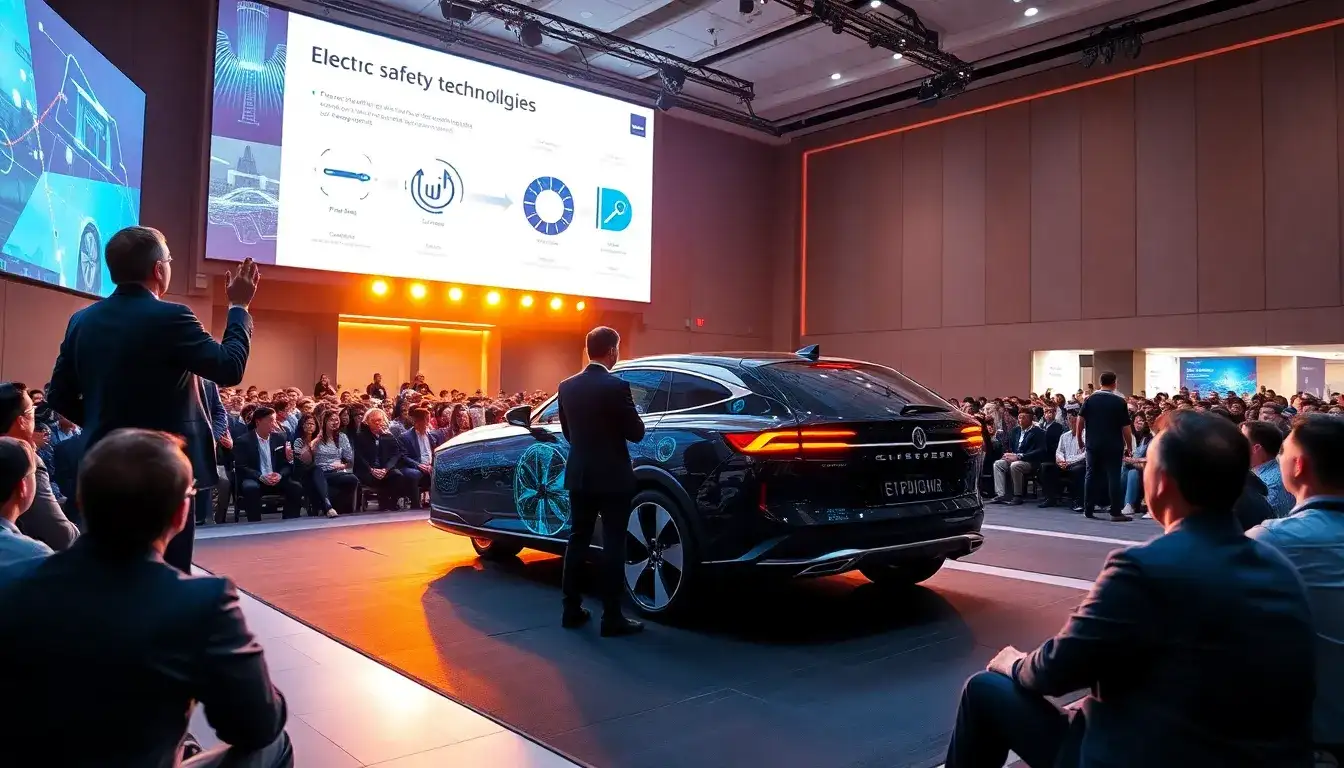
On April 22, 2025, the New Energy Vehicle Testing Center of the China Automotive Technology and Research Center hosted the “2025 New Energy Vehicle Electric Safety Technology Release and Exchange Conference” in Shanghai. The event brought together over 80 experts and representatives from the industry, enterprises, and media to discuss the latest technological trends in electric safety for new energy vehicles. The conference served as a platform to exchange verification technologies in key areas such as electromagnetic safety, charging, and thermal management, injecting new momentum into the development of electric safety technology for new energy vehicles.
<b>Mr. Zhou Hua, a member of the Party Committee and Deputy General Manager of the China Automotive Technology and Research Center, emphasized the center's mission</b> of leading the automotive industry’s progress and supporting the construction of a strong automotive nation. He highlighted the center's commitment to an independent, impartial, and third-party industry position, actively leveraging its technical, data, and industry platform advantages to support the national strategy for new energy vehicle development and carbon neutrality goals. This support is critical for the technological advancement and high-quality development of China’s automotive industry.

<b>The conference also featured the first release of electric safety technology reports in the industry.</b> The New Energy Vehicle Testing Center announced the evaluation results for the first batch of electric safety assessments for new energy vehicles in 2025, alongside the publication of the “Annual Report on Electric Safety Technology for New Energy Vehicles (2025).” A total of nine models, including the Xingjian 7, iCAR V23, Xingjiyuan ET extended version, Xingjiyuan ES extended version, with Zhizhong 06, Wenjie M8 extended version, Han L, Leapmotor B10, and Lynk & Co 900, received the inaugural “NESTA Six-Dimensional Electric Safety Certificate” for 2025.

<b>NESTA involves stringent and comprehensive verification of vehicles</b> based on typical consumer application scenarios, covering six dimensions: charging safety, electromagnetic safety, functional safety, high-voltage safety, battery safety, and fire safety. Additionally, models such as Zeekr 001, BYD Han L, Tang L, Haobo HL, and Geely received the “CCTA Charging New National Standard Function Verification Certificate.” Eight charging products from companies like Huawei, Li Auto, Keda, AVIC, Phoenix, Yonggui, and Zhidian Weilian were awarded high-quality charging certificates, while the Leapmotor B10 secured a high-quality thermal management certificate.

<b>The report systematically analyzes the current development status and technological trends of new energy vehicles in China.</b> It introduces the NESTA electric safety technology verification system, which encompasses the six dimensions mentioned earlier, thereby providing technical support for enterprises' research and development. Moving forward, the NESTA technology verification system will continue to align with cutting-edge industry technologies, expand testing projects and user scenarios, and promote the enhancement of testing standards and regulations.

<b>To enhance the electric safety technology verification system, the New Energy Vehicle Testing Center has released several verification brands</b> focusing on specific areas such as electromagnetic safety, charging quality, and thermal management quality, including “Automotive Electromagnetic Protection Technology Verification (EMTA),” “New Energy Vehicle Charging and Discharging Technology Verification (CCTA),” “High-Quality Charging and Discharging Technology Verification (Premium Charge),” and “High-Quality Thermal Management System Technology Verification (PITMS).”

In terms of electromagnetic safety, the complexity of the electromagnetic environment on China's roads far exceeds current standards in Europe and the United States, with over 100 complex electromagnetic scenarios and composite field strengths reaching 140V/m—significantly above the industry standard of 30V/m. <b>The EMTA focuses on “intelligence, safety, and health,”</b> establishing a verification system covering three dimensions: electromagnetic safety for assisted driving, electromagnetic smooth operation of the entire vehicle, and electromagnetic health for humans. Through precise scenario-based verification, it ensures the electromagnetic safety of vehicles in complex environments.

Regarding charging, the rapid iteration of charging technologies and the variety of charging stations necessitate collaborative efforts between vehicle manufacturers and charging companies to enhance charging efficiency and safety. The New Energy Vehicle Testing Center has introduced two verification brands, CCTA and Premium Charge, targeting both vehicle manufacturers and charging companies. These brands cover evaluations from basic safety and compatibility to extreme charging levels, providing technical solutions for products in various target markets.

Effective thermal management capabilities are vital for vehicle performance and user experience. Addressing both pure electric and hybrid (including extended-range) power systems, the New Energy Vehicle Testing Center has proposed a high-quality thermal management evaluation scheme encompassing four dimensions: thermal safety, comfort, functional safety, and energy consumption. This evaluation examines the maximum load capacity and safety redundancy of the thermal management system under extreme conditions, as well as the internal climate comfort and NVH comfort to meet passenger needs, providing a comprehensive assessment of system energy consumption performance.

<b>To support the globalization of new energy vehicles, the New Energy Vehicle Testing Center has established a partnership</b> with TÜV Rheinland Greater China. This collaboration focuses on charging technology, electric drive control, and energy systems, creating a regular communication mechanism to co-develop technical standards and initiate a cross-border mutual recognition plan for electric safety technology verification, allowing for “one test, dual certification.” This effort aims to enhance the efficiency of Chinese automotive companies in international markets while ensuring safety for global users.

Moreover, the New Energy Vehicle Testing Center has entered into strategic cooperation agreements with China Life Property Insurance Company and Chery’s Xingtu Automotive, signing on-site contracts to jointly introduce innovative insurance products for new energy vehicles, such as “Combination Assisted Driving Insurance” and “Electric Safety Special Insurance.” These products are designed to provide high-value, precise insurance solutions for new energy users, addressing insurance challenges within the industry.

<b>Mr. Gao Jidong, General Manager of the New Energy Vehicle Testing Center, stated</b> that the NESTA and Premium series of verification brands are propelling the industry from “compliance testing” toward “quality evaluation.” While maintaining strict safety standards, the center is steadily achieving high-quality development. Looking ahead, the New Energy Vehicle Testing Center will continue to keep pace with industry-leading technologies, iterating verification evaluation methods, and enhancing industry collaboration mechanisms to help automotive companies improve product safety and quality, ensuring user safety on the road.
Original article by NenPower, If reposted, please credit the source: https://nenpower.com/blog/successful-launch-of-2025-electric-safety-technology-for-new-energy-vehicles-at-shanghai-conference/

