

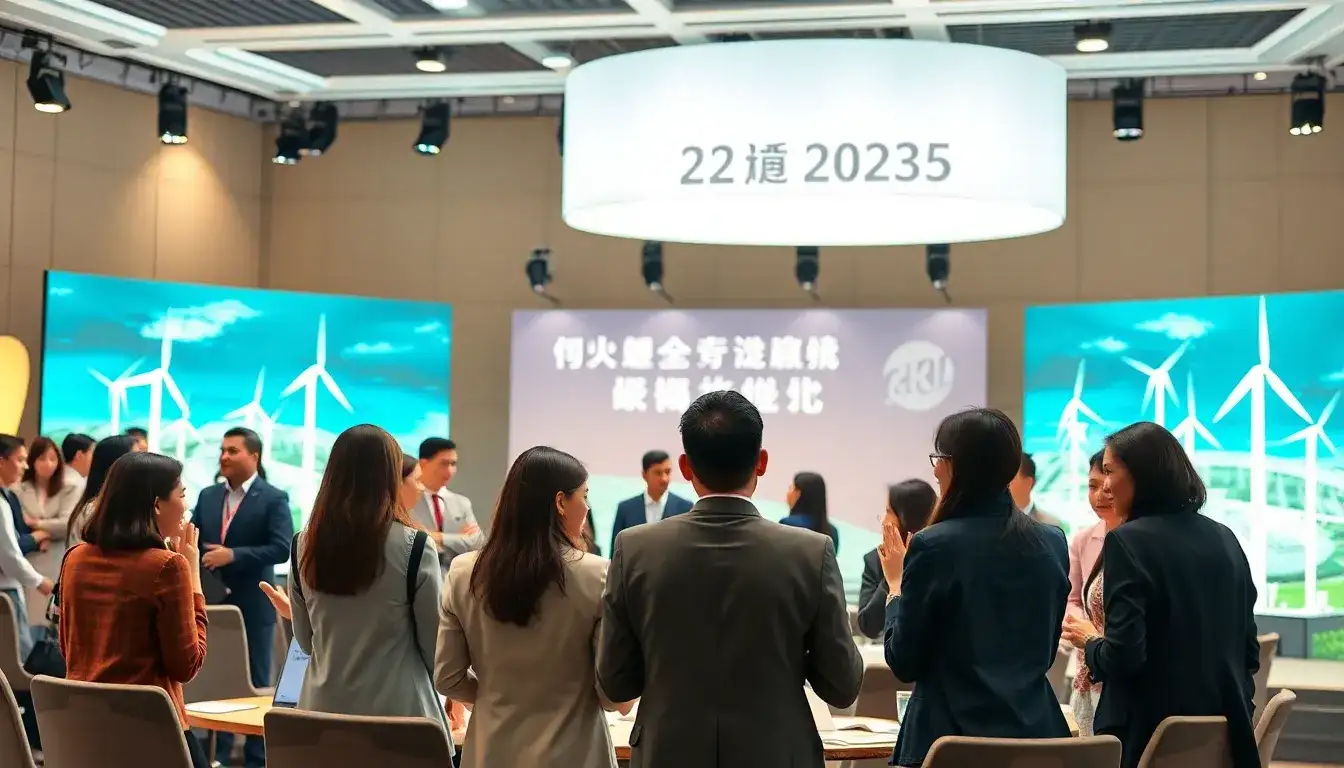
On September 27, the “2025 New Energy Industry Innovation Cooperation and the 15th Forum on the Top 500 New Energy Enterprises” was successfully held in Taiyuan, Shanxi Province. This event was organized by the Shanxi Provincial Energy Bureau and the State Power Investment Corporation, with support from the China Energy News and the China Energy Research Society.
Key figures attending the forum included Liu Zhenmin, China’s Special Envoy for Climate Change, Shi Yubao, Chairman of the China Energy Research Society, Wang Shaomin, Deputy General Manager of the State Power Investment Corporation, Sun Jinhua, an academician of the European Academy of Sciences and a professor at the University of Science and Technology of China, as well as leaders from the Shanxi Provincial Energy Bureau and representatives from domestic and international government departments, institutions, experts, industry enterprises, and think tanks.
The forum, an essential part of the “2025 Taiyuan Energy Low-Carbon Development Forum,” focused on the theme “Resilient Growth Across Cycles.” It aimed to explore how the new energy sector can navigate through cyclical fluctuations, intensified competition, and other challenges in an era of significant change, thereby fostering sustainable and high-quality industry development.
During the event, several key reports were released, including the “2025 Global Top 500 New Energy Enterprises Competitiveness Report,” the “2025 Carbon Neutrality Green Impact Brands,” and “2025 Dual Carbon Technology Innovation Cases.” These reports clarified the competitive landscape of global new energy companies and served the development of the global new energy industry.
Liu Zhenmin highlighted that after years of rapid development, China has achieved significant technological breakthroughs in areas such as electric vehicles, wind and solar power, hydropower, and smart grids. Key technologies like battery technology, solar conversion efficiency, and wind turbine capacity have reached world-leading levels.
Shi Yubao noted that China’s new energy industry ranks among the world’s best in terms of installed capacity, technological capability, and manufacturing capacity. It has established the largest and fastest-growing renewable energy system globally, creating the most comprehensive and competitive new energy industrial chain.
In the quest for sustainable development, China’s new energy industry is transitioning from a supplementary power source to a primary one, which is supported by substantial data. “Since the 14th Five-Year Plan, the annual new installations of wind and solar power have surged from the ‘tens of millions of kilowatts’ during the 13th Five-Year Plan to the ‘hundreds of millions of kilowatts,'” Shi Yubao explained. By the end of July this year, the total installed capacity of renewable energy reached 2.171 billion kilowatts, accounting for nearly 60% of the country’s total installed capacity. Among these, wind and solar power installations reached 1.68 billion kilowatts, surpassing thermal power installations for the first time in history.
According to the “500 Strong Report,” Chinese companies have moved from following to leading in the new energy sector. In 2025, seven out of the top ten global new energy enterprises will be Chinese, with the top four positions occupied by Chinese firms. These companies excel not only in the domestic market but also in global supply chain management and local market services, making Chinese manufacturing, technology, and solutions beneficial worldwide.
Wei Qiuli, Executive Vice President of the China Energy Economy Research Institute, interpreted the “500 Strong Report,” noting that while the overall growth rate of the new energy industry has slowed, it continues to expand due to increased installed capacity and ongoing development of downstream application markets. Various industry organizations predict that by 2060, the required installed capacity for wind and solar power in China will exceed 5 billion kilowatts, indicating substantial growth potential for the new energy sector.
Experts at the conference emphasized the inherent resilience of the new energy industry. Despite facing short-term fluctuations, the long-term positive fundamentals remain strong, driven by national strategic guidance and the proactive innovation of business entities.
Yin Xulong, Chairman of Yingli Energy Development Co., pointed out that as the installed capacity of clean energy such as wind and solar continues to grow, energy absorption has become a primary constraint on the development of new energy. He noted that national policies, beginning with Document No. 136 and extending to zero-carbon parks and green electricity connections, have provided new directions for new energy, shifting the focus from policy-scale driven growth to terminal application-driven growth.
Currently, after over a decade of explosive growth, the new energy industry is entering a new stage of development characterized by an emphasis on quality and efficiency rather than mere scale expansion. This shift means that the competitive landscape is evolving from competition between new and traditional energy sources to competition within the new energy sector itself, leading to new demand changes and inevitable growing pains.
Yang Jun, Deputy Chief Economist at the Electric Power Planning and Design Institute, stated that the construction of zero-carbon parks must meet multiple requirements, including park qualifications, new energy resources, and grid access. However, not all parks are equipped to meet the conditions for building low-carbon facilities. He pointed out, “This reflects a shift in new energy development from ‘sprawling expansion’ to ‘fine cultivation,’ necessitating higher standards for systematic planning and meticulous management.”
Safety issues also cannot be overlooked. Sun Jinhua noted that frequent fire incidents involving 3C electronic products and electric vehicles not only result in losses of life and property but may also undermine public trust in new energy technologies, hindering industry growth.
Li Shaotang, Product Planning Director of LONGi Green Energy, pointed out that “involutionary” competition leads to larger companies experiencing more “blood loss” in market scale. This “production without profit” cycle highlights that the industry has transitioned from a blue ocean market to a red ocean of competition, where prices below marginal costs can plunge companies into significant difficulties. Pan Qingzhi, Head of the Domestic Market Department at Xiamen Haicheng Energy Technology Co., expressed that such challenges not only harm corporate interests but, in the long term, can weaken the industry’s innovative drive, creating a vicious cycle.
Moreover, the evolving international trade environment is placing pressure on the export of Chinese new energy products. These challenges test companies’ market adaptability and demand new requirements for the global layout of China’s new energy industry. Importantly, these challenges are interconnected, with “price wars” leading to profit declines that impact research and development investments, while technical homogeneity exacerbates price competition.
Shi Yubao emphasized that the challenges of cyclical fluctuations, intensified competition, and diminishing profits in the new energy sector are increasingly pronounced, testing the wisdom and resilience of all stakeholders involved.
In light of these complex challenges, participants at the forum offered valuable insights, gradually outlining a roadmap for the future development of the new energy sector. Technological innovation is viewed as the primary driver for overcoming cycles and escaping the pitfalls of homogeneous competition. Liu Zhenmin suggested, “We must persist in promoting low-carbon transformation in energy through technological innovation and cultivate energy technologies and related industries into new growth points that drive industrial upgrading in China.”
Shi Yubao identified industrial collaboration as key to enhancing resilience, advocating for the establishment of an open, cooperative, and mutually beneficial industrial ecosystem that fosters new competitive relationships where collaboration leads to competition and vice versa.
Cui Jian, President of Xiamen Kehua Data Technology Co., noted that in response to industry cyclical fluctuations, companies should adopt a dual strategy of innovation and collaboration to share risks and results. Jin Xiufang, Director of the Energy Transition Project at the Natural Resources Defense Council, indicated that in the future, new energy will evolve across multiple dimensions and scenarios, with the crux of problem-solving lying in streamlining mechanisms on both the supply and demand sides of electricity.
She added, “In the short term, we need to improve the ‘market pricing + policy adjustment’ transitional mechanism and effectively utilize mechanism electricity prices to ensure that new energy companies have reasonable returns while participating in the market. In the long term, we need to create more application scenarios for green electricity, allowing the green attributes of new and renewable energy to be reflected in market pricing.” Jin Xiufang further stated that as mechanisms on the generation and consumption sides are clarified and industry development levels continue to progress, the profit and revenue levels for industry enterprises will also normalize.
Shi Yubao recommended enhancing the deep integration of “production, study, research, application, and finance” to connect the innovation chain with the industrial chain. He encouraged active exploration of the development model that integrates new energy with emerging technologies like the Internet of Things, artificial intelligence, and big data to foster an innovative ecological system that creates new application scenarios and business models.
Moreover, he emphasized the importance of deepening international exchanges and cooperation, enhancing interoperability in standards, technical assistance, and market coordination, and jointly exploring new opportunities and increasing value increments within the context of global competition to build a global green energy development community.
Despite the challenges ahead, the vast potential of new energy has become a consensus within the industry. On September 24, China announced a new round of national contributions, explicitly stating that by 2035, non-fossil energy consumption will account for more than 30% of total energy consumption, and the total installed capacity of wind and solar power will exceed six times that of 2020, striving to reach 3.6 billion kilowatts. This ambitious blueprint indicates that the new energy industry still has tremendous growth potential, focusing not only on scale expansion but also on high-quality development.
Participants unanimously agreed that transcending cycles does not mean avoiding fluctuations; rather, it involves enhancing resilience amid those fluctuations—shifting the focus from scaling to quality, from solitary efforts to ecological cooperation, and from price competition to value co-creation. The Chinese new energy industry is in the process of reshaping its growth logic, a journey filled with challenges yet brimming with infinite vitality.
Original article by NenPower, If reposted, please credit the source: https://nenpower.com/blog/successful-forum-on-innovation-and-collaboration-in-the-2025-new-energy-industry-held-in-shanxi/

