

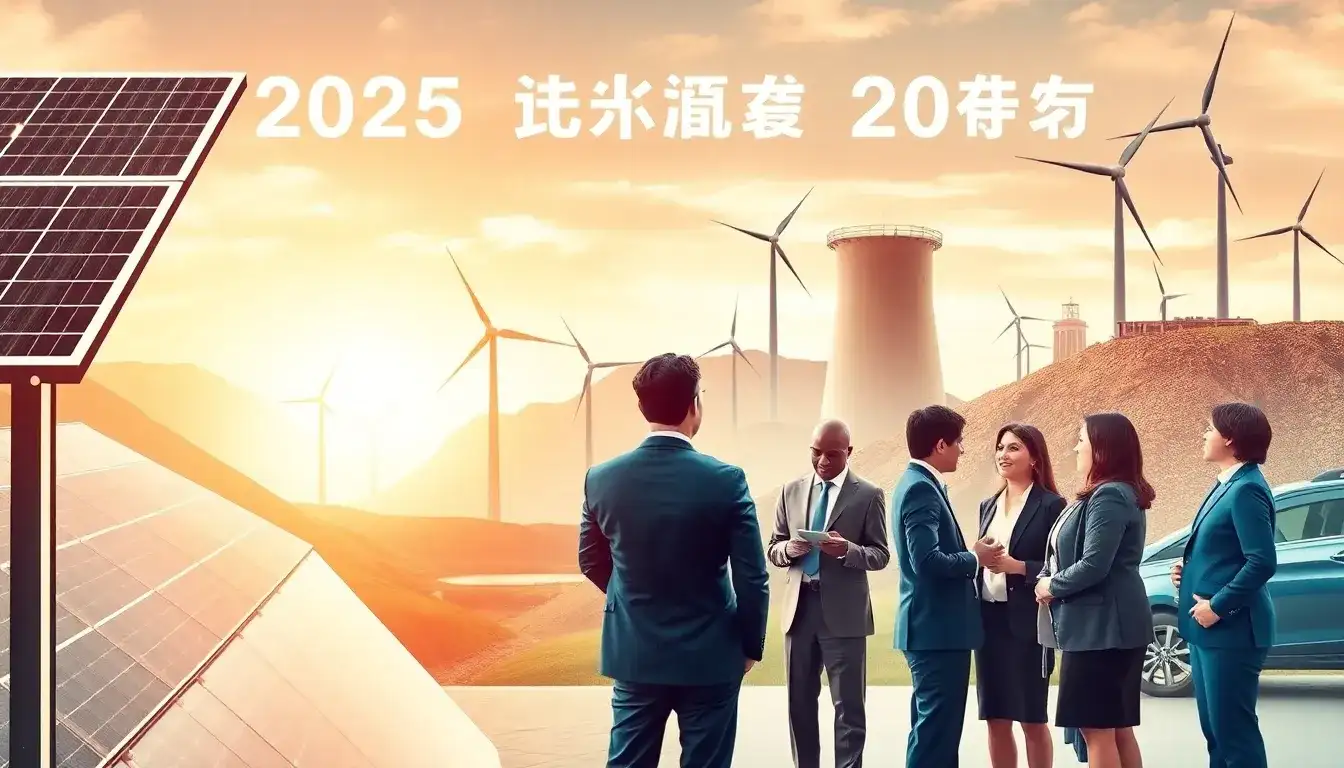
The “2025 New Energy Industry Innovation Cooperation and the 15th Forum of the Top 500 New Energy Enterprises” was successfully held on September 27, 2025, in Taiyuan, Shanxi Province. This event was organized by the Shanxi Provincial Energy Bureau and the State Power Investment Corporation, with support from the China Energy News and the China Energy Research Society. Notable attendees included Liu Zhenmin, China’s Special Envoy on Climate Change, Shi Yubo, President of the China Energy Research Society, Wang Shaomin, Deputy General Manager of the State Power Investment Corporation, Sun Jinhua, an academician from the EU Academy of Sciences and a professor at the University of Science and Technology of China, as well as leaders from Shanxi Province’s Energy Bureau and representatives from governmental departments, academicians, experts, and industry representatives.
This forum, part of the “2025 Taiyuan Low Carbon Development Forum,” centered around the theme of “Resilient Growth Through Cycles.” Discussions focused on how the new energy sector can navigate the challenges of cyclical fluctuations, homogeneous competition, and increasing internal competition in today’s rapidly changing environment, fostering sustainable and high-quality development within the industry.
During the forum, several significant reports were released, including the “2025 Global Top 500 New Energy Enterprises Competitiveness Report” (referred to as the “Top 500 Report”), the “2025 Carbon Neutrality Green Impact Brand,” and the “2025 Dual Carbon Technology Innovation Cases.” These publications aim to clarify the competitive landscape of global new energy enterprises and support the development of the global new energy industry.
Liu Zhenmin emphasized that after years of rapid growth, China has achieved major technological breakthroughs in fields such as electric vehicles, wind and solar energy, hydropower, and smart grids. Key technologies, including battery technology, photovoltaic conversion efficiency, and wind turbine capacity, have reached world-leading levels. Shi Yubo pointed out that China’s new energy industry ranks among the top globally in terms of installed capacity, technological level, and manufacturing capability, having established the largest and fastest-growing renewable energy system in the world. He noted that, “In the global pursuit of sustainable development, our new energy industry is transitioning from a supplementary power source to a primary power source at an unprecedented pace.” This assertion is supported by substantial data.
Since the start of the 14th Five-Year Plan, the annual new installations of “wind and solar” energy have surged from a “tens of millions of kilowatts” scale to a “hundreds of millions of kilowatts” scale. As of the end of July this year, the total installed renewable energy capacity reached 2.171 billion kilowatts, accounting for nearly 60% of the country’s total installed capacity. Among this, “wind and solar” installations totaled 1.68 billion kilowatts, representing 46% of the national total, surpassing thermal power installations for the first time in history.
In terms of industry development, Chinese new energy enterprises have made a significant leap from being followers to leaders. According to the “Top 500 Report,” seven out of the top ten global new energy enterprises in 2025 are Chinese, with the top four positions all occupied by Chinese companies. These enterprises not only excel in the domestic market but are also expanding their supply chains and services globally, benefiting from Chinese manufacturing, technology, and solutions.
Wei Qiuli, Executive Vice President of the China Energy Economic Research Institute, explained that while the overall growth rate of the new energy industry is slowing, the sector continues to expand, thanks to increased installed capacity and ongoing market development. Several industry organizations predict that by 2060, China will require more than 5 billion kilowatts of “wind and solar” installations, indicating tremendous growth potential for the new energy sector.
Experts at the forum expressed that the new energy industry possesses inherent resilience, ensuring that despite short-term fluctuations, the long-term fundamentals remain solid. This resilience is attributed to both strategic leadership at the national level and proactive innovation from enterprises.
Yin Xulong, Chairman of Yingli Energy Development Co., Ltd., noted that as the installed capacity of clean energy like “wind and solar” continues to rise, consumption capacity has become the primary constraint on the development of new energy. He explained that government policies have shifted from a focus on scale-driven development to one driven by end-use applications, guiding the high-quality development of the industry.
As the new energy sector transitions into a new development phase after over a decade of explosive growth, the focus is shifting from mere expansion to comprehensive improvements in quality and efficiency. This transition implies that competition is evolving from that between new energy and traditional energy to competition among new energy entities, leading to new demand changes and inevitable growing pains.
For new energy companies, addressing industry pain points while implementing policies and exploring new practices is crucial. For instance, building zero-carbon parks must meet multiple requirements, including park qualifications, renewable energy resources, and grid access, which not all parks can fulfill.
Yang Jun, Deputy Chief Economist at the Electric Power Planning and Design Institute, remarked that this indicates a shift in new energy development from “spreading out” to “focusing on quality,” necessitating higher demands for systematic planning and meticulous management. Safety issues also cannot be overlooked. Sun Jinhua pointed out that frequent fire incidents in 3C electronic products and electric vehicles not only result in loss of life and property but may also undermine public trust in new energy technologies, hindering industry growth.
Li Shaotang, head of product planning for LONGi Green Energy’s China division, highlighted that “involutionary” competition leads to increased losses for companies as their market scale grows. This “producing more without increasing revenue” phenomenon underscores the industry’s transition from a blue ocean market to cutthroat red ocean competition. “Prices below marginal costs can plunge companies into significant difficulties,” stated Pan Qingzhi, head of the domestic market for Xiamen Haichen Energy Technology Co., Ltd. “This predicament not only harms corporate interests but, in the long run, will weaken the industry’s innovation capabilities, creating a vicious cycle.”
Moreover, the shifting international trade environment is placing additional pressure on China’s new energy product exports. These challenges test companies’ market adaptability and impose new requirements on the global positioning of China’s new energy industry. It is noteworthy that these challenges are interrelated and impact each other. Price wars lead to profit declines, which affect R&D investment; technological homogeneity intensifies price competition; rising international trade barriers complicate export efforts, exacerbating domestic market competition. This complex challenge landscape necessitates a systematic response from the new energy industry rather than piecemeal solutions.
“The growth of any industry is fraught with difficulties,” stated Shi Yubo. “The challenges of cyclical fluctuations, homogeneous competition, intensified internal competition, and incremental gains without profit are increasingly prominent, testing the wisdom and resilience of all participants.” In facing these intricate challenges, participants at the forum offered suggestions, gradually outlining a roadmap for the future development of the new energy industry.
Technological innovation is regarded as the primary driving force to traverse cycles and escape the pitfalls of homogeneous competition. Liu Zhenmin advocated for a commitment to using technological innovation to promote low-carbon energy transformation, cultivating energy technologies and associated industries into new growth points that drive China’s industrial upgrade.
Industry collaboration is key to enhancing resilience. Shi Yubo pointed out that relying solely on individual enterprises or segments is insufficient to tackle systemic challenges. He suggested building an open, cooperative, and mutually beneficial industrial ecosystem that fosters a new competitive relationship based on cooperation and shared success. Collaborative thinking is gaining traction, as industry development has already surpassed the capabilities of single enterprises, necessitating synergy between upstream and downstream players in the supply chain.
Jin Xiufang, Director of the Energy Transition Project at the Natural Resources Defense Council, indicated that in the future, new energy will develop across multiple dimensions and scenarios. She emphasized the importance of aligning the mechanisms of electricity supply and demand. “In the short term, we need to improve the transitional mechanism of ‘market pricing + policy adjustment’ and effectively utilize mechanism pricing to ensure that new energy enterprises achieve reasonable returns while participating in the market.” In the long term, she added, “We should create more green electricity application scenarios to reflect the green attributes of new energy and renewable energy in market pricing. These explorations can accelerate the formation of new demands, business models, and market dynamics around green electricity.”
Shi Yubo recommended strengthening the deep integration of “industry, academia, research, application, and finance” to bridge the innovation and industrial chains. He called for active exploration of models that integrate new energy with emerging technologies such as the Internet of Things, artificial intelligence, and big data, fostering an innovative ecosystem that creates new application scenarios and business models. Additionally, he underscored the importance of deepening international exchanges and cooperation, enhancing connectivity in standards, technology assistance, and market collaboration to seize new opportunities and jointly expand value increments in global competition, ultimately building a global green energy development community.
Despite the challenges ahead, the vast potential of new energy has become a consensus within the industry. On September 24, the country announced a new round of national contributions, clearly stating that by 2035, non-fossil energy consumption will account for over 30% of total energy consumption, and the total installed capacity of wind and solar power will exceed six times that of 2020, striving to reach 3.6 billion kilowatts. This ambitious blueprint suggests that the new energy industry still has significant growth potential, focusing not only on scale expansion but also on high-quality development.
Participants unanimously agreed that navigating cycles does not mean avoiding fluctuations but rather enhancing resilience through them—shifting the focus from scale to quality, from individual efforts to collaborative ecosystems, and from price involution to value co-creation. The Chinese new energy industry is reshaping its growth logic, a process filled with challenges but also brimming with infinite possibilities.
Original article by NenPower, If reposted, please credit the source: https://nenpower.com/blog/success-of-the-2025-new-energy-industry-innovation-cooperation-and-the-15th-forum-of-the-top-500-new-energy-companies/

