

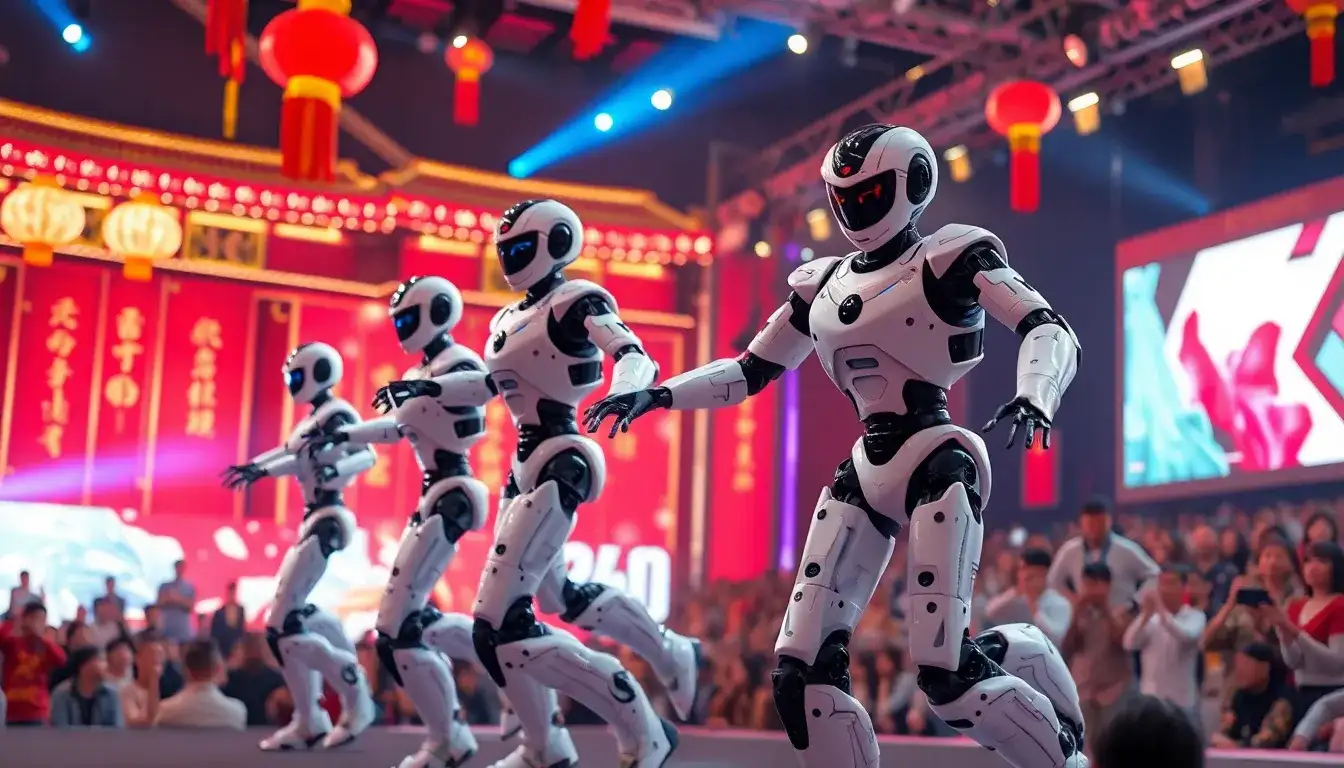
The Spring Festival Gala Robots: A Major Hit!
As the clock strikes midnight on New Year’s Eve, millions of viewers are captivated by the stage of CCTV, witnessing a technological feast that showcases the future. During the 2026 Spring Festival Gala, four humanoid robot companies—Yushu Technology, Galaxy General, Magic Atom, and Songyan Power—collaborated to set a new record for the largest display of robot brands in the history of the event. This is not a scene from a science fiction movie; it is a current reality.
From the debut of Yushu’s robotic cow, “Benben,” in 2021, to the phenomenal breakout of “YangBOT” in 2025, and now the competitive showcase of four companies this year, the Spring Festival Gala has become the premier platform for demonstrating the strength of China’s robotics industry. Behind the dazzling performances lies significant investment, the challenges of technological iteration, and the ambition of an emerging trillion-dollar market.
The robots on the Spring Festival Gala stage are undoubtedly the star attractions, marking the most impressive lineup of robotic performances in the event’s history. In addition to the opening act and a duet with celebrities, the subsequent three segments—including skits, song and dance, and action performances—featured the appearance of domestically produced humanoid robots. These robots exhibited not only precise motion control but also natural interaction capabilities.
Songyan Power introduced four humanoid robots that made their debut in the evening’s first skit titled “Grandma’s Favorite.” This segment highlighted the value of robots as “home assistants” in providing emotional companionship, also hinting at their potential applications in elderly care services. Due to the constraints of the skit format, the robots had limited movement space, necessitating a higher level of performance precision. The program included various human-mimicking actions and interactions, such as the walking posture of “Bumi” and acrobatic moves like side flips performed by N2. To achieve this, the team collaborated with children who closely resembled the robots to collect and record motion data for training reference.
Another technical challenge involved synchronizing lip movements with speech. To ensure that the robots’ lip shapes matched each line of dialogue, a sufficient number of miniature drive motors had to be placed within the limited space of the mouth. This posed a significant design challenge regarding how to layout these intricate components in such a compact area. Ultimately, Songyan Power achieved accurate motion replication by equipping the robots’ mouths with 12 degrees of freedom and utilizing a self-developed expression drive algorithm.
The small robots successfully performed high-difficulty actions, including backflips and side flips, while interacting with the actors throughout the skit. A lifelike humanoid robot replicating actress Cai Ming appeared at the end of the skit. Reports indicate that Songyan Power’s technical team first conducted a 3D scan of the actress’s face to create a 3D model that closely replicated her skin texture and patterns. They incorporated 32 independently driven motors into the robot’s facial structure, with 12 motors dedicated solely to the lips, ensuring precise synchronization between lip movements and sound in every frame. Additionally, the team added three degrees of freedom to the robot’s neck, allowing it to turn its head side to side and perform nuanced poses like tilting and leaning forward while delivering lines.
This year marks the third appearance of Yushu Technology on the Spring Festival Gala stage. During the main event’s segment “WuBOT,” Yushu’s G1 and H2 humanoid robots performed in a “human-robot dance” alongside dancers. The G1 showcased a series of complex routines, including staff techniques, boxing, swordplay, and drunken boxing, while the H2 demonstrated sword techniques. In the Yiwu sub-venue, Yushu’s robots participated in character performances: H2 portrayed the Monkey King, Sun Wukong, making a dramatic entrance with wires, while the B2-W robot dog represented “Auspicious Clouds,” creating a fantastical festive atmosphere.
Yushu Technology’s founder, Wang Xingxing, stated in an interview with CCTV that this year, the robots demonstrated dynamic interspersing and martial arts movements during high-speed running, marking the first global public display of such advanced dynamic and collaborative control technology. He emphasized that this technology holds significant practical value, laying the groundwork for future robot deployments in various scenarios.
Another performance was brought by Magic Atom, featuring a singing program titled “Creating the Future.” Six high-dynamic bipedal robots, MagicBot Z1, along with two full-sized humanoid robots, MagicBot Gen1, took the stage. The program incorporated cutting-edge technology elements like AI glasses, smartwatches, and drones, creating a visually stunning auditory experience.
Galaxy General robots later appeared in the New Year’s microfilm “The Night I’ll Never Forget,” performing alongside Shen Teng and Ma Li. Their wheeled dual-arm robot G1 demonstrated its practical capabilities in household tasks, such as folding clothes, delivering items, and simple cooking.
To secure a spot on the prestigious Spring Festival Gala platform, each robot company invested significantly in marketing. While Yushu Technology has now made its third appearance, the other brands were debuting on this stage for the first time. The Spring Festival Gala serves not only as a showcase for technology but also as a crucial opportunity for companies to demonstrate their technical prowess, expand brand influence, and drive commercialization.
At 10 PM on New Year’s Eve, JD.com listed multiple robots, including the “Spring Festival Gala Edition,” for sale. Within minutes of the event’s launch, robots from brands like Magic Atom, Yushu Technology, and Songyan Power were sold out. For startups, the exposure provided by the gala helps break down barriers with potential customers and establishes a foundation of trust for their brands.
The Cost of Accessing the Gala Stage
The Spring Festival Gala has never lacked traffic, but the price for this exposure is steep. According to Caixin, a quote sheet from a robot company for the CCTV Spring Festival Gala indicates that the cost for advertising placement varies based on whether it is in the main venue or a sub-venue and includes interactive elements, ranging from 16.99 million to 44.4 million yuan. Participation in a co-created stage program can cost as much as 59.99 million yuan. Industry insiders report that the “registration fee” for a single robot performance has now exceeded 100 million yuan.
Despite these high costs, why are robot companies eager to participate? One investor explained, “After Yushu Technology’s robots sold out following their last appearance at the Spring Festival Gala, this is the fundamental reason everyone is rushing to get involved.” The competition to appear at the gala is not only a brand positioning battle but also a test of the companies’ capabilities. The appeal of the Spring Festival stage provides immense brand exposure, but it also poses extreme challenges for the stability and collaboration of the robots. Under the gaze of billions of live viewers, any slight error could be magnified, making this both a showcase and a pressure test for robot companies.
In fact, several exposure opportunities for robots had already occurred prior to the Spring Festival Gala. In November 2025, the Beijing Yizhuang Half Marathon, featuring humanoid robots as competitors, was successfully held. This was the world’s first marathon event centered on humanoid robots. The “Tiangong Ultra” team from Tiangong won with a time of 2 hours, 40 minutes, and 42 seconds, while Songyan Power’s “Little Rascal” team took second place. This event not only demonstrated the stability of robots in long-distance running but also allowed the public to directly experience the technological advancements of humanoid robots.
As one investor noted, “If robots can run a marathon, then the tasks people hope robots can perform won’t be far behind.” A similar logic was further validated at the World Humanoid Robot Games in August 2025, held at the National Speed Skating Hall, “Ice Ribbon.” This event attracted 280 teams and over 500 humanoid robots from 16 countries, competing in 26 events including athletics, soccer, gymnastics, dance, and martial arts. Yushu Technology secured victories in both the 1500-meter and 400-meter finals. While these competitions may seem like mere displays of skill, they serve as rigorous tests of robots’ motion control, balance algorithms, and decision-making capabilities.
In February 2026, the world’s first commercial humanoid robot fighting league, URKL, was officially launched by Zhongqing Robotics. The champion team will receive a pure gold belt worth 10 million yuan. Zhao Tongyang, CEO of Zhongqing Robotics, admitted, “At this stage, it is unrealistic to bring humanoid robots into households. Hosting fighting competitions to validate the capabilities of humanoid robots is a foundational requirement for future applications in dirty and labor-intensive tasks.” The fighting scenarios demand high requirements from robots, including instantaneous explosive power, high-torque motor responses, impact-resistant structures, and the ability to quickly recover after falling—capabilities that are essential for industrial applications.
Marathons, sports events, and fighting competitions may seem “meaningless” to outsiders, but they serve as the “litmus test” for the robotics industry. They visually showcase the maturity of robotic technology, build market confidence, and promote industry development. The Spring Festival Gala is the pinnacle of this logic—an opportunity to complete a national-level “roadshow” in front of hundreds of millions of viewers.
Moreover, the exposure effect from the gala is translating into tangible orders and capital momentum. Yushu Technology’s humanoid robot shipments exceeded 5,500 units in 2025, with mass production surpassing 6,500 units, leading to a valuation surge to 13 billion yuan and the initiation of guidance for a listing on the Science and Technology Innovation Board. Galaxy General completed over $300 million in financing by the end of 2025, with a valuation exceeding 20 billion yuan. Within two hours of the Spring Festival Gala broadcast, JD.com reported a more than 300% increase in robot search volume, a 460% rise in customer inquiries, and a 150% growth in order volume.
At 10 PM on New Year’s Eve, JD.com listed multiple robots, including the “Spring Festival Gala Edition,” for sale. Within minutes of the event’s launch, robots from brands like Magic Atom, Yushu Technology, and Songyan Power were sold out. A leader of a Shenzhen robotics company remarked, “The factory is my Spring Festival Gala stage.” This statement encapsulates the industry’s divergence—while companies primarily targeting B-end industrial applications may find the gala’s cost-benefit ratio low, those eager to tap into the C-end market and establish brand recognition view the gala as an unparalleled strategic opportunity.
2026 marks a pivotal year for robots entering more real-world operational scenarios. The theme for this year is “commercialization,” with mass production and assembly line establishment as foundational steps. Building commercial channels and achieving real “deliverables” are core to a company’s healthy development.
The Long March Toward General Intelligence
Looking back from the starting point of 2026, the humanoid robot industry is undergoing a critical shift from “technology validation” to “scale production.” IDC predicts that by 2026, the application scenarios for humanoid robots in China will increase to more than three times their current levels, with the market size approaching $1.3 billion and more than doubling year-on-year. According to data from the High-Tech Robotics Industry Research Institute, domestic humanoid robot shipments are expected to rise to 62,500 units in 2026, with leading manufacturers achieving deliveries in the thousands.
These numbers reflect the maturity of the supply chain and the rapid decrease in costs. For example, the price of a core component, the harmonic reducer, from Japan’s Harmonic Drive is around 2,000-3,000 yuan, while domestic alternatives have dropped to 500-800 yuan. If a humanoid robot uses 40 joints, this alone can save 50,000-60,000 yuan in hardware costs. Major automotive component manufacturers like Sanhua Intelligent Control and Top Group have entered the field of robotic actuators, transferring their large-scale manufacturing capabilities and cost control from the automotive industry to the robotics sector.
However, the technical challenges remain severe. The “brain” of humanoid robots—the embodied intelligent model—is still in its early stages. Galaxy General showcased a “dual-drive model” combining “embodied large models + highly reliable bodies” at the Spring Festival Gala, representing the industry’s cutting-edge direction. Unlike traditional robots that rely on pre-set programs, embodied large models emphasize the integration of “perception-decision-execution,” enabling robots to learn and make dynamic decisions in unstructured environments.
Expanding application scenarios is another key factor. In 2025, UBTECH’s 1,000th Walker S2 industrial humanoid robot officially rolled off the production line, with annual deliveries exceeding 500 units and order amounts approaching 1.4 billion yuan, primarily applied in logistics, sorting, and inspection tasks in the automotive manufacturing and 3C electronics sectors. Zhiyuan Robotics’ G2 has been deployed in Longqi Technology’s production line, while companies like Baosteel and Geely have introduced robots for welding and component inspection. Galaxy General has partnered with Baida Precision Engineering to deploy over 1,000 embodied intelligent robots. These examples indicate that industrial scenarios are becoming the first stop for the commercialization of humanoid robots.
In contrast, household scenarios remain a more distant goal. According to data from CCID Consulting, the global household robot market is expected to reach 257.7 billion yuan by 2024, projected to exceed 428.3 billion yuan by 2029. However, pricing remains the most significant barrier. Yushu Technology’s G1 is now priced at 99,000 yuan, while Songyan Power has launched a humanoid robot “Bumi” at a price point of 10,000 yuan. Leju’s “Kua Fu” has dropped from 600,000 yuan to 300,000 yuan. Leju’s Vice President, Ke Zhendong, predicts that within the next 3 to 5 years, robot prices may fall below 100,000 yuan, and in 10 to 15 years, they could become as ubiquitous as electric vehicles.
According to Morgan Stanley’s report “Outlook of Humanoid Robots in 2026,” it predicts that 2026 will be a key turning point for the Chinese market, akin to the shift in the electric vehicle market in 2019-2020. The report argues that the maturity of China’s supply chain and cost control capabilities will enable the humanoid robot industry to replicate the successful trajectory of electric vehicles. However, this path is not without obstacles. Technical bottlenecks, lack of standards, ethical controversies, and employment impacts are challenges the industry must confront.
The World Humanoid Robot Sports Federation was established at the closing ceremony of the 2025 Games to promote the development of industry standards and international collaboration. The China Electronics Society’s “2026 White Paper on the Development of China’s Humanoid Robot Industry” indicates that the industry is shifting from concept hype fueled by capital to a focus on application implementation and deliverable products.
Ultimately, the robot performances at the Spring Festival Gala are meticulously choreographed “shows.” The true test lies in whether these steel dancers can step into factories, hospitals, and homes to fulfill their missions in the real world once the lights dim and the audience disperses. This narrative encompasses technology, capital, policy, and society, and 2026 may be a pivotal chapter in this story.
Original article by NenPower, If reposted, please credit the source: https://nenpower.com/blog/spring-festival-gala-showcases-revolutionary-robots-in-a-spectacular-display-of-technology/

