

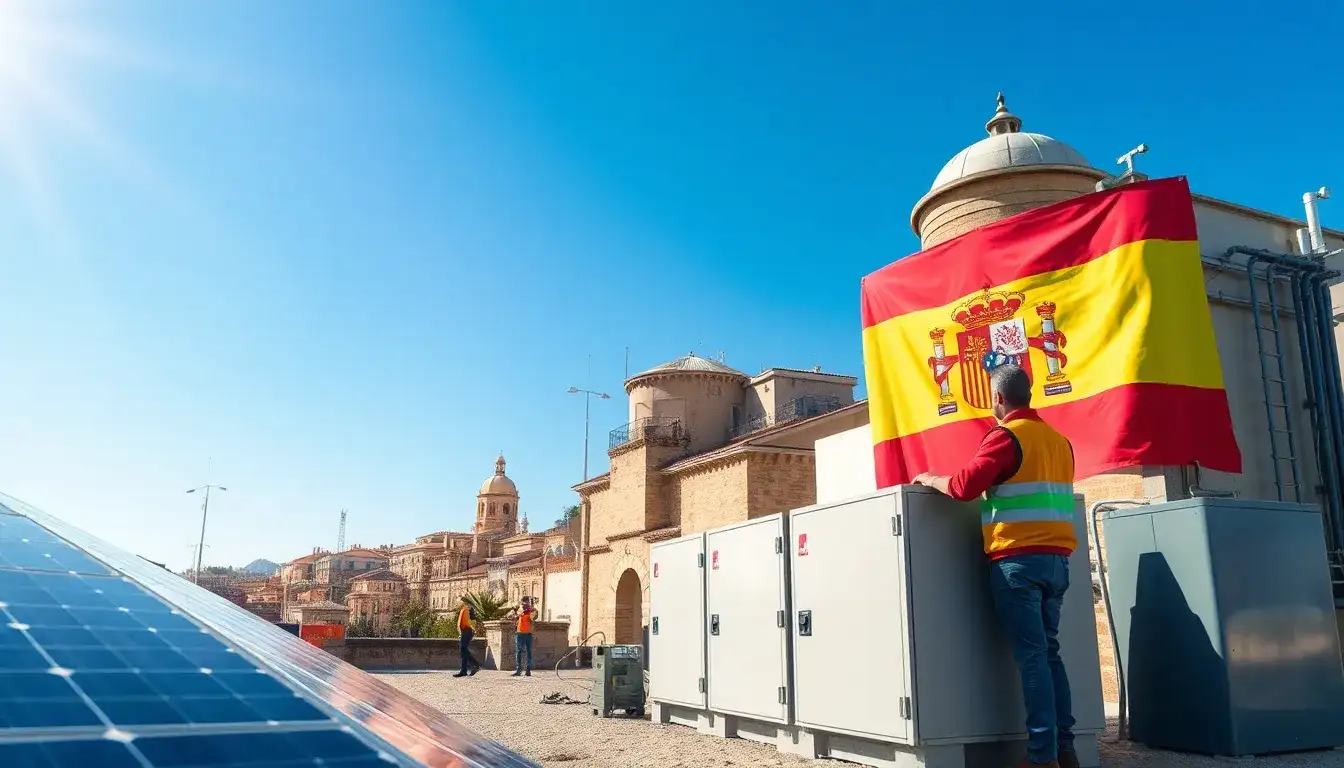
The Spanish government made a significant advancement in energy storage policy by approving Royal Decree 7/2025 on June 24, which addresses multiple longstanding challenges that have hindered the secure and lawful implementation of energy storage projects. This decision comes in response to a large-scale blackout that occurred in April of this year. The Spanish Battery Energy Storage Association (AEPIBAL) has hailed the new regulation as a pivotal moment for the development of energy storage in Spain.
To promote the growth of the energy storage industry, the decree includes several key provisions:
– Energy storage facilities associated with renewable energy power stations that have completed environmental impact assessments will be exempt from additional environmental evaluation procedures. This change is expected to significantly reduce project approval timelines, addressing long-standing demands from the industry.
– For the first time, energy storage facilities and their related grid connection infrastructure are explicitly classified as “public utility.” This classification provides them with legal support comparable to that of power generation facilities regarding land acquisition and permitting processes, representing a substantial shift in Spain’s energy storage policy.
– The decree establishes the Declaration of Public Utility (DUP) for energy storage facilities and their associated infrastructure, allowing these projects to inject and withdraw electricity between transmission and distribution networks. This declaration recognizes the public interest served by such projects, granting them rights to legally acquire land and streamline approval processes.
– For hybrid power generation projects equipped with battery storage, the approval processes will be significantly expedited if the energy storage facilities are located within the project’s planned boundaries. Notably, these projects will be exempt from environmental impact assessments.
– “Installed capacity” is clearly defined as the maximum output power of inverters, which alters the approval authority threshold for hybrid projects. Projects exceeding 50 MW will require central government approval, while those at or below 50 MW will need local government approval. Consequently, capacity calculations for different components of hybrid projects will no longer be cumulative.
– A resolution has been reached regarding a contentious issue between the Ministry of Energy and the National Markets and Competition Commission (CNMC): the new regulations eliminate the discriminatory treatment of hybrid generation projects under technical curtailment orders. All renewable energy power stations, regardless of their energy storage configuration, will now receive priority protection during grid congestion, ensuring they are among the last to be curtailed.
– Another significant development is that energy storage facilities will receive demand-side flexible access permits and will no longer be categorized as electricity consumers. Additionally, the regulation standardizes grid connection guarantee requirements, with relevant matters being managed solely by project file management agencies. Guarantee releases will now be linked only to generation warranties and will be decoupled from supply contracts.
– Lastly, the regulation explicitly outlines the functions of independent aggregators for Behind-the-Meter (BTM) energy storage for the first time. This innovative institutional framework will require further specialized discussion and refinement.
It is important to note that this Royal Decree (RDL) has a provisional validity period of 30 days and must be approved by the Congress of Deputies within this timeframe to become a permanent part of the legal framework. If parliamentary approval is not granted, all provisions of the decree will lapse, reverting to the original regulatory system.
The backdrop to this regulatory change was a widespread blackout that occurred on April 28, which resulted in a 60% drop in grid power supply within five seconds, equivalent to 15 GW. The interconnected grid with Portugal also experienced extensive outages, leading to transportation paralysis, communication failures, and widespread disruption to public life, although electricity supply was largely restored the following day. This incident is regarded as one of the most severe power failures in Europe in recent years.
A government report released on June 17 attributed the blackout to an instantaneous voltage surge and noted that Spain’s power system suffered from “insufficient voltage control capability,” which resulted from inadequate planning and ineffective responses. The surge was not absorbed in time due to misjudgments, leading to a series of uncontrollable chain reactions. While theoretically, Spain’s grid was robust enough to handle such events, there was a lack of coordination, transparency, and clear division of responsibilities within the system. The government has indicated that enhanced regulation of power operators and grid improvements will be necessary moving forward.
Original article by NenPower, If reposted, please credit the source: https://nenpower.com/blog/spain-recognizes-energy-storage-as-public-utility-in-landmark-policy-shift/

