

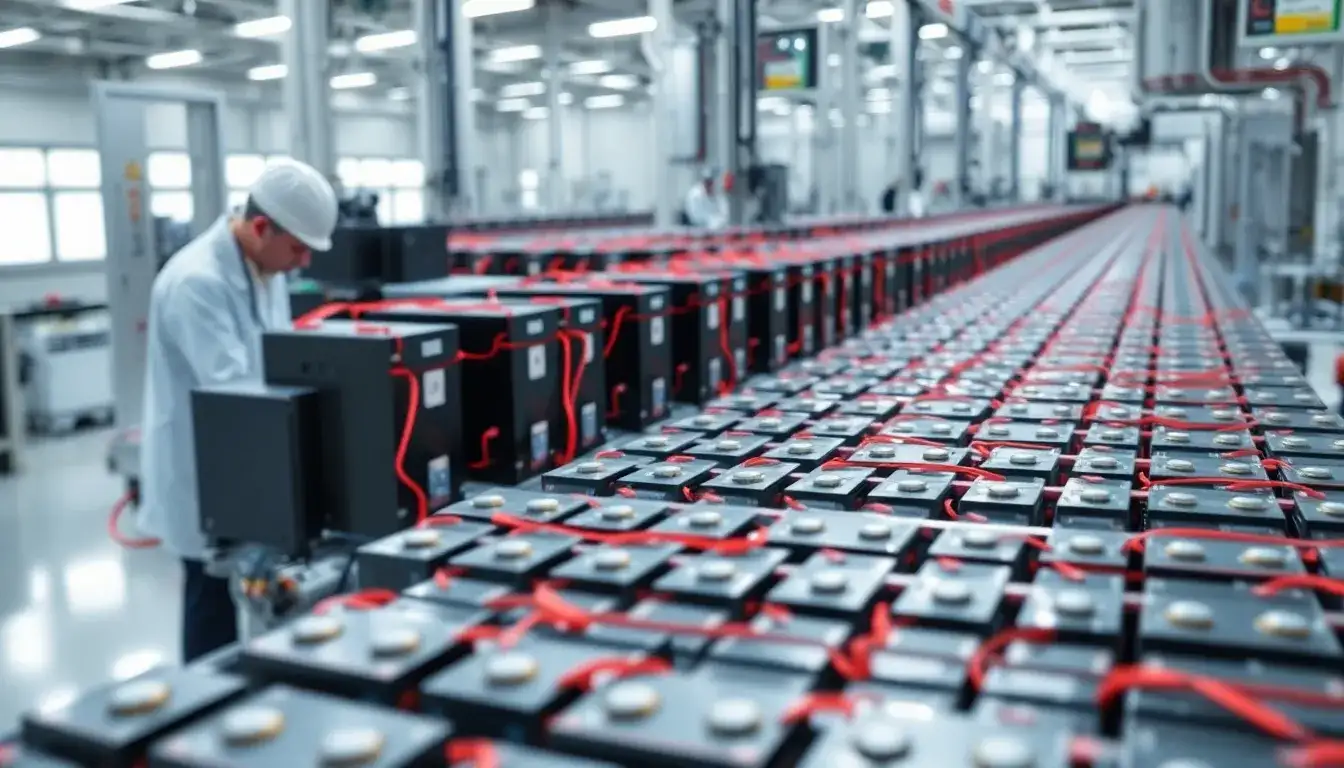
Recent developments in the solid-state battery sector indicate significant progress towards commercialization. On January 13, the Inter-Ministerial Joint Conference on the Development of the Energy-Saving and New Energy Vehicle Industry emphasized the need to accelerate breakthroughs in all-solid-state battery technologies. In conjunction with the draft national standard for solid-state batteries in electric vehicles, which sets boundaries for battery types and establishes a strict 0.5% weight loss rate threshold, the industry is aligning itself towards large-scale solid-state battery production, fostering technological innovation and capacity planning.
On the corporate side, on January 12, Jinlongyu announced plans by its subsidiary to construct a production line capable of producing 2GWh of solid-state batteries annually. Delong Co. reported that its solid-state batteries have passed safety tests and have entered continuous pilot production, while also signing strategic cooperation agreements or letters of intent with multiple clients. Additionally, Fulimeng Precision stated its intention to increase research and investment in new energy battery materials, with some of its cathode materials already suitable for solid-state batteries.
The alignment of national policies and corporate strategies suggests that China’s solid-state battery industry is transitioning from a phase of rapid, unregulated development to a more standardized growth stage. The year 2026 is being recognized as the “verification year” for the industry, with multiple signals indicating a shift from experimental phases to large-scale commercial applications.
Major Chinese automakers like FAW Hongqi, SAIC, and GAC have announced their plans for solid-state battery integration, which aligns with the advancement of national standards and may serve as a crucial driver for accelerating the commercialization of solid-state batteries. Industry experts predict that by 2026, several leading domestic automakers may achieve solid-state battery validation on a scale of approximately 1,000 vehicles. This milestone is not only a key indicator of the technology’s transition from laboratory to market but also serves as a pivotal point for the collaborative upgrade of the entire supply chain.
Testing in real vehicle scenarios will quickly highlight issues regarding battery material compatibility and interface stability, compelling battery manufacturers to optimize solid-state battery materials and production processes further. Moreover, the demand for scaling production to support 1,000 vehicles will stimulate the expansion of upstream critical material capacities and the evolution of specialized solid-state battery equipment, fostering a positive spiral of development within the solid-state battery supply chain.
From an industry perspective, the solid-state battery ecosystem in China is expected to accelerate its formation. On the materials front, a pattern of converging technological routes, capacity expansion, and simultaneous cost reduction is emerging. In the cathode sector, high-nickel ternary and lithium-rich manganese-based materials have become mainstream, with leading ternary material manufacturers achieving shipments ranging from tons to tens of tons. The competition in the anode materials sector is now between silicon-based and lithium metal anodes, catering to various energy density requirements. As a critical technological barrier, different electrolyte technologies, such as sulfide and polymer electrolytes, are expected to converge during large-scale vehicle validation.
On the equipment side, advancements in isostatic pressing and solid electrolyte transfer technologies will evolve alongside market demand. The collaboration between battery manufacturers and automakers will become more efficient and integrated, paving the way for a closed loop of “product validation – large-scale deployment,” thereby solidifying the foundation for the industry’s mass production window by 2030.
Globally, battery companies and major automakers in Japan and South Korea have outlined timelines for the mass production of solid-state batteries. In the face of fierce competition in the global market, Chinese battery manufacturers are also presented with both opportunities and challenges. For these companies, aligning with national standards and adjusting R&D directions to fit the country’s solid-state battery development strategy will be crucial. They will also face pressures to upgrade equipment and adapt to supply chain collaborations. Furthermore, the ability to control costs for critical materials such as sulfide electrolytes will be a key factor in the successful commercialization of solid-state batteries.
In the future, companies that meet national standards, overcome critical technical challenges, and build collaborative ecosystems within their supply chains will likely emerge as leaders in this technological race. Additionally, China’s battery enterprises are poised to contribute significantly to the global new energy sector, showcasing Chinese solutions and innovations.
Original article by NenPower, If reposted, please credit the source: https://nenpower.com/blog/solid-state-battery-validation-scale-expected-to-reach-thousands-of-units-this-year/

