

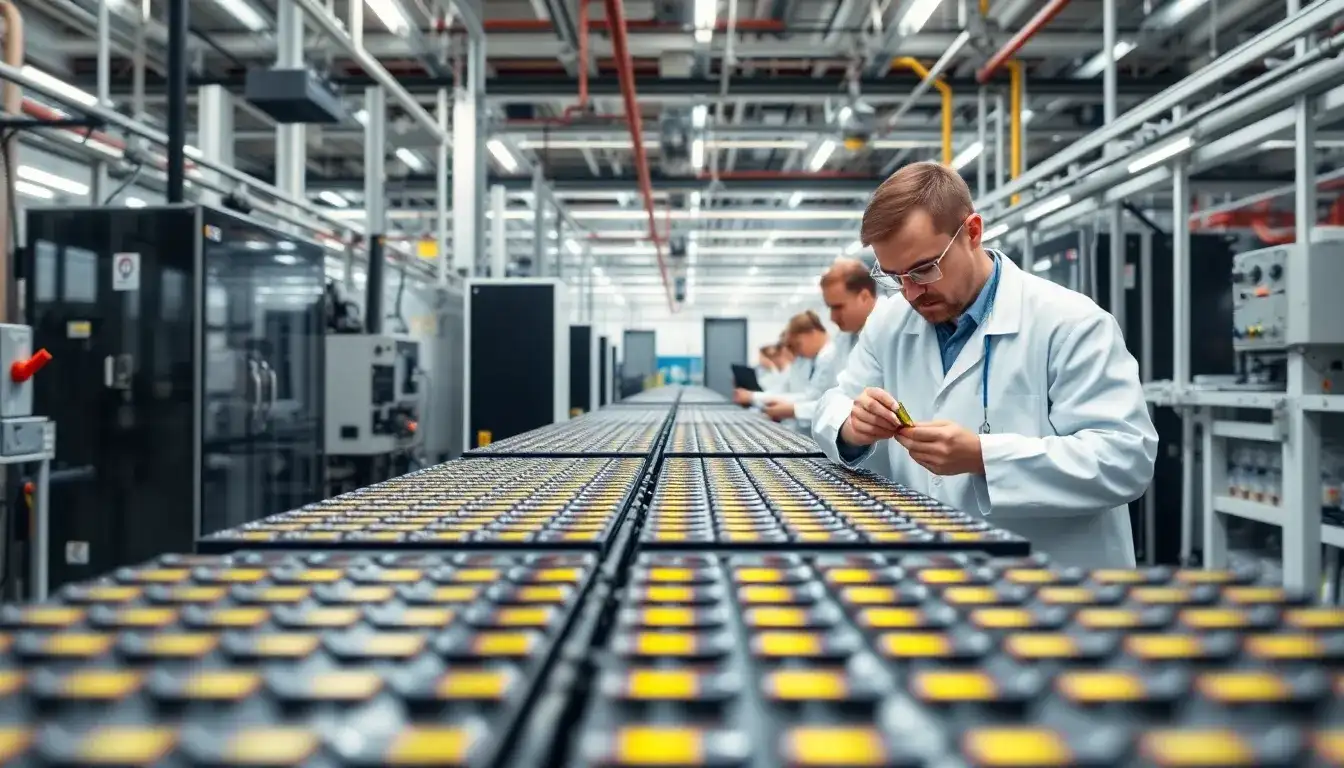
As the next generation of power battery technology, solid-state batteries have consistently captured the attention of both investors and the industry. For a long time, consumers have eagerly anticipated the mass production of solid-state batteries in electric vehicles (EVs). However, as of now, the mass production in the EV sector remains dominated by semi-solid batteries. Nevertheless, the commercialization of solid-state batteries is progressing steadily. Recent insights indicate that the narrative around solid-state batteries is shifting towards more explosive potential sectors such as the low-altitude economy and humanoid robots. Currently, various companies in these emerging fields have achieved significant technological breakthroughs and secured customer orders.
“First semi-solid, then fully solid” has been the mantra in the industry. Despite the long-standing anticipation for fully solid-state batteries, their commercialization has followed a gradual path from simpler to more complex technologies. In this context, semi-solid batteries are paving the way for large-scale applications. At the Chengdu Auto Show on August 29, the new SAIC MG4, the first vehicle equipped with a semi-solid battery, was officially launched with a starting price of 65,800 yuan, making it the first semi-solid battery model priced under 100,000 yuan. This battery has innovatively reduced the liquid electrolyte content to 5%, nearing the level of quasi-solid-state batteries, fundamentally addressing the risk of battery combustion. Industry experts suggest that the SAIC MG4 brings this technology to the 100,000 yuan electric vehicle market, initiating an era of accessibility for semi-solid battery technology, potentially altering the competitive landscape of the EV sector.
The successful market application also paves the way for more advanced technological pathways. In September, Funeng Technology disclosed its progress in developing the third generation of semi-solid batteries through an investor interaction platform, confirming that this product is scheduled for mass production in 2026. This breakthrough focuses on the dual pathways of “solid electrolyte application + in-situ solidification technology,” enhancing the energy density of soft-pack cells to 400 Wh/kg. By reducing electrolyte volume and introducing solid-state materials, Funeng is laying a crucial foundation for the industrialization of high-safety, high-energy density batteries, moving semi-solid batteries from laboratory settings to large-scale applications.
As Yang Hongxin, chairman of Honeycomb Energy, stated, semi-solid batteries have become a core area of competition in the industry due to their relative independence and widespread applicability. He noted that beyond significantly improving safety, semi-solid batteries can enhance manufacturing yield and optimize quality throughout their lifecycle. Honeycomb Energy has successfully overcome several technical bottlenecks in mass production with its self-developed “electrolyte thermal composite transfer process.” This process uses a polar transformation liquid formulation and gradient thermal pressure technology to achieve efficient and uniform transfer of the electrolyte layer from the separator to the electrode, increasing the transfer rate from about 20% to over 95%. This technique is also fully compatible with existing production lines and requires no additional equipment investment, delivering significant improvements in processing accuracy, yield, and safety: a 10% increase in HIPOT yield, a 6% reduction in pressure difference defect rates, and a 50% enhancement in safety.
Currently, Honeycomb Energy is adhering to the “first semi-solid, then fully solid” strategy for industrialization, balancing technological maturity and market acceptance while gradually advancing the commercialization of solid-state battery technology. According to official plans, Honeycomb Energy aims to complete the development of a 10 Ah, 400 Wh/kg fully solid-state cell system by the end of 2025, with the first generation of semi-solid batteries ramping up production in 2026 and the second generation of 400 Wh/kg semi-solid batteries under development. By 2028, they plan to launch the third generation of 450 Wh/kg semi-solid batteries and develop pure solid-state batteries with capacities exceeding 70 Ah and energy densities of 500 Wh/kg.
As the focus remains on electric vehicles, the application scenarios for solid-state batteries are quietly expanding, with humanoid robots and the low-altitude economy emerging as new competitive fields for battery companies. With “embodied intelligence” and “smart robots” included in this year’s government work report, humanoid robots have become a hot topic in technology, and 2025 is being touted as the “year of mass production” for these robots. However, the power battery, deemed the “energy heart” that determines their mobility, remains a key bottleneck in the development of humanoid robots. Feng Yanqiang, chief engineer of robot batteries at Yiwei Lithium Energy, recently pointed out at a forum that the greatest challenge facing humanoid robots today is insufficient endurance, a significant pain point for the industry.
To tackle this challenge, Yiwei Lithium Energy showcased its “dense energy solutions” at the 2025 World Robot Conference, presenting a complete range of battery solutions for robots. Following this, in September, the Yiwei Lithium Energy solid-state battery research institute officially opened its mass production base in Chengdu, where the “Longquan No. 2” fully solid-state battery was successfully produced. This “Longquan No. 2” features a 10 Ah capacity, with an energy density of 300 Wh/kg and a volumetric energy density of 700 Wh/L, targeting applications in humanoid robots, low-altitude flying vehicles, and high-end AI equipment.
According to Yiwei Lithium Energy, the solid-state battery base spans approximately 11,000 square meters, with an annual production capacity close to 500,000 cells upon full operation. The base is being constructed in two phases, with Phase One set to be completed by December 2025, capable of manufacturing 60 Ah batteries. Phase Two aims to achieve a delivery capacity of 100 MWh by December 2026. Furthermore, Yiwei Lithium Energy has established a deep partnership with Weitah Power, collaborating to advance the commercialization of embodied intelligent products based on user needs and trends in robotic battery technology. Together, they are developing higher-density battery packs, expected to boost energy capacity by 30% and outdoor endurance to over six hours, meeting daily usage demands.
In addition to electric vehicles, Honeycomb Energy is actively exploring the low-altitude economy and robotics, having formed collaboration agreements with multiple automotive companies and aircraft manufacturers. Reports indicate that Honeycomb Energy has constructed a dedicated production line for semi-solid batteries with a capacity of 2.3 GWh and has completed the development of the first generation of 270 Wh/kg square cells, with plans for batch testing in November 2025. This product has already secured orders from a renowned European electric vehicle brand and is aligned with a centrally coordinated eVTOL project. Meanwhile, Honeycomb Energy is developing mass-production-ready soft-pack semi-solid batteries with an energy density of 360 Wh/kg and has officially delivered samples to a central enterprise focused on low-altitude flying vehicles, with the first flight planned for this year. Recently, Ganfeng Lithium also revealed on its investor interaction platform that its solid-state batteries have begun trial installations and mass production in certain vehicle models, along with significant advancements in drones and consumer electronics.
Industry experts believe that China is showcasing leadership in emerging fields such as the low-altitude economy and humanoid robots. As a breakthrough point for industrialization, semi-solid batteries are positioned as a strategic foothold for Chinese enterprises aiming to capture high-end and emerging markets. Yang Hongxin emphasized that, considering product maturity distribution, the low-altitude economy and humanoid robots are likely to become the pioneering scenarios for the true commercialization of solid-state batteries.
Since 2025, the solid-state battery sector has experienced a wave of favorable policies. On September 22, the National Energy Administration, the Ministry of Industry and Information Technology, the State-owned Assets Supervision and Administration Commission, and the State Administration for Market Regulation jointly issued the “Guiding Opinions on Promoting High-Quality Development of Energy Equipment,” which explicitly calls for the development of “long-life, wide-temperature range, low-degradation lithium batteries, sodium batteries, and key equipment for solid-state batteries.” Wu Guogang, a second-level inspector at the Ministry of Industry and Information Technology’s Electronics Information Department, also stated in September that the next steps will involve strengthening lithium battery technological innovation, accelerating the layout of forward-looking technologies, and expediting the research and industrialization of solid-state batteries, sodium-ion batteries, all-climate batteries, fast-charging batteries, and key materials.
Indeed, there is a growing consensus in the industry regarding the progress of solid-state battery mass production. “Since this year, at least at the capital market level, there is a general consensus on the trend of solid-state battery industrialization. This core judgment is that in the next three to five years, China will become the fastest country in advancing solid-state battery industrialization, including technological maturity and the completeness of the industrial chain,” stated Zeng Tao, Executive General Manager and Chief Analyst of New Energy at China Galaxy Securities.
However, industry insiders point out that fully solid-state batteries still face significant mass production pressures, with numerous technological challenges that need to be overcome. Nevertheless, once breakthroughs are achieved, the safety and ultra-high energy density potential they offer will likely become the ultimate technological route for power and energy storage batteries. Morgan Stanley predicts that by 2030, the global solid-state battery market size will reach $120 billion, with China expected to account for as much as 40% of this market, leading to a rapid acceleration in production capacity construction. A research report from CITIC Securities also mentions that since 2025, companies like SolidPower and Guoxuan High-Tech have gradually begun road testing their fully solid-state batteries, with 2025-2026 anticipated to be a period of intensive road tests for solid-state battery vehicles.
As the leading company in the global power battery sector, CATL has emphasized the progress of solid-state batteries during previous earnings calls. CATL believes that the scientific issues surrounding solid-state batteries have largely been resolved, with the main challenges now being engineering-related. They anticipate that small-scale mass production of solid-state batteries will be achieved by 2027, with hopes for large-scale applications by 2030. Currently, fully solid-state batteries still face interface issues and manufacturing process challenges. Additionally, the costs of fully solid-state batteries are significantly higher than those of liquid batteries, with expectations that even in two to three years, there will still be a 5-10 times cost differential. Therefore, the core issue for industrialization remains how to achieve mass production while controlling material costs. CITIC Securities also notes that the core challenges for fully solid-state batteries on vehicles are expansion and cycle life degradation, with an agreement among automotive and battery companies to alleviate these issues through solid-solid improvements and pressure adjustments.
Regardless of whether liquid or solid-state batteries, they fundamentally belong to the category of lithium batteries. Yang Hongxin stated that after decades of development, some sectors have entered a mature phase, while others have shifted from policy-driven to market-driven dynamics. New application scenarios such as the low-altitude economy and humanoid robots continue to emerge. Looking ahead, the application boundaries of lithium batteries are expanding, potentially extending into fields such as aerospace and deep-sea exploration.
The upstream of the industrial chain is already reaping the “benefits.” Currently, the technological pathways for solid-state batteries exhibit diversified characteristics. From the perspective of electrolyte types, they primarily include polymers, oxides, sulfides, and the recently highlighted halides. Among major manufacturers, sulfide electrolytes are currently dominant. Indeed, every step toward the industrialization of solid-state batteries captures market attention. As the solid-state battery industry continues to catalyze, several listed companies have disclosed their strategic layouts in the solid-state battery supply chain. Equipment manufacturers, positioned upstream in the supply chain, are the first to experience the benefits brought about by solid-state batteries. In June of this year, XianDao Intelligent announced the delivery of multiple sets of core solid-state battery equipment, including composite transfer equipment and high-speed stacking equipment, to a globally leading battery manufacturer. The company has successfully streamlined the entire process of mass-producing fully solid-state batteries and has delivered the world’s first pilot line for solid-state batteries.
In the same month, Yinghe Technology announced that solid-state wet coating equipment, solid-state rolling equipment, and solid-state electrolyte transfer equipment delivered to a leading domestic battery enterprise have successfully arrived at the customer’s site for pilot line construction. On September 23, Haimuxing released an investor relationship activity record stating that the company is among the first in the industry to achieve the “oxide + lithium metal anode” technology route and has completed a commercial closed loop for lithium metal solid-state battery equipment, which is currently being delivered in batches for low-altitude flying vehicles. The company has also received multiple pilot line orders from leading global new energy technology companies for the “sulfide + silicon-carbon anode” technology pathway.
However, some industry insiders have pointed out that the recent surge in stock prices of several lithium battery equipment companies, which have claimed to offer “complete solid-state battery mass production equipment,” is misleading, as the related processes and equipment are far from mature, and significant gaps remain before true mass production is achieved. Undeniably, under the dual impetus of policy and technology, the pace of solid-state battery industrialization is accelerating. Overall, mainstream battery companies in China have basically clarified their technological routes for solid-state batteries and continue to promote mass production. With the collaborative push of the supply chain, emerging application fields are becoming crucial engines for the commercialization of solid-state batteries. As Yang Hongxin urged, the industry should work together to build a “new ecosystem” for China’s solid-state batteries, contributing Chinese solutions and wisdom to the global automotive industry’s green transformation.
In conclusion, the race for solid-state batteries has transcended a mere pursuit of energy density; it represents a strategic layout concerning future industrial discourse. From the wide-open roads to the vast skies and into the realm of intelligent robots that integrate into our lives, the extreme demands for safety and performance are driving battery technology toward profound iterations. The early adoption of semi-solid batteries has established a solid “foothold” for industrialization, while the ultimate goal of fully solid-state batteries guides the entire industry toward breakthrough advancements. While this path is fraught with technical and cost challenges, the rewards are transformative. Solid-state batteries are expected to become an essential “energy cornerstone” for ushering in a society characterized by intelligence and low-altitude operations in the 21st century. This silent energy revolution tests not only the technological endurance of enterprises but also a nation’s foresight and determination within the high-tech industrial ecosystem. The first to cross the finish line in the industrialization of solid-state batteries will hold the key to the next wave of industrial transformation.
Original article by NenPower, If reposted, please credit the source: https://nenpower.com/blog/solid-state-batteries-enter-mass-production-expanding-beyond-just-electric-vehicles/

