

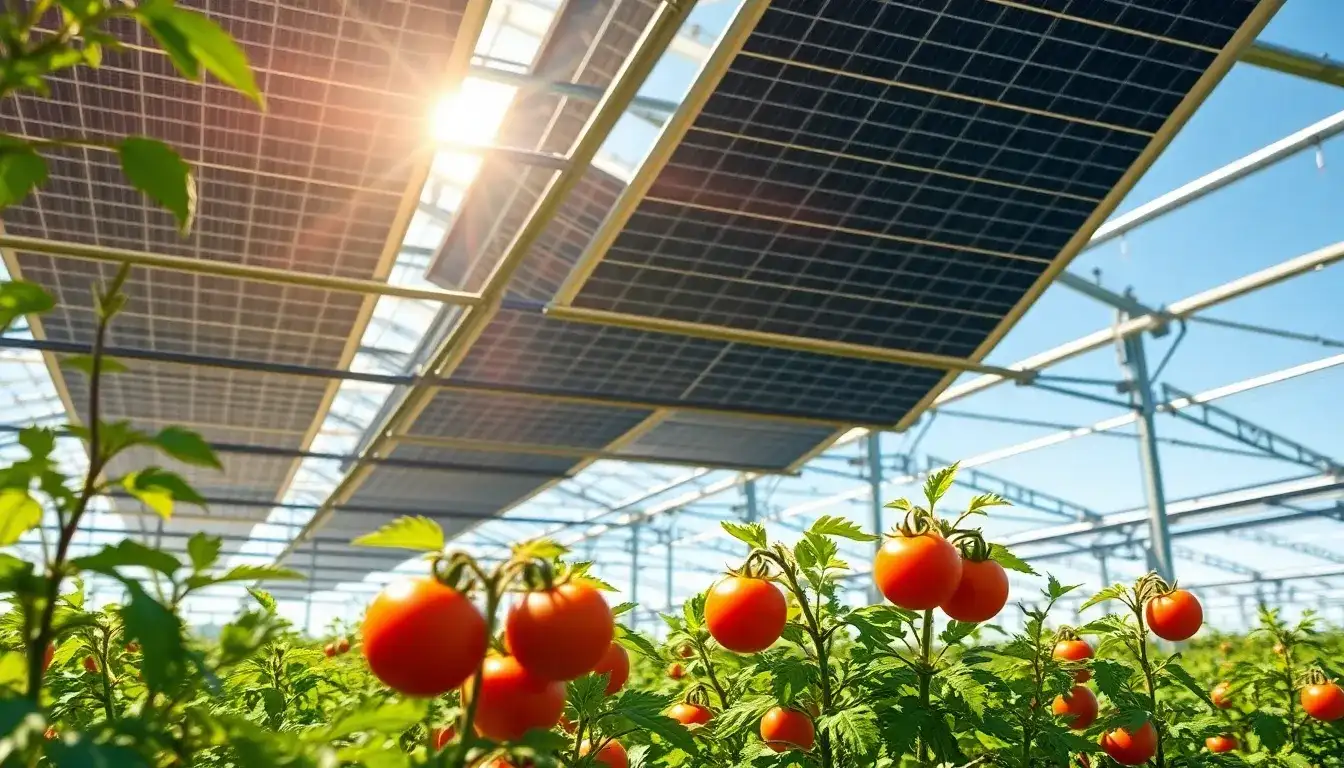
Researchers at the National Renewable Energy Laboratory (NREL) recently conducted an intriguing experiment to see if tomatoes would thrive better under a specially designed light filter that utilizes an innovative photovoltaic cell technology known for being flexible, lightweight, and cost-effective.
Last summer, in a corner of the Field Test Laboratory Building, the NREL team grew a dozen tomato plants in two custom greenhouses. Six plants received full sunlight, serving as a control group, while the other six were grown under reduced light filtered through purplish panels, allowing only the spectrum most beneficial to tomatoes.
This experiment aimed to demonstrate the effectiveness of a method called BioMatch, which allows the exact light spectrum that best meets the physiological needs of the plants to pass through organic semiconducting materials found in solar cells. Now in the second year of the multi-disciplinary project named “No Photon Left Behind,” researchers found that the tomatoes grown under filtered light not only grew faster but also became larger than their counterparts exposed to direct sunlight.
“When light interacts with a plant, various physiological pathways are triggered based on the type and intensity of light,” explained Bryon Larson, an NREL chemist specializing in organic photovoltaics and the principal investigator of the project. “We are examining what occurs when sunlight is filtered to only deliver the light spectrum and intensity the plant requires, which we can achieve through BioMatched spectral harvesting. This allows us to generate electricity from the light that plants do not need using transparent OPV modules.”
Early research efforts were focused on algae, where initial experiments involved covering bottles containing the single-celled organisms with BioMatched photovoltaic filters designed to optimize their growth. These algae experiments yielded results over a single weekend, demonstrating faster growth rates and increased biomass even with a significant portion of the light spectrum removed.
Lieve Laurens, a plant biologist and co-principal investigator on the project, noted, “We showed that the algae converted photons into electrons and biomass more efficiently, which led us to wonder if similar benefits could be observed in crops, allowing for higher yields with just the necessary light spectrum.”
The findings from the algae experiments provided preliminary data that boosted the researchers’ confidence to seek funding from the Laboratory Directed Research and Development program. Although a dedicated greenhouse would have been ideal, the team utilized the available space for their tomato project.
While the OPV filters do not generate electricity, the eventual goal is to incorporate BioMatched materials into semi-transparent solar panels that can power a greenhouse while allowing the necessary light to reach the plants. “When full-spectrum light hits a plant, it contains both productive and harmful photons, forcing the plant to expend energy to protect itself,” Larson explained. “By separating useful wavelengths from non-useful ones, we can collect the non-useful part for electricity and allow the beneficial light to promote plant growth. This unique approach enhances overall solar energy efficiency by categorizing light for different functions—photosynthesis for plant growth and electricity generation through photovoltaics.”
The makeshift greenhouses, approximately eight feet tall and four feet wide, received sunlight from a wall of windows and skylights. Three evaporative coolers on the roof circulated moist air, while a refrigerator in the room was stocked with ripe beefsteak tomatoes, some as large as a baseball. Despite their appearance—the tomatoes had been harvested on a schedule that caused some skin to split—they were a promising product of the experiment.
Seth Steichen, a biologist involved in the project, closely monitored the tomatoes alongside Kelly Groves. They observed that plants grown under the OPV BioMatched Light outpaced their counterparts exposed to full sunlight, even though the control plants received 30% more light. The OPV plants were selectively illuminated with the spectrum they needed.
“For laboratory experiments, these exceptionally bright tomatoes are quite rare,” Steichen remarked. “Typically, their size and longer lifecycle dissuade their use in lab settings. However, they represent the most common variety grown in U.S. greenhouses, making this experiment relatable to real-world agricultural practices.”
Regular tests assessed factors such as size, weight, and photosynthetic yield, which indicates how effectively plants convert light into biomass. The tomatoes grown under BioMatched filters consistently outperformed the control group. “Overall, these plants demonstrate slightly better photosynthetic yield compared to the control plants,” Steichen noted. “The concept here is to show that it’s possible to reduce certain light wavelengths while still maintaining similar fruit yields.”
NREL researchers are exploring organic solar cells, which are made from synthetic materials, as a promising alternative to traditional silicon-based solar cells. Larson’s extensive database of organic semiconductor properties allows him to select compounds that generate the right light spectrum for specific plants. After determining a plant’s light requirements, the team uses a specialized software program to create BioMatch compositions and scales up thin-film deposition processes to produce filters that allow only the desired spectrum to reach the plants.
Larson initially worried about the complexities of transitioning from single-celled algae to more intricate multicellular plants as summer approached. However, he considered the opportunity to apply the BioMatch concept to tomato cultivation a significant milestone. “The fact that we were able to grow tomatoes in the first year exceeded our original project expectations,” he said.
The findings from this research could significantly impact the burgeoning field of agrivoltaics, where various plants are cultivated alongside and beneath solar panels, or aid in designing next-generation energy-efficient greenhouses. The panels can be tailored to provide the ideal light spectrum for any plant species, regardless of location.
After confirming the accelerated growth of the tomatoes grown under the OPV, the final test involved a taste test. “We’ve been eagerly anticipating this moment,” Larson said, expressing concern that the tomatoes might lack flavor given their promising appearance. The light reaching the tomatoes can enhance traits such as sweetness and texture.
In a departure from typical experiments at NREL, this project culminated in a taste test. Larson purchased organically grown reference greenhouse tomatoes for comparison, chopped them up, and mixed them on plates, ensuring he couldn’t identify them by sight. The researchers tasted the tomatoes plain, with salt, with pepper, and alongside crackers, ranking their preferences.
The consensus revealed that the store-bought tomatoes ranked lowest in flavor. However, opinions were divided on whether the OPV tomatoes or the control tomatoes were preferred. Larson viewed the results as a success for Steichen and the biology team, who diligently cared for the plants for nearly five months.
With this initial experiment concluded and the tomatoes proving to be flavorful, the researchers are now poised to deepen their understanding of how light influences plant growth.
Original article by NenPower, If reposted, please credit the source: https://nenpower.com/blog/solar-panels-enhance-tomato-growth-through-tailored-light-filtering-at-nrel/

