

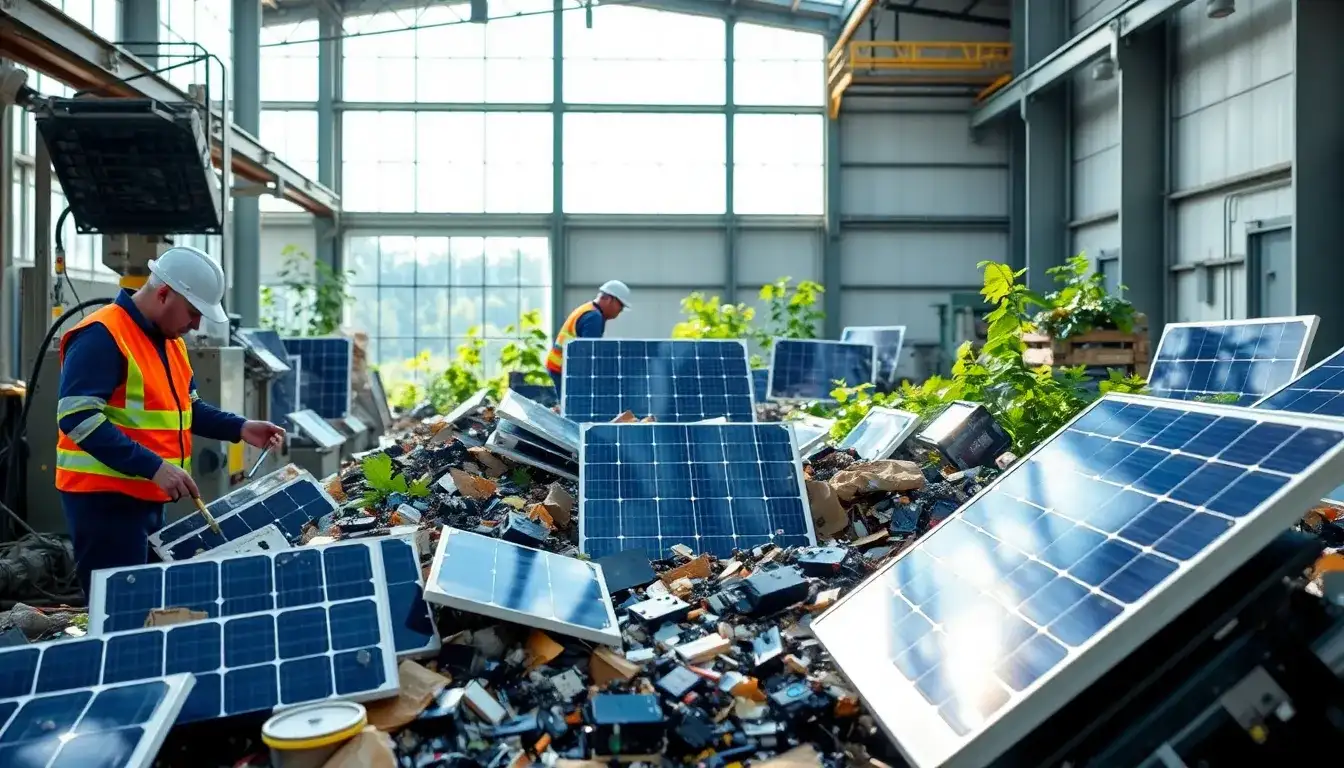
2025-2030: Solar Panel Recycling Market Set to Reach $548 Million Amid Growing Decommissioned PV Waste
CHICAGO and PUNE, India, June 26, 2025 /PRNewswire/ — The Solar Panel Recycling Market is projected to grow from USD 384.4 million in 2025 to USD 548.0 million by 2030, achieving a compound annual growth rate (CAGR) of 7.4%, according to a recent report from The Research Insights. The rapid advancement of the global solar industry is leading to an increase in solar panel production. Consequently, as more panels are deployed, a larger number of them will eventually reach the end of their useful life, generating a significant amount of decommissioned and obsolete units. This situation creates a substantial opportunity for green waste management solutions, as proper recycling and disposal of solar panels can mitigate environmental contamination and alleviate landfill pressures.
Governments worldwide are implementing stricter regulations and standards to ensure the responsible disposal and recycling of photovoltaic (PV) panels. Additionally, the recycling process is becoming increasingly economically viable, as valuable materials such as silicon, silver, aluminum, and glass can be recovered from old solar panels and reused in new ones. The report provides a comprehensive analysis of market trends, key players, and future opportunities. The anticipated growth of 7.4% in the Solar Panel Recycling Market encompasses various factors, including type, shelf life, technique, and geography, all of which are expected to demonstrate strength in the coming years.
### Market Overview and Growth Trajectory
The Solar Panel Recycling Market is experiencing significant growth, primarily driven by the increasing number of end-of-life (EOL) and decommissioned solar panel installations and limited supplies of critical raw materials for solar panels. A decline in primary silver prices further emphasizes the importance of the solar panel recycling industry. The rising demand for green energy is also a crucial factor propelling this market forward. According to recent studies, perovskite-based solar panels are expected to disrupt the traditional silicon-based PV industry in the coming years, potentially impacting the solar panel recycling market and related sectors.
Public awareness regarding the benefits of solar panel recycling is another key factor influencing market growth. The high costs associated with raw material recovery are significant, as solar panels are manufactured without contact with liquids, complicating the recycling process.
### End-of-Life Solar Panels and Increasing Solar Waste
One of the most pressing drivers for the solar panel recycling market is the growing number of decommissioned and aging solar panels reaching their end of life. Most photovoltaic (PV) panels have a lifespan of approximately 25–30 years. As early installations from the 1990s and 2000s start to expire, the global volume of solar waste is rapidly escalating. The International Renewable Energy Agency (IRENA) projects that by 2050, as much as 78 million tonnes of solar panel waste could accumulate worldwide. This significant accumulation presents environmental, regulatory, and logistical challenges that necessitate robust recycling systems. Recycling helps recover valuable materials such as silver, aluminum, silicon, and glass, thereby reducing the environmental impact of PV systems and promoting sustainability throughout the product lifecycle.
### Government Regulations and Policy Support
Government regulations and extended producer responsibility (EPR) mandates are significantly propelling the growth of the solar panel recycling industry. In regions such as the European Union, solar panels are legally classified as e-waste under the Waste Electrical and Electronic Equipment (WEEE) Directive, requiring proper collection and recycling. Manufacturers are obliged to finance the take-back and recycling of their products. Similarly, countries like Japan, South Korea, and India are implementing or planning regulatory frameworks to address solar waste management. In the United States, states such as California and Washington are leading policy initiatives that include EPR laws for PV modules. These regulations incentivize solar companies to incorporate recycling programs and stimulate investments in specialized recycling facilities, technological development, and workforce training—all essential for market expansion.
### Resource Recovery and Circular Economy Incentives
The economic and environmental benefits of recovering rare and finite materials from solar panels serve as a powerful motivator for recycling. PV modules contain valuable components such as silver, copper, high-purity silicon, and rare earth elements, which are costly to mine and refine. Recycling enables the reuse of these materials, reducing reliance on virgin mining operations, conserving natural resources, and lowering energy consumption in manufacturing. This is particularly relevant as raw material prices fluctuate and the demand for solar-grade materials rises alongside the growth of renewable energy installations. The circular economy model, which emphasizes reuse, refurbishment, and resource efficiency, is gaining traction among governments, businesses, and environmental organizations. By reintegrating recovered materials into the production cycle, solar panel recycling aligns with global sustainability goals and corporate ESG commitments, further driving market growth.
### Geographical Insights
The increasing number of solar installations reaching their end of life and growing public awareness of the environmental benefits of solar panel recycling are major factors driving growth in the North American solar panel recycling market. Additionally, government initiatives imposing stringent environmental regulations while providing monetary incentives for solar power generation also favor the solar panel recycling market.
Europe holds a strong position in the global solar panel recycling market, accounting for a market share of 39.5% in 2024. This high share is primarily due to Europe’s commitment to environmental sustainability. The Asia Pacific solar panel recycling market is expected to experience rapid growth in the coming years, driven by anticipated increases in solar installations in China, Japan, and India, as well as government initiatives aimed at enhancing renewable energy usage and improving electronic waste management.
### Global Solar Panel Recycling Market Segmentation
The solar panel recycling market is categorized by type into Mechanical, Thermal, and Laser, with mechanical recycling accounting for the majority of the output at 59.6% in 2024. By shelf life, it is divided into Early Loss and Normal Loss, with the early loss segment dominating the market share in 2024. By technique, the market includes Monocrystalline, Polycrystalline, and Thin Film, with monocrystalline panels being a favored choice due to their efficiency and longevity.
### Key Players and Competitive Landscape
The Global Solar Panel Recycling Market features several key players, including:
– First Solar Inc.
– Echo Environmental, LLC
– Silcontel LTD
– Canadian Solar
– Silrec Corporation
– SunPower Corporation
– Reiling GmbH & Co. KG
– Trina Solar
– Aurubis
– Envaris
– SiC Processing GmbH
– Yingli Energy Co. Ltd.
– Hanwha Group
These companies are employing strategies such as product launches, joint ventures, and geographical expansion to maintain their competitive advantage in the market.
### Conclusion
The emphasis on sustainable development, coupled with growing awareness of the benefits of recycling, is driving the demand for the solar panel recycling market. As the global adoption of solar power continues to rise, so too does the parallel increase in EOL PV waste, presenting both challenges and opportunities for the solar panel recycling industry. Advanced recycling technologies such as shredding, separation, and refining are enabling the recovery of components like silicon, silver, and aluminum, thus reducing the industry’s reliance on raw material mining and supporting a circular economy.
The recycling and safe disposal of PV systems have gained additional momentum thanks to government regulations and producer responsibility programs. This has led to strategic investments in automated recycling infrastructure, the implementation of scaling procedures, and the development of innovative separation technologies, all of which are contributing to the rapid growth of the solar panel recycling market. As the industry transitions toward green energy, solar panel recycling will play a vital role in achieving long-term energy sustainability and minimizing the environmental impacts of renewable energy technologies.
Original article by NenPower, If reposted, please credit the source: https://nenpower.com/blog/solar-panel-recycling-market-set-to-reach-548-million-by-2030-driven-by-growing-e-waste-concerns/

