

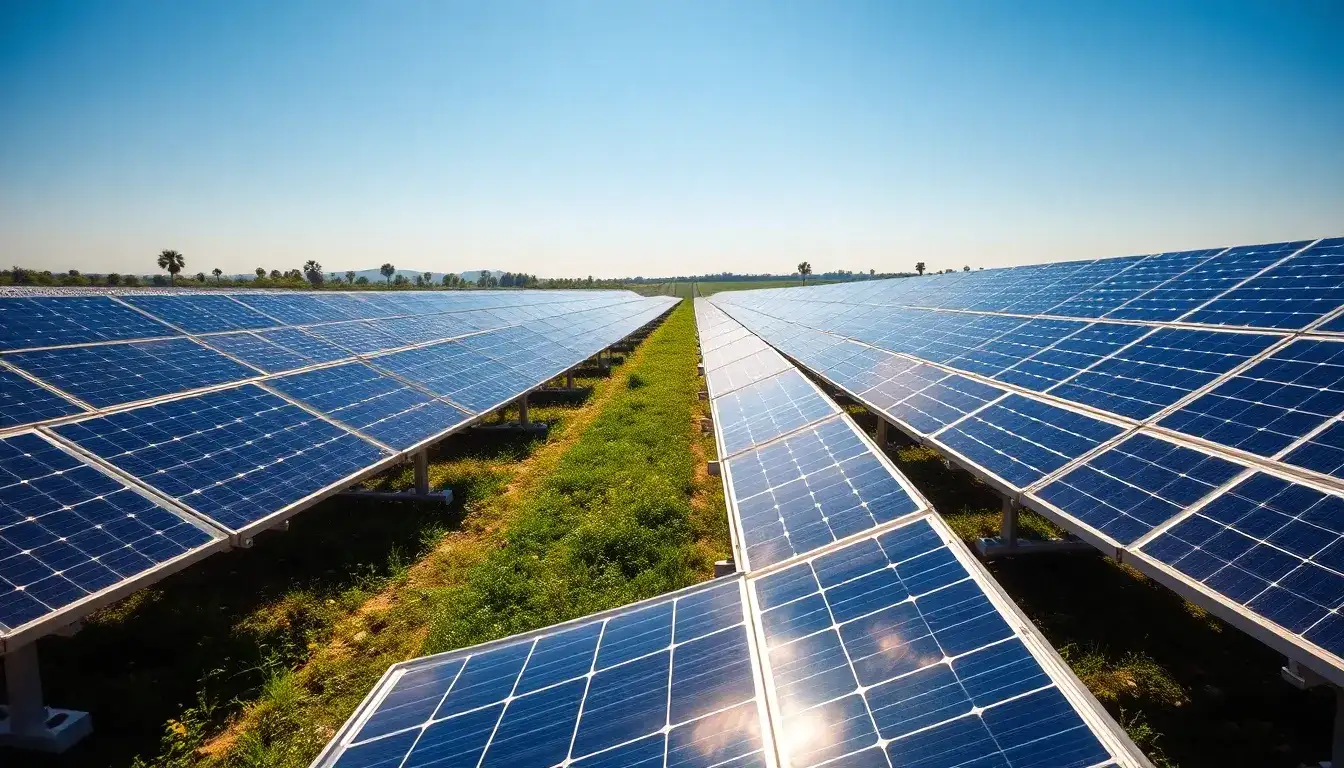
Since late June 2025, there has been a significant release of signals regarding the “anti-involution” approach in the photovoltaic (PV) industry. This has led to a sustained rebound in the PV sector on the Hong Kong and A-shares markets. Recently, media reports indicated that relevant national departments are set to release a notification aimed at strengthening the regulation of PV production capacity, further igniting investment enthusiasm in the sector.
On October 14, it was reported that the relevant authorities would likely issue a notification to enhance the regulation of PV production capacity. This move is expected to help transition the industry from “wild growth” to “high-quality development.” Consequently, the A-share PV industry chain experienced a surge in stock prices, although stocks in the Hong Kong market, such as New Special Energy (01799), showed relatively muted performance. The following trading days saw the sector consolidating and absorbing this information.
Over the past four years, the PV sector has experienced significant declines, with investment valuations shrinking by over 70% across the A-shares, Hong Kong, and U.S. markets. The bottoming out continued through 2025, but signs of a policy turnaround began to emerge in June, with a series of “anti-involution” policies introduced to support prices in the industry chain. With expectations of performance reversals, most PV stocks across the three markets have seen a continuous rebound for six consecutive months. The “anti-involution” measures in 2025 are markedly more robust compared to 2024 and have made noticeable advances in exiting excess production capacity and avoiding price competition, providing considerable valuation support for the PV sector.
From an industry perspective, after the introduction of the carbon neutrality policy in 2020, numerous supporting subsidy policies were launched, leading to a phase of rapid growth in the PV sector where industry prices surged. However, the pace of production capacity expansion outstripped downstream installation rates, resulting in severe overcapacity. For instance, the total production capacity of polysilicon reached 3.76 million tons, according to a report from Guojin Securities. Prices for polysilicon peaked at over 300,000 yuan per ton in 2022, only to plummet below cost levels to as low as 30,000 yuan per ton in 2024.
In 2024, top-level policy-making bodies communicated several times about addressing structural contradictions in key industries like PV. The Central Political Bureau’s meeting in the second half of that year proposed measures to prevent “involution-style” vicious competition. In 2025, signals regarding “anti-involution” policies intensified, with six ministries, including the Ministry of Industry and Information Technology, explicitly stating their intent to combat sales below cost and promote the orderly exit of outdated production capacity through market-oriented legal methods.
Recent policies, such as the “2025-2026 Stable Growth Action Plan for the Electronic Information Manufacturing Industry,” released in September by the Ministry of Industry and Information Technology and the State Administration for Market Regulation, emphasize achieving high-quality development in the PV sector by eliminating “involution-style” competition. Furthermore, the draft national standard for “Energy Consumption Limits for Polysilicon and Germanium Products” mandates companies not meeting Grade 3 standards to rectify their operations within a specified timeframe, with penalties for non-compliance.
Thanks to these policy interventions, significant improvements in supply and demand dynamics have been observed. Prices in the PV industry chain have begun to rise, with increases noted in polysilicon, silicon wafers, solar cells, and modules in September. Since June, futures prices for polysilicon have surged by over 50%. However, the task of reducing polysilicon production capacity remains challenging. As of the end of September, the number of operational polysilicon manufacturers in China remained at ten, with overall operating rates still relatively low.
On the demand side, the installation capacity for PV continues to grow at a rapid pace, with China’s PV generation capacity reaching 886.6 GW in 2024, representing a compound annual growth rate of 36.82% over the past five years. The dual carbon policy remains the primary driver of downstream expansion in the PV sector, and future growth is expected to maintain a double-digit increase. Additionally, energy storage systems will help address the volatility and consumption issues associated with renewable energy integration, further driving demand for PV installations.
As valuations hit a bottom and rebounded, new investment opportunities are emerging in the sector. Strict control of production capacity on the supply side, along with increased support on the demand side, is driving the industry toward sustained growth. The PV industry chain includes polysilicon (Tongwei, Daqo Energy, and New Special Energy), silicon wafers (TCL Zhonghuan and Shuangliang Eco-Energy), solar cells (Aiko Solar), and integrated modules (LONGi Green Energy and JA Solar), with photovoltaic cell technology being the core component.
Leading battery manufacturers are likely to break free from the profitability challenges arising from long-term homogeneous competition by upgrading their TOPCon production capacity, potentially leading the sector out of a cyclical downturn. However, due to falling prices and industry involution, most segments of the PV industry chain have been operating at a loss for over a year, with substantial losses reported in 2025. For instance, leading companies such as Tongwei, JA Solar, and LONGi Green Energy reported net losses of 4.955 billion yuan, 2.58 billion yuan, and 2.57 billion yuan, respectively, in the first half of the year. In contrast, New Special Energy recorded a net loss of less than 300 million yuan during the same period.
New Special Energy’s relatively lower loss rate is attributed to its expansion into downstream demand through the construction and operation of solar power plants, which has contributed to profitability and offset losses from its polysilicon business. In the first half of 2025, the company generated revenues of 13.68%, 67.62%, and 18.9% from its polysilicon business, wind energy, and solar power plant operations, respectively, despite a gross loss of 1.033 billion yuan in polysilicon, with gross profits from plant construction and operations totaling 1.423 billion yuan.
The company has also ventured into electrical equipment, including inverters, contributing 22.5% of its revenue with a gross profit of 236 million yuan. Aligning with policy trends, New Special Energy has increased its investments in solar power plants during this adjustment phase, adopting a multi-track approach that includes centralized, distributed, and decentralized plant development. This year, it has accelerated the construction of a 3 GW new energy project in the Xinjiang region, continuously contributing to performance through a combination of self-use and external expansion. As of the first half of 2025, the company has completed and confirmed revenues from approximately 1.35 GW of solar and wind projects.
Due to the lower proportion of its polysilicon business, New Special Energy is less affected by fluctuations in industry prices compared to its peers. For example, LONGi Green Energy, while also involved in power plant business, has a minimal contribution to its revenue, with only 3.54% coming from plant operations in the first half of 2025, whereas PV products accounted for a staggering 93.5%. Similarly, TCL Zhonghuan’s power plant revenue constituted merely 0.76% of its total, while over 92% came from silicon wafers, modules, and other silicon materials.
In conclusion, the PV industry chain has endured three years of overcapacity, and while some manufacturers continue to expand production capacity, the pace of capacity digestion has been slow, resulting in persistent price declines and significant losses across the industry. In response to industry calls for action, the forthcoming production capacity regulation is expected to be expedited, imposing strict controls on supply and encouraging the introduction of more efficient PV technologies to foster high-quality development in the sector and facilitate continued rebounds in stock prices. Investors focusing on industry leaders such as LONGi Green Energy and TCL Zhonghuan, which are sensitive to price fluctuations and exhibit high valuation elasticity, may benefit from higher valuation premiums in this sector recovery. Conversely, companies like New Special Energy, which boast resilient performance and lower price sensitivity due to diversified business operations, may emerge as a preferred choice for conservative investors.
Original article by NenPower, If reposted, please credit the source: https://nenpower.com/blog/solar-industry-recovery-how-anti-competition-policies-are-boosting-valuations/

