

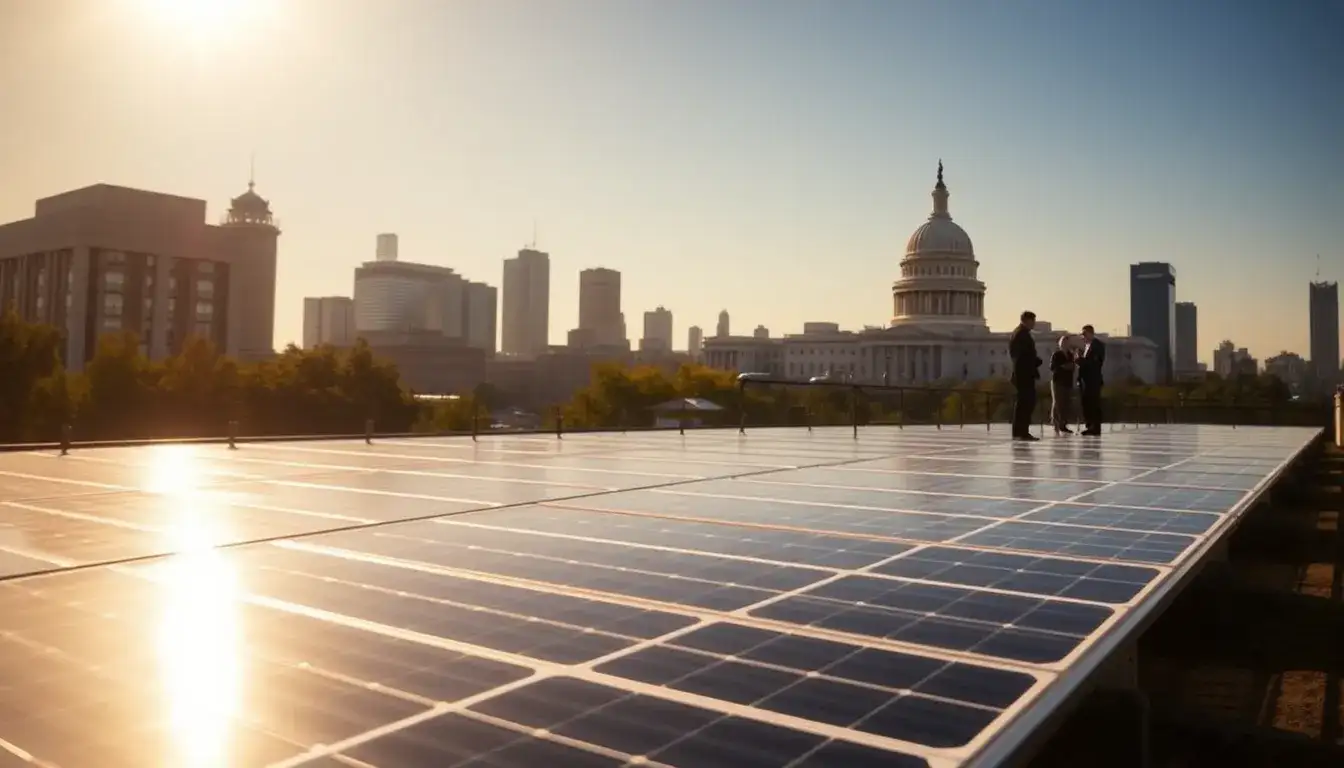
Solar Shines Brightly in 2025, But Clouds May Be Ahead
By Kennedy Maize
Despite facing challenges from an administration that does not fully embrace an “all of the above” energy policy, the solar industry performed impressively in the first quarter of 2025. Solar energy constituted 69% of all new electric generating capacity added to the U.S. grid during this period.
A recent analysis by the Solar Energy Industries Association (SEIA) and the consulting firm Wood Mackenzie revealed that “the U.S. solar industry added 8.6 gigawatts (GW) of new solar module manufacturing capacity in Q1 2025, marking the third-largest quarter for new manufacturing capacity on record.” Overall, the industry installed 10.8 GW of new electricity generating capacity during the quarter, with solar and storage accounting for 82% of all new generating capacity added to the grid. However, this 10.8 GW figure represents a 7% decrease compared to the first quarter of 2024 and a significant 43% decline from the fourth quarter of 2024.
The addition of 8.6 GW of new manufacturing capacity brings the total U.S. manufacturing capacity to 51 GW. However, “growth in upstream manufacturing capacity remains slow or non-existent.” The ES Foundry in South Carolina became the second domestic cell manufacturer when it opened a 1 GW cell factory in January, but no new polysilicon or wafer manufacturing facilities came online in Q1.
Texas, with its natural gas dominance, saw the most significant growth, adding 2.7 GW, which is 92% more than the second-ranked state, Florida. In both states, this growth was primarily driven by utility-scale projects. The solar market appears to be shifting increasingly towards utility installations rather than rooftop solar. The report noted that the residential sector installed 1,106 MW of new capacity in the first quarter, representing a 13% year-over-year decline and a 4% quarter-over-quarter decline, largely due to high interest rates and economic uncertainty suppressing demand. California continued to lead in residential solar rankings with 255 MW, although this was the state’s lowest quarterly capacity since Q3 2020.
Community solar, which has gained attention in recent years, added 486 MW, but this was a 22% decline year-over-year and a 71% decline quarter-over-quarter. Strong community solar growth at the end of 2024 in states like Maine and New York, driven by changes in net metering and alleviated interconnection backlogs, did not continue into Q1, leading to decreased national volumes.
In a press release, Abigail Ross Hopper, SEIA CEO, praised the solar industry’s first-quarter results but cautioned about looming challenges. “Solar and storage continue to dominate America’s energy economy, adding more new capacity to the grid than any other technology using increasingly American-made equipment. However, our success is at risk. If Congress fails to address the legislation passed by the House, which would make energy tax incentives unusable, lawmakers could trigger a dangerous energy shortage that would raise electric bills and halt America’s manufacturing boom. The Senate still has time to rectify this and secure President Trump’s vision for American energy dominance.”
Wood Mackenzie analyst Zoë Gaston commented that their analysis “suggests that the U.S. solar market has yet to reach its full potential. Proposed changes to federal tax incentives, along with ongoing tariff concerns, could significantly affect this growth trajectory and potentially lead to energy supply challenges. It’s crucial to recognize the vital role of solar in America’s energy landscape.”
A separate SEIA analysis of the House-passed reconciliation bill found that the legislation could result in “the loss of 330,000 current and future American jobs, the closure or stalling of 331 factories, and a disappearance of $286 billion in local investments. The bill could also trigger massive energy inflation, raising consumers’ electricity costs by $51 billion nationwide.” If the House bill is enacted (which is unlikely as the Senate reviews it), SEIA warned that the United States “will not be able to meet demand or compete with China in the global race to power AI.”
Original article by NenPower, If reposted, please credit the source: https://nenpower.com/blog/solar-energy-thrives-in-2025-amidst-legislative-challenges-and-economic-uncertainty/

