

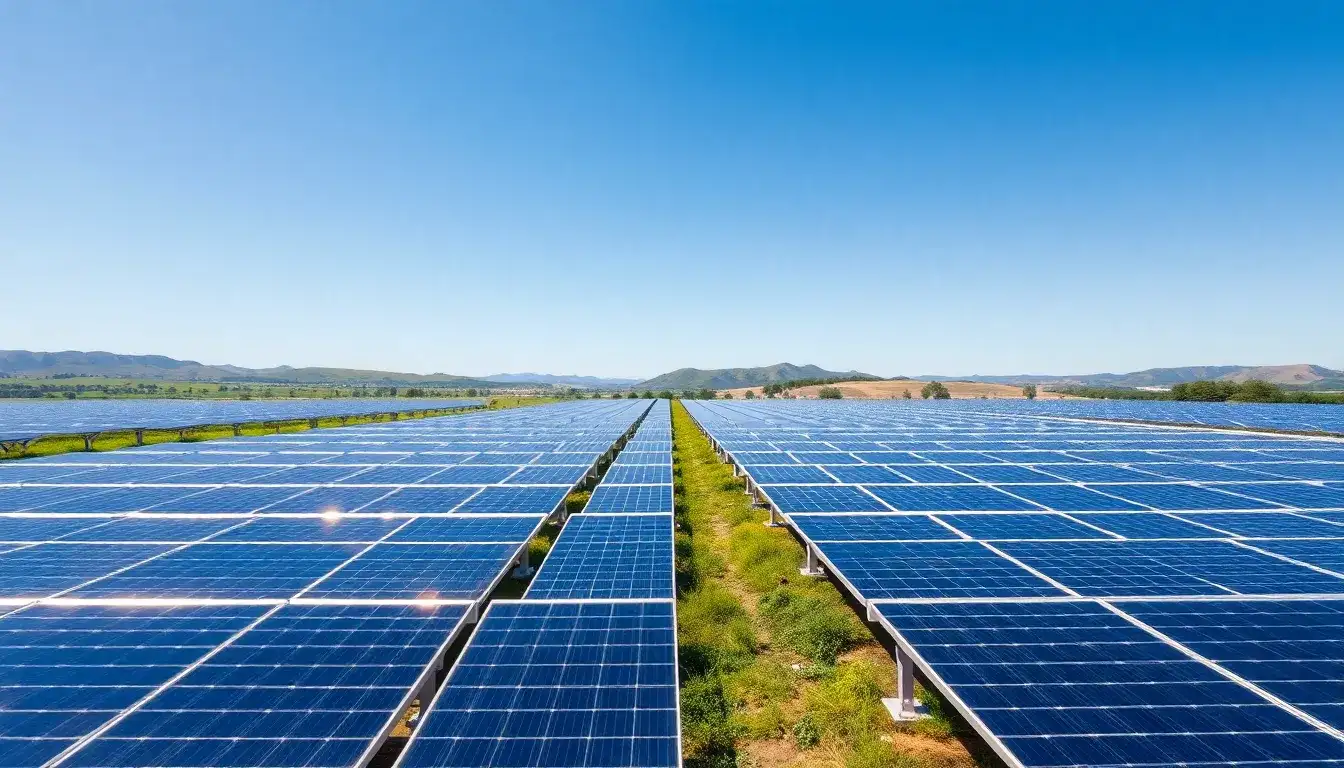
The global solar cells and modules market is projected to reach approximately USD 420 billion by 2034, growing at a CAGR of 9.2% as demand for clean energy continues to rise. Currently valued at around USD 170 billion in 2024, the market’s growth is driven by increasing investments in solar technology, improving cost competitiveness, and favorable policy frameworks across the globe.
### Market Segmentation
**By Technology:**
– **Monocrystalline Solar Cells and Modules:** Dominating the market with roughly 40% share, these cells are recognized for their high efficiency (15% to 22%) and are well-suited for residential and commercial uses where space is limited. Advancements in technology are expected to enhance their performance and decrease costs further.
– **Polycrystalline Solar Cells and Modules:** Holding about 30% market share, these cells offer moderate efficiency (13% to 16%) at a more economical price, making them attractive for budget-conscious applications, especially in utility-scale projects.
– **Thin-Film Solar Cells and Modules:** While they occupy a smaller market share of approximately 10%, thin-film technology is effective in niche markets due to its lightweight and flexible properties, catering to innovative applications such as building-integrated photovoltaics (BIPV).
**By Application:**
– **Residential:** Leading the application segment with an estimated 40% share, the residential market is driven by decreasing module costs and increased consumer awareness, with innovations like solar rooftops gaining popularity.
– **Commercial:** Accounting for around 25% of the market, businesses are increasingly adopting solar solutions to reduce costs and enhance their sustainability image.
– **Utility-scale:** Comprising about 35% of the application share, utility-scale solar projects are critical for transitioning to clean energy, supported by government incentives globally.
**By Component:**
– **Modules:** Representing nearly 70% of the market, solar modules are fundamental to solar power systems, with innovative designs and materials improving efficiency and lowering production costs.
### Regional Outlook
**Asia-Pacific:**
Leading the market with about 50% of global revenue, this region benefits from strong government backing and rapidly growing energy demands. Countries like China and India are heavily investing in solar farms and rooftop systems, with a forecasted growth rate of approximately 12%.
**North America:**
Holding a 25% market share, North America is propelled by favorable policies and an increasing awareness of renewable energy. The U.S. is the largest contributor in this region, with a projected CAGR of around 8% by 2034.
**Europe:**
With a 20% market share, Europe is characterized by stringent climate policies aimed at reducing fossil fuel dependency. The market is anticipated to grow at a CAGR of 7%, driven by rising electricity prices and regulatory support.
**Latin America and Middle East & Africa:**
Emerging markets in these regions show promising potential with estimated CAGRs of 10% and 9%, respectively, as countries like Brazil and South Africa enhance energy security through solar solutions.
### Market Drivers
Key drivers include the increasing demand for sustainable energy, advancements in photovoltaic efficiency, and policy-driven incentives. Innovations such as bifacial solar modules and smart solar systems are altering market dynamics, while decentralized energy generation trends are appealing to a broader user base.
### Challenges and Restraints
Despite a favorable outlook, the market faces challenges such as supply chain disruptions affecting key materials like silicon, leading to increased production costs. Additionally, inconsistent regulatory frameworks can complicate expansion efforts. Competition from alternative renewable technologies necessitates continuous innovation among solar companies to maintain a competitive edge.
### Emerging Opportunities and Trends
Several trends are opening new avenues for industry players. Off-grid solar solutions are gaining traction in remote areas, and the integration of smart technologies is optimizing energy management. Community solar models are also facilitating participation without high upfront costs. Breakthroughs in materials science, particularly perovskite solar cells, promise to significantly improve efficiency and reduce costs.
### Key Competitors
– First Solar
– SunPower Corporation
– Trina Solar Limited
– Canadian Solar Inc.
– JinkoSolar Holding Co., Ltd.
– Longi Green Energy Technology Co., Ltd.
– Hanwha Q CELLS
– REC Group
– Vivint Solar
– LG Electronics
– JA Solar Technology Co., Ltd.
– Tata Power Solar Systems Ltd.
– Adani Solar
– Risen Energy Co., Ltd.
– Solaria Energia y Medio Ambiente S.A.
### Recent Strategic Developments
– **First Solar** announced a $1 billion investment to expand its manufacturing facility in India, expected to create about 5,000 jobs.
– **Adani Solar** launched a new line of high-efficiency panels aimed at improving energy output in utility projects.
– **JinkoSolar** partnered with a leading renewable energy firm for large-scale projects across Asia-Pacific.
This market outlook indicates a vibrant future for solar technology, underscored by innovation, policy support, and shifting consumer preferences towards sustainable energy solutions.
Original article by NenPower, If reposted, please credit the source: https://nenpower.com/blog/solar-cells-and-modules-market-expected-to-hit-usd-420-billion-by-2034-driven-by-clean-energy-demand/

