

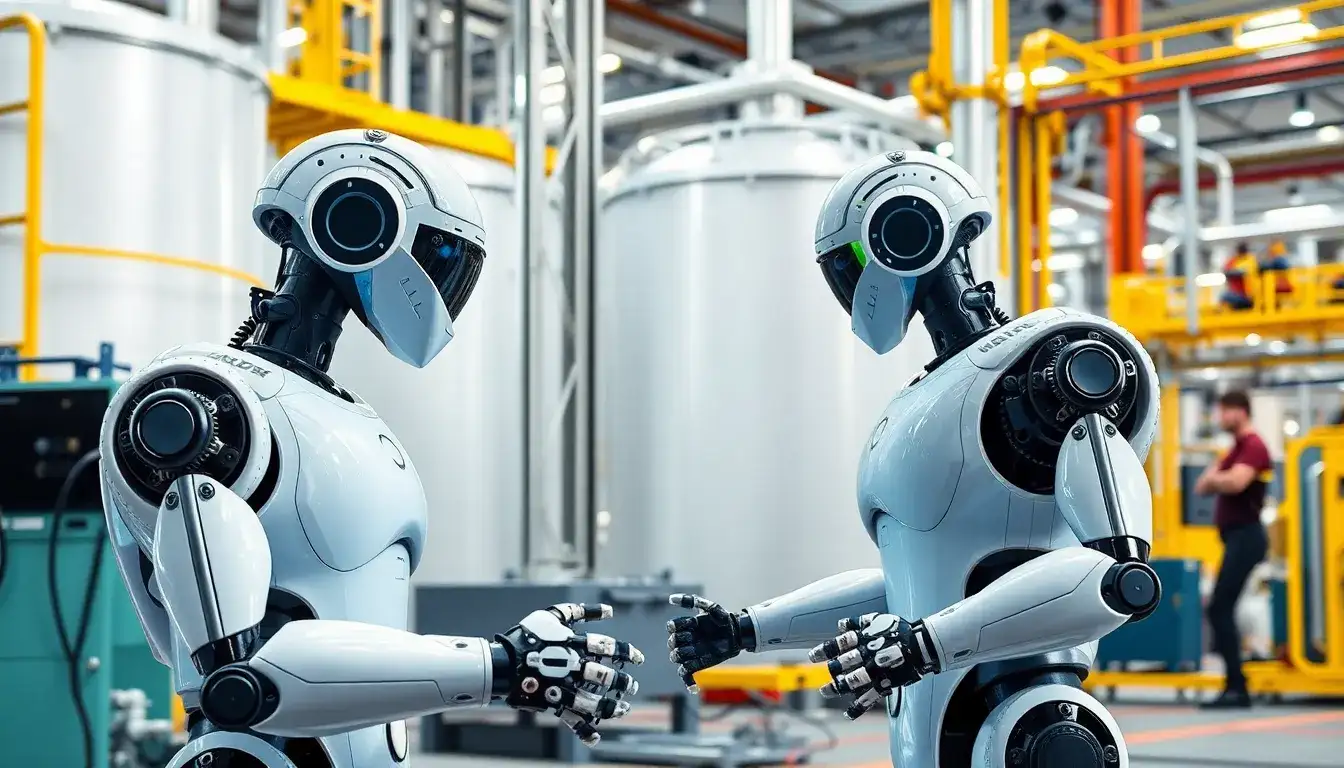
Intelligent Robots: The “New Colleagues” on the Production Line
Intelligent robots are becoming the “new colleagues” on the frontlines of the petrochemical industry, from drones cleaning solar panels to robots inspecting pipelines, from intelligent welding machines to automated laboratories. In the 2026 government work report, the State Council highlighted the goal of expanding smart manufacturing and establishing new intelligent factories and smart supply chains. The group’s 2026 work conference emphasized enhancing the overall maturity of intelligent manufacturing. This feature presents the vivid practices of three companies that are empowering production with intelligent equipment, showcasing how smart manufacturing addresses industry pain points and supports a second wave of entrepreneurship.
Shijian Company: From “Intelligent Workers” to “Intelligent Factories”
On March 3, during a visit to the Shijian Company’s intelligent construction base in Qingdao, welding technician Liu Jianguo expressed excitement about the new intelligent welding robot, which can complete the welding of 620 mm pipes in just three days with a 100% quality pass rate. Recently, Shijian Company collaborated with Nanjing University of Science and Technology to develop a new generation of intelligent welding robots. This “steel tailor,” which has undergone three years of development and two iterations, has successfully overcome the limitations of earlier models that could not perform the root weld, increasing welding efficiency to four times that of traditional manual welding while reducing the need for welders by 75% and maintaining a quality pass rate of 100%.
The evolution from “capable of welding” to “skilled in welding,” and from “replacing human labor” to “surpassing human capabilities,” reflects Shijian Company’s precise understanding of the pain points in the engineering construction industry, driven by the integration of production and research that spurs technological breakthroughs.
Addressing Challenges: Three Years of Development to Overcome Root Welding Technical Hurdles
In pipeline welding, the root weld is the first critical checkpoint that determines welding quality. Its formation directly affects the pipeline’s sealing and pressure resistance, requiring extremely precise control over welding accuracy and molten pool management. For a long time, intelligent welding robots have struggled to perform the root weld independently due to technical challenges such as groove recognition accuracy and adaptive welding path adjustments, which left the core processes reliant on experienced welders, resulting in inefficiency and a risk of skilled labor shortages.
“Pipeline welding conditions are complex, with different pipe diameters, materials, and wall thicknesses, coupled with varying environmental temperatures. The parameters for root welding need precise matching. While manual welding relies on experience and skill, robots must possess the capabilities of ‘perception, judgment, and decision-making’ to achieve this,” explained Wang Yinfeng, head of the intelligent manufacturing R&D team at Shijian Company.
As early as 2022, Shijian Company had accumulated mature technology in the field of nine-axis intelligent welding robots. To further expand application scenarios, they focused their R&D efforts on the core pain point of “intelligent root welding technology.” The first challenge they faced was “weld seam positioning.” Traditional robots depend on pre-set programs, and any deviation in pipe placement can lead to misalignment in welding. To tackle this issue, the R&D team innovatively introduced a large-field laser camera system that utilizes three-dimensional vision technology for automatic recognition and positioning of the weld seam.
“The robot has developed ‘smart eyes’ that can rapidly capture the position of the weld seam under complex conditions, accurately identifying groove angles and gaps. Even slight movements of the pipe can be corrected in real-time,” noted Wang Kehong, a senior professor and doctoral advisor at Nanjing University of Science and Technology.
In May 2023, the prototype of the first-generation intelligent welding robot completed tests, achieving root welding for pipes with outer diameters ranging from 80 to 400 mm. However, challenges remained with unstable molten pools when welding special materials like alloy steel. The R&D team promptly initiated the first iteration, focusing on optimizing the sensing system by integrating multi-dimensional data, such as current voltage, line energy, inter-layer temperature, molten pool morphology, and gas flow, to establish a real-time feedback mechanism. When the molten pool deviated, the system could adjust welding speed and current parameters within 0.1 seconds to ensure uniform weld formation.
In 2025, the second iteration of the intelligent welding robot focused on “craft database construction.” The R&D team collected over a thousand welding process parameters for various pipe diameters, materials, and working conditions and optimized the parameter matching logic through machine learning algorithms, creating a “welding expert database” that encompasses carbon steel, stainless steel, and alloy steel. This allows the robot to have “experience accumulation” capability; under new working conditions, it only needs to input basic parameters for the system to automatically match the optimal welding plan and achieve “one-click welding.”
By January of this year, the new generation of intelligent welding robots completed all development tasks, achieving stable “one-click” intelligent root welding while integrating filling and cover welding functions, truly becoming a “jack of all trades” covering the entire welding process. Its core hardware comprises a six-axis robot, a new high-precision digital positioning machine, a three-dimensional vision system, and an intelligent welder. The software includes the welding expert database and an intelligent planning control system, collaboratively building a fully automated intelligent welding process system.
Demonstrating Effectiveness: From Solving Welding Technology Issues to Setting Industry Standards
At the construction site of the DMTO (Methanol-to-Olefins) facility in Tengzhou, Shandong, undertaken by Shijian Company, the mechanical arm of the intelligent welding robot accurately grasps the pipe, the positioning machine rotates the pipe to adjust its angle, and the laser camera scans to locate the weld seam, while the welding torch smoothly delivers the arc. The entire process requires only one operator to monitor the operation of four intelligent robots from the control room. In this project, the intelligent welding robots completed welding tasks for 3,960-inch diameter pipes, with 320 weld seams achieving a 100% quality pass rate, setting a new record for welding efficiency among similar projects.
Beyond its efficiency advantages, the intelligent welding robot’s “full lifecycle information tracing” capability addresses long-standing pain points in the engineering construction industry. During the welding process, the system automatically records over 20 data points, including current voltage curves, welding speed, and inter-layer temperatures, generating a unique “weld seam ID.” Management personnel can query complete data via mobile phones or computers, achieving comprehensive control over the welding operation process with “pre-welding plans, in-process monitoring, and post-welding traceability.” “Previously, when quality issues arose, we had to sift through thick paper records to identify the problems. Now, we can locate the cause in just 30 seconds, increasing quality control efficiency by more than four times,” said Ji Peng, deputy manager of the technical quality department at Shijian Company.
More profoundly, the intelligent welding robot systematically addresses the pain points within the petrochemical construction industry. Currently, the field faces high risks of safety and quality fluctuations, shrinking profit margins, rising labor costs, and an aging workforce. The new generation of intelligent welding robots provides a comprehensive solution: firstly, intelligent welding operations reduce the time welders are exposed to hazardous environments, significantly improving intrinsic safety levels and providing a low smoke and noise working environment. Secondly, the intelligent welding process diminishes reliance on human experience, alleviating the pressure of talent shortages, while precise cost control and efficiency improvements expand profit margins for engineering companies. “The intelligent welding robot not only completed the welding tasks but also highlighted the immense potential of intelligent manufacturing in cost reduction, efficiency enhancement, quality improvement, and risk control, which is unparalleled by traditional welding processes,” stated Zhang Rui, project manager for the Shijian Company’s Tengzhou DMTO project.
As a key player in the second wave of entrepreneurship in engineering construction, the value of this intelligent welding robot extends beyond the equipment itself. The core technologies developed during its R&D process, such as “multi-dimensional sensor fusion” and “intelligent parameter matching,” lay a solid foundation for future intelligent equipment development. The demonstrated advantages of “safety, efficiency, quality, and controllability” in projects set a practical benchmark for intelligent manufacturing in the engineering construction industry.
Laying the Groundwork for the Future: Comprehensive Upgrades from Intelligent Equipment to Industrial Ecosystems
Leveraging the technological accumulation from the nine-axis intelligent robots and intelligent welding machines, Shijian Company undertook the “challenge-based” project and the demonstration of the intelligent pipeline prefabrication production line in 2025, pushing intelligent manufacturing from “point breakthroughs” to a new phase of “system integration.” “If a single robot is an ‘intelligent worker,’ then the intelligent prefabrication production line is an ‘intelligent factory,’” explained Wang Yinfeng. The intelligent pipeline prefabrication production line will integrate multiple independent processes, including intelligent processing of pipeline materials, three-dimensional storage, intelligent transport, intelligent assembly, and intelligent welding, achieving full-process automated linkage through an AI control system.
“From inbound inventory, processing, assembly, welding to finished product outbound, the entire process requires no manual handling or operation. The system will automatically schedule equipment based on production plans, achieving a streamlined production process for craft pipelines,” Wang Yinfeng added. The intelligent pipeline prefabrication production line was put into operation on February 10, aiming to achieve an annual output of 200,000-inch diameter pipes. Compared to traditional prefabrication workshops, production efficiency has increased threefold, with product quality consistently above 99.8%.
The intelligent pipeline prefabrication production line can quickly adjust welding process parameters based on different project requirements, achieving “flexible production.” This flexibility caters to both large-scale refining and chemical engineering projects and personalized orders for smaller renovation projects, significantly enhancing the industrialization level of petrochemical engineering construction. In the beginning of the 14th Five-Year Plan, Shijian Company has clearly outlined its development direction as “AI + manufacturing,” focusing on addressing industry pain points by actively exploring a new model of “base layout + modular construction.” From breakthroughs with single intelligent robots to integrated production lines, and from technological research and development to industrial application, Shijian Company’s practices in intelligent manufacturing reflect the transformation direction of the petrochemical engineering construction industry. Amid the new wave of industrialization, intelligent equipment as the core of new productive forces is gradually replacing traditional labor-intensive production modes, hastening the process of second entrepreneurship in engineering construction.
Tianjin Petrochemical: “Robot Colleagues” Reshaping Production Models
In the production area of Tianjin Petrochemical, a quiet revolution in digitization is taking place. Robots and “digital workers” are no longer just the realm of science fiction; they are now everyday “colleagues” working alongside frontline employees. From overhead pipelines to underground substations, from intelligent three-dimensional warehouses to precision laboratories, the integration of these robotic colleagues is not merely a replacement of human labor but a profound transformation of production models. Tianjin Petrochemical is focused on constructing a digital twin intelligent factory, enabling a harmonious resonance between the physical and digital worlds.
“Sky Scout”: The Guardian Above the Pipeline
In the facility pipeline corridor, a drone is patrolling along a preset route. This is Tianjin Petrochemical’s 5G smart inspection drone, likened to an “aerial scout,” equipped with a high-definition camera to monitor the condition of the inter-factory pipeline corridor over a radius of several kilometers. Utilizing a comprehensive 5G network and RTK (Real-Time Kinematic) high-precision positioning, the drone, in conjunction with an intelligent hangar, enables fully autonomous inspections. It not only performs routine inspections on long-distance pipelines, transmitting images and data back to the monitoring platform but can also detect gas leaks through infrared imaging, identifying hazards that are often invisible to the naked eye. Tasks that previously took manual inspection half a day can now be completed in just 30 minutes by the drone, significantly improving inspection efficiency.
“Wall Climber”: The Expert for Overhead Pipelines
The drone acts as the “eye in the sky,” while the newly developed wall-climbing detection robot serves as the specialized doctor diagnosing the pipelines. To address the industry’s challenges of low efficiency and high safety risks in manual inspections of overhead pipelines, Tianjin Petrochemical’s Equipment Research Institute developed a wall-climbing robot. This device adheres securely to the pipe wall using magnetic power and is equipped with a high-definition camera and electromagnetic ultrasonic probe, capable of simultaneously performing macro inspections of the outer wall and precise thickness measurements, with an accuracy of up to 0.01 mm. “The wall-climbing robot not only eliminates the time cost of scaffolding but also accurately locates points of corrosion, providing reliable data for maintenance planning,” said Shi Yaozhong, director of the Technology Development Center at the Equipment Research Institute.
During the 2025 plant maintenance period, this robot was successfully deployed to inspect over 30 overhead pipelines. Tasks that traditionally required several days of manual scaffolding inspection were completed with precision by the robot in just a few hours, without the need for personnel to work at heights, achieving breakthroughs in both safety and efficiency.
“Automated Laboratory”: A Transformation in Chemical Testing
At the Tianjin Nankang Ethylene Center laboratory, AGV sorting robots operate flexibly, accurately grabbing sample bottles, while the fully automated analysis system runs in an orderly manner. This is the first fully intelligent analysis system for water quality in a petrochemical industry laboratory in China. Starting from sample collection at the plant, the intelligent safety unmanned sample delivery vehicle takes over the process. External operators access the sampling cabinet using facial recognition, place the samples inside, and the unmanned vehicle follows a planned route to deliver samples to the central laboratory. Throughout the process, sample identification, scanning, sorting, testing, data uploading, and bottle cleaning and storage are all completed by “digital employees.” Currently, this system has achieved integrated management for water quality analysis, chromatographic analysis, and more, saving over 30 positions and reducing business response times by 50%. Laboratory technicians have shifted from repetitive tasks to more valuable data analysis and quality control work.
“Substation Sentinel”: The Unblinking Guardian of Safety
Within the relay protection room of the 220 kV substation, a track-based intelligent inspection robot slowly moves along its track. It is equipped with visible light cameras, infrared thermal imaging devices, and partial discharge sensors, conducting comprehensive inspections of over 100 secondary screen cabinets. “Previously, manual inspections of these cabinets required checking numerous alarm indicators and the status of pressure plates, leading to a huge workload with potential for oversight,” said Wang Zheng, the person in charge. Now, this robot employs odometry and radio-frequency identification navigation, achieving millimeter-level positioning accuracy, and through deep learning algorithms, it can accurately identify instrument readings and switch statuses, with infrared temperature measurement accuracy exceeding 98%. More impressively, it has the “sense of smell”—thanks to a three-in-one partial discharge sensor and a six-in-one gas sensor, the robot can continuously monitor the discharge conditions and operating environment of switch cabinets. In September 2024, the indoor inspection robot detected transformer lead faults through smoke sensors, promptly sending alarms and providing valuable support for emergency response. Currently, Tianjin Petrochemical has deployed 22 substation inspection robots and 80 intelligent cameras, conducting over 70,000 inspection points daily, with a total of 323 effective alarms and 128 identified anomalies, allowing for the optimization of 30 personnel to higher value-added positions.
“Warehouse Manager”: Intelligent Scheduling at Heights of 37.8 Meters
In the intelligent three-dimensional warehouse of the Tianjin Nankang Ethylene project, stackers navigate flexibly between shelves that reach 37.8 meters high. This facility, with 38,252 storage spaces, is the largest single intelligent warehouse in China for storage capacity. Utilizing intelligent manufacturing equipment, the entire process from inbound inventory to outbound loading is automated. Polyolefin products are sealed in bags, palletized, and formed with protective film, then automatically assigned to storage locations within the three-dimensional warehouse. During outbound operations, the system provides optimal routing for orders, pre-stocks items, and enables one-click loading when vehicles arrive. “The pick-up efficiency has increased by over 30%, and there are zero errors in product distribution,” said management personnel Shu Chunyan. By embedding chips in shared pallets, every product can be traced, achieving 100% accuracy in inbound and outbound tasks. The “Warehouse Manager” has become a crucial part of the efficient operation of the intelligent factory.
Zhejiang Ningbo Petroleum: Entering the Low-altitude Economy with Drone Cleaning of Solar Panels
On February 26, the low-altitude test flight route and flight service platform project (Phase I) was launched in Ningbo City, with Zhejiang Ningbo Petroleum signing a strategic cooperation agreement with Ningbo Low-altitude Economic Development Co. Ltd., becoming a core strategic partner of the project. Previously, Ningbo Petroleum’s successful pilot in drone cleaning technology for solar panels laid a solid foundation for comprehensive cooperation, representing a precise alignment of the company’s energy network resources with Ningbo’s low-altitude infrastructure system, and a key move to expand development space and uncover new value in its primary business during the second wave of entrepreneurship.
Drone Cleaning: A New Intelligent Solution for Solar Panels
As early as September 2025, Ningbo Petroleum pioneered the use of drone technology for cleaning solar panels at the Funan charging station, marking the first step in exploring the integration of low-altitude economy and energy business. Traditional manual cleaning of solar panels poses safety risks associated with working at heights and uses significant amounts of water, while requiring coordination of downtime, resulting in variable cleaning efficacy. In this pilot, technicians operated drones to perform full-area scanning, pollution identification, and precise cleaning, completing the task in just half an hour without halting operations or erecting scaffolding, effectively addressing the pain points of traditional cleaning methods. The drone cleaning system consists of a high-altitude operational drone, a cleaning liquid supply system, a visual recognition system, and a control platform, maintaining a safe height of 2-3 meters during operations. It first sprays a neutral environmentally-friendly cleaning solution to break down grease and dust, then switches to clean water mode for rinsing, ensuring no collision or damage to the solar panels, and reducing water use by over 60% compared to manual cleaning. Following the cleaning, the solar panels at the Funan charging station saw a 15% increase in power generation efficiency, restoring daily power generation to design levels. The initiative is expected to reduce electricity consumption by 10,000 kWh annually and generate approximately 5,000 yuan in economic benefits.
Technological Pilot: Smart Transformation of Solar Operations
The successful pilot of the drone cleaning technology for solar panels exemplifies Ningbo Petroleum’s focus on addressing industry pain points and promoting digital transformation, accumulating valuable technology and practical experience for its low-altitude economic layout. According to relevant technical personnel, this cleaning system operates at over ten times the efficiency of manual labor, capable of completing the cleaning of solar panels at 6-8 charging stations in a single day. In terms of safety and environmental protection, the drone is remotely controlled throughout the process, completely avoiding the safety risks associated with manual work at heights; the cleaning solution is biodegradable, neutral in pH, and does not corrode the surface of the solar panels or pollute the surrounding soil and water, aligning perfectly with green and low-carbon development principles. While the initial investment in the system is slightly higher than that of manual labor, considering the reduced cleaning frequency, water savings, increased power generation efficiency, and diminished safety hazards, the long-term economic benefits are significant. Furthermore, drone cleaning can be flexibly scheduled during low-traffic periods, ensuring minimal impact on the normal operation of charging stations and truly realizing a new model of safe, efficient, environmentally friendly, and low-disruption photovoltaic maintenance.
Partnering in the Low-altitude Economy: Unlocking Diverse New Scenarios for Second Entrepreneurship
Building on the success of the drone solar panel cleaning technology pilot, Ningbo Petroleum is now a core strategic partner in the low-altitude test flight route and flight service platform (Phase I) project in Ningbo City. This partnership connects Ningbo Petroleum’s network of over 150 “Petrochemical Easy Electric” charging stations with Ningbo’s low-altitude infrastructure system, creating an excellent platform for the large-scale application of drone cleaning technology while opening up new avenues for the company’s low-altitude economic initiatives and injecting new energy into its second wave of entrepreneurship. It is reported that after the project is completed, it will support 200,000 hours of low-altitude flights annually and is scheduled for trial operation by the end of September 2026. The drone solar panel cleaning service is currently the first energy application scene where the two parties have collaborated, marking a significant entry point into the low-altitude economy for Ningbo Petroleum. Simultaneously, a project for low-altitude inspections of urban roads is in the site selection phase, which will serve as another important exploration for expanding low-altitude economic application scenarios. Moving forward, Ningbo Petroleum plans to leverage its existing “Petrochemical Easy Electric” charging station network to plan and establish drone take-off and landing sites, ensuring efficient coordination between energy supply and flight operations. Additionally, it will develop ground signal stations for communication, navigation, monitoring, and meteorology to solidify the foundation for low-altitude flight safety and actively engage in developing low-altitude economic application scenarios and project financing, driving the successful implementation of low-altitude economic projects.
Original article by NenPower, If reposted, please credit the source: https://nenpower.com/blog/smart-robots-revolutionizing-the-workforce-in-petrochemical-production/

