

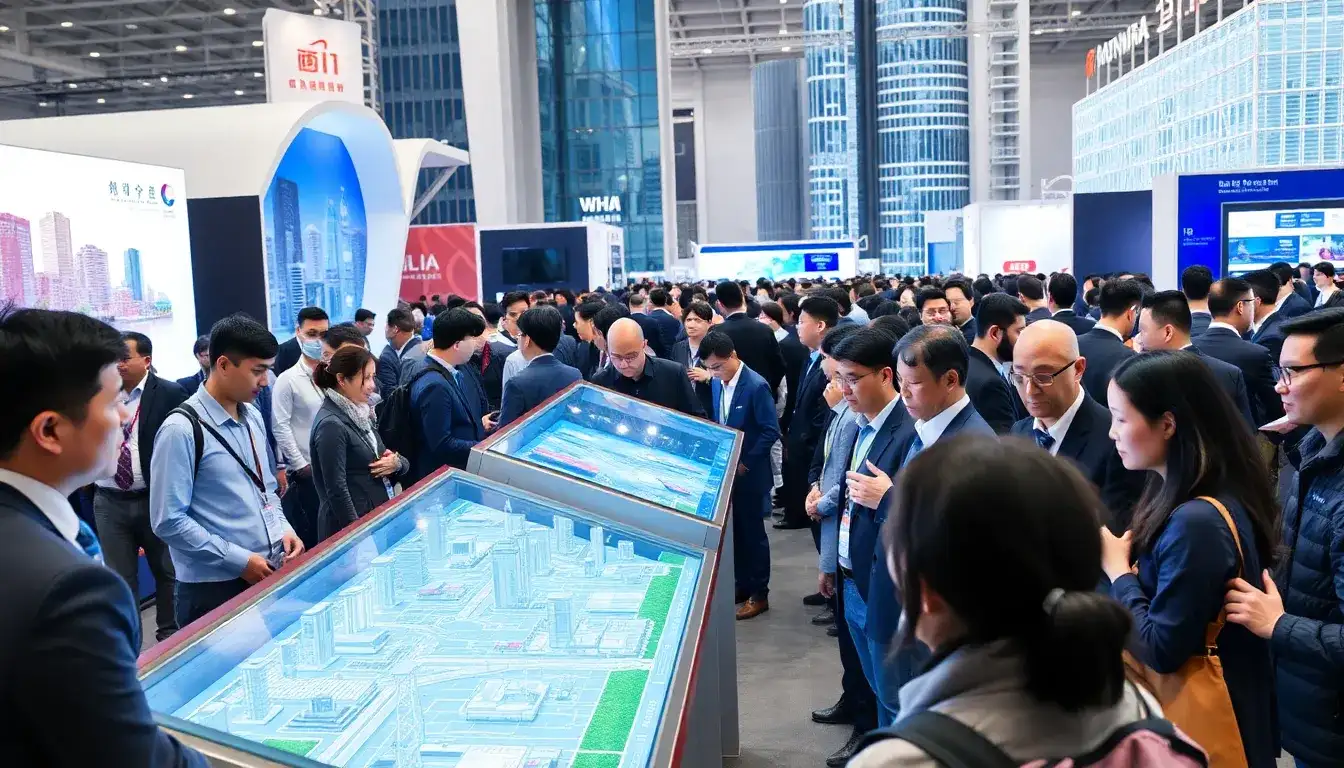
The 6th Smart City and Intelligent Construction Industry Expo and Forum Opens
On April 24, the 6th Smart City and Intelligent Construction Industry Expo (referred to as the “Dual Intelligence Expo”) and forum officially commenced in Wuhan. This event is organized by the Wuhan Urban Construction Investment and Development Group and is centered around the theme of “Urban Evolution and Construction Revolution in the AI Era.” The expo focuses on the cutting-edge developments in the smart city and intelligent construction sectors, promoting mutual learning, exchange, and collaborative growth within the industry, ultimately aiming to better serve the high-quality development of cities, efficient governance, and enhanced living standards.
Since its inception in 2019, the Dual Intelligence Expo has successfully held five editions, attracting over <b>3,000 key enterprises</b> and more than <b>50,000 buyers and distributors</b> for discussions and collaborations, along with <b>100,000 industry professionals</b> participating in networking activities. This year's expo is the largest and most influential gathering since its establishment.

The exhibition area spans <b>60,000 square meters</b>, featuring a total of <b>500 enterprises</b> from central state-owned enterprises, local state-owned enterprises, and high-tech companies. The expo includes five major thematic pavilions: the Global Security Pavilion, Social Emergency Rescue Pavilion, Comprehensive Energy Supply Chain Pavilion, Smart City and Intelligent Construction Pavilion, and the State-Owned Enterprise Innovation Ecological Application Pavilion. In total, there are six exhibition halls, with over <b>100 industry leaders</b> in attendance. Special events during the expo, such as the <b>China-Korea Hydrogen Energy International Exchange and Cooperation Conference</b> and the <b>Beidou Transportation Industry International Cooperation Exchange Conference</b>, further enhance the international character of the event.

On the morning of April 24, the expo showcased the latest technological achievements in smart cities and intelligent construction, featuring innovations in smart water management, digital municipal services, artificial intelligence, and smart transportation. The Wuhan Urban Investment Group demonstrated a robot fleet focusing on smart water management, energy, and urban bridge management. The Wuhan Construction Group introduced the application scenarios for their unmanned intelligent bridge construction equipment, which is expected to see widespread use in future bridge welding robotics. Additionally, the fifth-generation intelligent 3D laser cutting equipment from Wuhan Investment Control Group was recognized as a "National Champion Product" by the Ministry of Industry and Information Technology in 2024.

Wuhan Financial Holdings Group showcased its "Hanrong Check" product, providing comprehensive insights into corporate business registration, operational data, asset status, technological capabilities, financing information, and risk data, thus creating a digital hub for credit services throughout a company's lifecycle. The Smart City Pavilion exhibited the latest technologies in smart construction, monitoring, and gas management. For instance, Shanghai Tunnel Engineering Co. presented a digital shield tunneling system that enables autonomous tunneling with minimal human involvement. They also showcased the largest digital twin of an LNG receiving station in the country, which supports the high-quality development of urban atmospheric source bases.

Other notable exhibits included a smart brick-laying robot from Wuhan Yucheng Group, which offers a glimpse into the future of intelligent construction, and the Kunlong D model liquid cooling integrated machine displayed by Wuhan Linkong Investment, which provides computational support for smart city development. Additionally, the smart charging vehicle from Wuhan Urban Transportation Group allows for seamless one-click charging for new energy vehicles, enhancing convenience for users. The Wuhan Energy Group announced its technical requirements for the development of a third-party construction monitoring system and an all-weather monitoring system to achieve intelligent oversight of gas pipeline construction.

In addition to local state-owned enterprises, central state-owned enterprises such as China Mobile and China Telecom also presented numerous smart city technologies. China Mobile showcased a three-dimensional service system for the low-altitude economy, promoting the large-scale application of unmanned inspections, while China Telecom introduced smart inspection technology aimed at improving inspection efficiency and hazard detection. As a representative of district-level state-owned enterprises, Shiyi Kechuang Investment presented its domestically developed Shiyi Rendu dual-brain model integrated machine, establishing a controllable data intelligence system for government and enterprise users.

Throughout the event, over <b>500 high-tech enterprises</b> from across the nation brought hundreds of new technologies, products, and applications, covering various fields such as large models, hydrogen energy, photovoltaic technology, green electricity, charging stations, tunneling machines, new materials, and intelligent equipment, attracting numerous attendees.

During the opening ceremony and forum, experts and industry professionals discussed the deep integration of artificial intelligence with urban construction, focusing on how digital intelligence can elevate urban quality. Zhang Xiaochun, Secretary of the Party Committee and Chairman of Shenzhen Smart City Technology Development Group, delivered a keynote speech on <b>"Exploration and Practice of Digital Twin City Construction,"</b> sharing Shenzhen's experiences and insights in advancing digital twin technology, ultra-broadband, artificial intelligence, and digital energy.

Academician Zhou Wenyin from the Russian Academy of Engineering emphasized that sharing technological resources between universities and enterprises can foster high-quality transformation in the low-altitude economy. Baidu Vice President Shi Qinghua discussed how large models could accelerate innovations in intelligent construction and urban services. Huang Zhengdong, Vice Dean and Professor at the School of Architecture and Urban Planning at Shenzhen University, highlighted that digital transformation can modernize and refine urban governance, addressing various challenges. Xue Zhigang, an expert committee member from the Ministry of Transport's Fifth Expert Committee (Postal Group), provided insights on exploring collaborative applications in the low-altitude industry.

On the afternoon of April 24, the <b>2nd Wuhan State-Owned Enterprises Embracing High-Tech Enterprises Conference</b> was held concurrently with the 6th Dual Intelligence Expo. This event utilized an "Innovation Conference + Exhibition" model to create a collaborative platform for state-owned enterprises, central enterprises in Wuhan, private high-tech enterprises, and research institutions, promoting an innovative ecosystem.

Throughout the expo, additional forums were held, including the <b>2nd Comprehensive Management and Application Technology Forum on Smart Energy</b> and the <b>2025 China Operational Vehicle Safety Production and Insurance Risk Control Service Conference</b>, among others, totaling over ten industry forums and international exchange activities.

The Dual Intelligence Expo serves not only as a platform for technology demonstration but also as an accelerator for the implementation of smart industries. This year’s event has bridged the entire chain from technology showcase to supply-demand matching and results transformation, injecting strong momentum into the fields of smart cities and intelligent construction in Wuhan. In the smart transportation demonstration area, a truck was showcased, demonstrating its automatic emergency braking system, which halts just before colliding with a mannequin. This system, developed by Zhuhai Mofang Core Intelligence Technology Co., utilizes Beidou technology to provide various features such as one-click rescue, high-definition navigation, and emergency braking. The product, which is mature and easy to install, is priced at just over 3,000 yuan, helping to mitigate many driving risks.

Moreover, the expo featured high-precision positioning chips and smart transportation solutions, with participating companies collaborating with local enterprises on projects integrating Beidou technology with intelligent construction and smart cities, promoting technological synergy and resource sharing, and accelerating the large-scale application of Beidou technology in the Yangtze River Economic Belt.

In the Urban Rescue Equipment Pavilion, companies such as China Aneng, China Railway Eleventh Bureau, Wuhan Water Group, and various rescue teams showcased multiple emergency vehicles and equipment. On the morning of April 24, China Aneng conducted a live emergency rescue drill, impressing attendees with the level of intelligence involved in modern emergency responses.

As digital twin technology meets the banks of the Yangtze River, Wuhan is using the <b>Dual Intelligence</b> framework to craft a new blueprint for future cities, providing a <b>"Wuhan Model"</b> for the global digital transformation of urban areas. As Hubei Province accelerates its development as a strategic pillar in Central China, Wuhan is solidifying its foundation with strong support from technological innovation.
Original article by NenPower, If reposted, please credit the source: https://nenpower.com/blog/sixth-smart-city-and-intelligent-construction-expo-opens-in-wuhan-highlighting-ai-innovations-and-industry-collaboration/

