

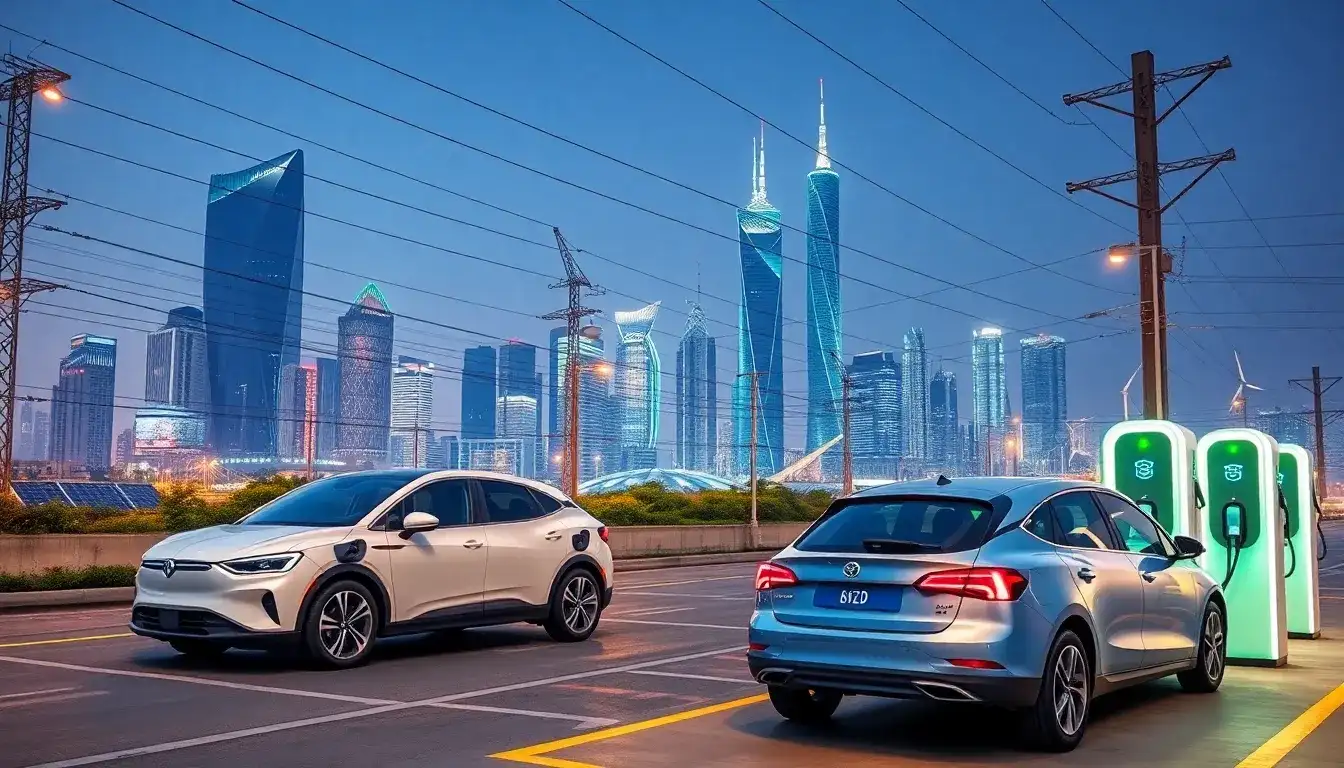
According to recent developments, the announcement of the first batch of pilot projects marks a significant step towards the large-scale application of Vehicle-to-Grid (V2G) technology in China. This initiative aims to address existing developmental bottlenecks and gather valuable experience for future commercialization.
The National Development and Reform Commission, National Energy Administration, Ministry of Industry and Information Technology, and State Administration for Market Regulation jointly released a notification identifying nine cities, including Shanghai, as part of the first batch of V2G pilot cities. Among the 30 projects listed are initiatives like the V2G collaborative regulation project based on new energy storage in Beijing.
V2G facilitates a two-way flow of both energy and information between vehicles and the power grid. Industry experts believe that the unveiling of these pilot projects signifies a substantial advancement in the large-scale application of V2G technology, which will help overcome current challenges and lay the groundwork for commercial implementation.
In recent years, policies at both national and local levels have been consistently introduced to promote the V2G industry. Last August, the relevant departments issued a notice encouraging the large-scale application of V2G technology, emphasizing the principles of “innovation-led and pilot testing.” The aim is to promote orderly charging of electric vehicles, expand the scale of bidirectional charging and discharging projects, and enrich V2G application scenarios. Cities are tasked with developing sustainable policies for large-scale V2G implementation, focusing on advanced technologies, clear business models, and market-driven development.
Industry insiders widely regard the initiation of these pilot projects as a crucial milestone for the V2G sector. Zhang Hong, a member of the Expert Committee of the China Automobile Circulation Association, stated that the pilot projects would provide a solid foundation for the future integration of electric vehicles with the power grid through technological innovation, policy support, commercialization efforts, cross-regional collaboration, and coordinated development across the industry chain. For instance, the V2G project in Guangzhou is set to serve as a city-level benchmark, guiding the large-scale development of vehicle-grid interaction through market mechanisms.
Moreover, V2G technology is being actively applied in various regions, including Guangdong and Zhejiang, where integrated solar storage and V2G stations are being constructed, prioritizing public facilities and commercial parks for V2G infrastructure. This indicates that V2G has transitioned from the technology validation phase to large-scale application.
Additionally, several provinces and cities have already established V2G projects and are actively conducting practical applications. For example, in March, Shenzhen launched a V2G testing initiative involving over 17,000 vehicles and 18,000 charging piles across more than 760 charging stations, resulting in an interactive electricity volume of 88,000 kWh. Concurrently, the State Grid Shanghai Electric Power Company collaborated with the Shanghai Electrical Science Research Institute and various automotive and charging enterprises to conduct large-scale integration tests of vehicle-grid interaction.
Experts believe that the accelerated promotion of V2G will provide low-cost and efficient solutions for building a new power system, achieving a win-win situation for grid security, user benefits, and green transformation. Wang Ning, the director of the Automotive Industry and Technology Strategy Research Center at Tongji University, emphasized that the growing electricity demand cannot lead to unlimited grid expansion due to operational cost constraints. During peak load periods, the grid can leverage electric vehicles’ unique time and space characteristics to manage electricity dispatch, thereby enhancing the grid’s peak-shaving capabilities while effectively controlling construction and operational costs.
Zhang Hong further mentioned that V2G can enhance grid resilience through smart charging and discharging, push battery manufacturers to develop more durable batteries, and promote the smart transformation of charging pile companies, allowing vehicle owners to profit from electricity price fluctuations.
Guotai Junan Securities noted that the advancement of V2G projects presents three key opportunities for benefit. First, the charging pile and infrastructure sector will accelerate the layout and upgrading of charging stations. Second, the battery and energy storage sector will require more advanced battery technologies to support bi-directional energy flow. Third, the smart grid sector will face higher demands for intelligence and information levels, indicating a positive long-term development outlook for related industries.
Despite the existing practical applications of V2G technology, several challenges remain. Analysts suggest that governments and enterprises should prioritize issues related to standard formulation, infrastructure upgrades, business models, and profit distribution in advancing V2G commercialization. Additionally, since V2G spans multiple industries governed by different departments, effective coordination is crucial. An industry practitioner emphasized the need for enhanced collaboration among stakeholders to establish a comprehensive standard system for vehicle-grid synergy and interaction, promoting the standardization and certification of related technologies.
Furthermore, there is a call for strengthened data sharing. V2G involves various entities, including grid companies, automotive manufacturers, charging operators, and third-party data platforms, leading to data silos that hinder interoperability and sharing. Grid companies often lack access to essential information, such as vehicle battery status and transaction details, necessary for V2G interactions. At the same time, automotive companies may hesitate to share sensitive data due to confidentiality concerns, complicating the assessment of vehicles’ real-time adjustability.
Looking ahead, as policies, technology, and market forces converge, the profitability model for V2G is expected to become increasingly clear, with promising prospects for large-scale and commercial applications. It is anticipated that by the end of 2025, preliminary construction of a technical standard system will commence, time-of-use pricing policies will be implemented, and the scope of V2G pilot applications will expand. By 2028 to 2030, large-scale V2G applications are expected to be realized, providing millions of kilowatts of regulation capacity for the power system.
Original article by NenPower, If reposted, please credit the source: https://nenpower.com/blog/significant-progress-in-large-scale-vehicle-to-grid-interaction-applications-in-china/

