

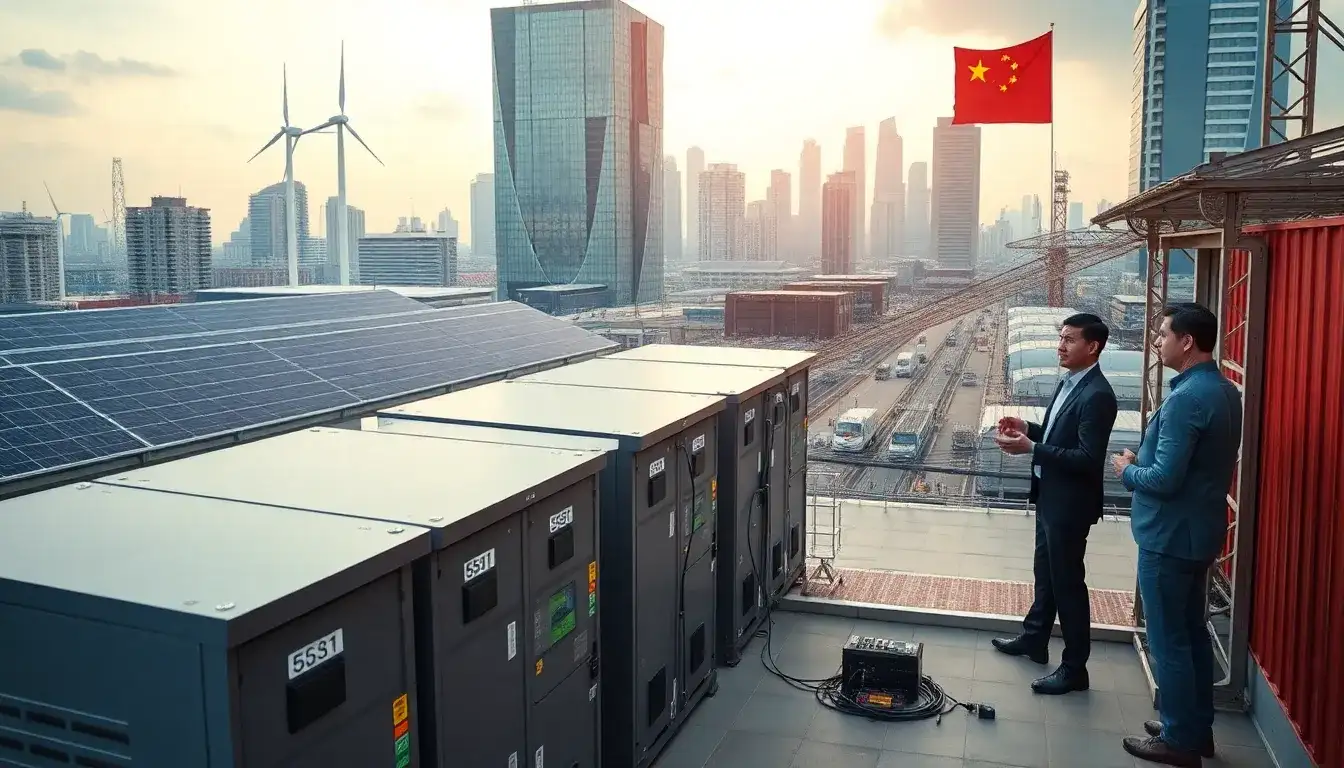
The “531” milestone is approaching, bringing significant changes to the energy storage market.
As we approach the beginning of 2025, the release of Document No. 136 marks a pivotal moment for China’s new energy sector. This document signals an intensive and profound policy adjustment period aimed at accelerating the development of a new power system and promoting the marketization of the new energy sector. The energy storage industry is currently undergoing a transformation, shifting from “policy dependence” to “value creation.” This evolution is not only redefining the fundamental logic of the energy storage industry but also fostering technological iterations, innovative models, and systemic ecological restructuring.
Is a rush to install energy storage systems on the horizon?
On February 9, 2025, the National Development and Reform Commission and the National Energy Administration jointly issued a notice titled “Notice on Deepening the Market-oriented Reform of New Energy Grid Connection Prices to Promote High-quality Development of New Energy” (commonly referred to as “Document No. 136”). This document clearly states that the installation of energy storage systems cannot be a prerequisite for the approval, grid connection, or operation of new energy projects. This marks the end of the era characterized by excessive reliance on mandatory energy storage installations, which has been criticized for being built but not utilized. Additionally, the document promotes the full entry of new energy grid connection volumes into the electricity market, signaling the beginning of a fully market-oriented era for new energy pricing. Therefore, the energy storage industry is transitioning from being “policy-driven” to “market-driven.”
The document establishes a timeline of June 1, 2025, as a critical point, categorizing new energy projects into “old” and “new” segments to facilitate differentiated market entry. Projects that commence operation before June 1 will still benefit from a guaranteed purchase mechanism, with electricity prices adhering to current policies (not exceeding local coal power benchmark prices). However, these projects will need to enhance their competitiveness through equipment upgrades and actively engage in the market. In contrast, projects launched on or after June 1 will have all their electricity volumes enter the electricity market through competitive bidding, determining prices based on market demand.
Consequently, public opinion suggests that policies will have two significant impacts on the energy storage market: first, the withdrawal of policy support may lead to short-term fluctuations in energy storage installations; second, to benefit from more favorable pricing policies and secure relatively stable returns, new energy companies are accelerating project construction to achieve grid connection before the “531” milestone, thus driving a surge in the construction and installation of energy storage projects.
Data from multiple institutions indicate that in the first quarter, new installations of advanced energy storage experienced a quarterly decline for the first time. However, according to data from the CESA Energy Storage Application Committee’s industrial database, the energy storage tendering market and new energy storage installations are currently showing a rapid growth trend. In the first four months of 2025, the domestic energy storage EPC/PC (including DC-side equipment), energy storage systems, and battery procurement have reached a staggering 34.52 GW/125.6 GWh, reflecting a year-on-year increase of 156%.
As of May 20, 2025, there have been 487 new energy storage projects connected to the grid, with a total installed capacity of 11.9 GW/32.32 GWh. This represents a year-on-year increase of 70.98% in installed power and 76.9% in capacity. Among these, 62 grid-side energy storage projects have been added, totaling 6.34 GW/14.63 GWh, with power and capacity increasing by 74.18% and 52.4%, respectively. Additionally, 76 power-side connection projects have a total capacity of 4.15 GW/13.73 GWh, with power and capacity growing by 59% and 102.2%, respectively. It is evident that to secure revenue through price differential settlement mechanisms and avoid risks associated with market pricing fluctuations, project owners are incentivizing the rapid placement of numerous orders before the “531” milestone, which has energized the tendering market. As energy storage projects typically have longer construction cycles, a decline in installations during the first quarter is not uncommon. Generally, the second quarter and the latter half of the year are expected to be peak periods for the delivery of energy storage projects, indicating that the rapid growth of new energy storage installations will remain a significant trend in the market this year.
Implementation of supporting measures for Document No. 136 in various regions
The issuance of Document No. 136 is perceived as fundamentally reshaping the development logic of the energy storage industry, marking a critical turning point for the electricity market as it transitions to a trading phase. Therefore, supporting local measures are crucial. Since May, Shandong and Guangdong, as frontiers for power reform and new energy storage development, have issued detailed documents, while Guangxi has also released online versions of its guidelines. This indicates that the market-oriented reform of new energy is entering a new phase of accelerated local implementation, providing a reference for subsequent policies in other provinces.
Shandong was the first province to publicly release the implementation details of Document No. 136. The policy highlights include enhancing the electricity market mechanism to directly increase energy storage revenue. Shandong mandates that by the end of 2025, wind and solar power must fully participate in electricity market transactions, with competitive bidding for electricity prices planned to begin in June 2025. To promote the continuous and healthy development of new energy storage, Shandong has implemented several favorable measures. On the one hand, regarding the electricity pricing mechanism, it has appropriately loosened price limits in the spot market, widening the price difference between charging and discharging. Existing projects (those operational before May 31, 2025) will see their mechanism price follow the national ceiling of 0.3949 yuan/kWh, which is approximately 12.8% higher than the average spot price for new energy in 2024, set at 0.35 yuan/kWh. New projects (commencing operations on or after June 1, 2025) will determine their mechanism price through competitive bidding, requiring a sufficient charging rate of no less than 125%, with the final price based on the highest bid among selected projects. These measures are designed to directly enhance the profitability of energy storage in the electricity market.
Furthermore, the policy clarifies that when independent energy storage delivers electricity to the grid, the corresponding charging volume will not incur transmission and distribution tariffs or government funds and surcharges. This significantly increases the profitability of energy storage stations, enhancing the competitiveness of independent storage facilities, which are expected to attract more investment. Guangdong’s policy emphasizes the full market participation of new energy, providing potential growth opportunities for energy storage. The detailed guidelines released by Guangdong specify that starting June 1, 2025, all new energy projects, including wind and solar, will fully enter the market, with prices determined through market transactions. Users can participate by either submitting bids independently, aggregating bids, or accepting prices.
While Guangdong’s implementation details regarding energy storage are relatively limited, the comprehensive market participation of new energy provides potential growth avenues for energy storage development. As all new energy grid connection volumes enter the market, the volatility and intermittency of new energy generation will become more pronounced. Energy storage, as an effective solution to these challenges, is likely to see increased market demand. For instance, energy storage can store electricity during periods of oversupply in new energy generation and release it when generation falls short, ensuring a stable power supply and better meeting market demands for supply stability.
According to the draft of the “New Energy Participation in the Electricity Spot Market Work Plan (2025 Edition)” released by the Southern Power Grid, to implement the spirit of Document No. 136, five southern provinces (Guangdong, Guangxi, Yunnan, Guizhou, and Hainan) will initiate a trial run of long-cycle spot settlement starting June 2025, promoting both centralized and distributed new energy grid connection volumes to fully participate in the spot market. The operation of the spot market will make electricity price signals more sensitive, allowing energy storage to generate profits by participating in spot market transactions and leveraging price fluctuations, thereby creating favorable market conditions for energy storage development in Guangdong.
Recently, a draft of the implementation details of Document No. 136 in Guangxi has garnered widespread attention within the industry. According to the circulated information, Guangxi’s implementation plan also clearly differentiates between existing and new projects. The mechanism price for existing distributed energy projects is set at the Guangxi coal benchmark price of 0.4207 yuan/kWh, which is fully included in the mechanism electricity scale. The price for centralized new energy projects is set at 0.324 yuan/kWh, with the electricity volume for 2025 secured through long-term contracts, and no additional mechanism electricity is set. The proportion of new individual projects applying for inclusion in the mechanism electricity does not exceed 80%. New projects will determine their mechanism price annually through competitive bidding, with the first bidding transaction set to occur in 2025 for projects committed to commencing operations between June and December. The bidding will be sorted from lowest to highest, with the final mechanism price generally determined by the highest bid among selected projects, not exceeding the upper limit of 0.4207 yuan/kWh. The highlight of this plan lies in establishing a sustainable pricing settlement mechanism for new energy, governing the pricing and volume of new energy projects. Although the document does not contain direct pricing support measures for energy storage, a more regulated market environment will benefit the collaborative development of energy storage and new energy sources.
However, on May 21, the Guangxi Development and Reform Commission refuted rumors that there is no formal version of the implementation details of Document No. 136 submitted for approval. Despite the varying focuses of the documents from the three regions, they will all significantly impact the development of the energy storage industry. As these policies continue to advance and be implemented, and with the subsequent follow-up from other provinces, the energy storage industry will continue to grow along the path of marketization, playing an increasingly vital role in constructing a new power system.
The energy storage market faces another significant milestone.
In the broader context of energy transition, the value of energy storage becomes increasingly prominent. Only in a mature electricity spot market can the full depth and breadth of energy storage’s value be realized. Shortly after the release of Document No. 136, the energy storage market welcomed another policy initiative referred to as “Document No. 394.” This document mandates that by the end of 2025, the electricity spot market must achieve nationwide coverage and begin continuous settlement operations. This policy will utilize the invisible hand of market pricing mechanisms to guide the optimal allocation of energy storage resources and expedite the phasing out of outdated capacities. While Documents No. 136 and 394 appear to be independent, they are, in fact, complementary and collaborative. Both aim to promote the marketization of the electricity sector, enhance the high-quality development of new energy, assist in constructing a new power system, and advance the establishment of a unified national electricity market.
Document No. 136 focuses on reforming the pricing mechanism for new energy grid connection, clarifying policies for existing and new projects, and signaling the end of government pricing for new energy generation. In contrast, Document No. 394 emphasizes the construction of the electricity spot market, outlining a timeline for market operation, promoting user-side participation, and deploying measures for transaction varieties and price transmission mechanisms to provide concrete trading methods and market conditions for new energy entry. Together, these documents form a policy framework for the marketization of new energy, with Document No. 136 ensuring the objectives of the marketization process and Document No. 394 offering flexibility for implementation pathways. This policy combination is expected to trigger profound changes within the new energy industry chain, reshaping the ecology of the energy storage industry, user energy consumption patterns, and regional energy cooperation dynamics.
Specifically, the accelerated construction of the electricity spot market will have three significant impacts on the energy storage industry:
- Expanding revenue channels: The high-frequency price fluctuations in the spot market (for example, intra-day or 15-minute transactions) will significantly widen the price differential between peak and valley periods, enabling energy storage to profit from “buying low and selling high,” thereby increasing revenue potential. During extreme weather or tight supply-demand situations, the spot price may surge temporarily, allowing energy storage to capture high-price periods.
- Forcing technological upgrades for energy storage: The shortened trading cycles in the spot market, now at 15-minute intervals, necessitate that energy storage systems possess faster response times and longer cycle lives. Technologies such as flow batteries and flywheel storage are likely to see development opportunities. Energy storage operators must optimize charging and discharging strategies using AI algorithms, for instance, by automatically generating operational plans based on predicted next-day price curves.
- Encouraging innovation in energy storage business models: Policies now allow energy storage to participate in the market as an independent entity without being tied to power generation plants or users. This will promote the large-scale construction of independent, shared, and grid-side energy storage. Distributed energy storage can also aggregate through virtual power plants to participate in spot market bidding and demand-side responses, enhancing economies of scale (as seen in Jiangsu’s VPP pilot project, which has already integrated user-side energy storage).
The traditional peak-valley arbitrage model is becoming less viable.
The marketization impacts driven by Documents No. 136 and 394 also extend to commercial and industrial energy storage. Recently, several provinces, including Jiangsu, Guizhou, and Sichuan, have made intensive adjustments to their time-of-use pricing mechanisms, altering not only electricity prices and time periods but also restructuring the revenue models for distributed solar and energy storage projects. The peak-valley arbitrage model, which has sustained commercial energy storage, is gradually losing its viability, and the original investment logic is beginning to “collapse.”
On April 30, Jiangsu’s development and reform commission announced that starting June 1, 2025, the basis for time-of-use pricing would shift from “customer electricity prices” to “user purchase prices.” Although peak periods may see an increase of up to 80% and valley periods decrease by 65%, the actual peak-valley price differential has narrowed. For two-part users, for instance, the previous peak-valley price differential above 0.85 yuan/kWh has shrunk to around 0.65 yuan/kWh, with the flat-to-valley differential compressed to less than 0.3 yuan/kWh, making the “two charge, two discharge” energy storage scheduling strategy less sustainable. Additionally, the introduction of afternoon valley segments (11:00 AM – 1:00 PM) aims to guide users to consume electricity during peak solar generation periods. However, if energy storage charges at noon, it must sell electricity during higher-priced periods to remain profitable, increasing the complexity of project operations and scheduling.
Starting May 1, Sichuan implemented a new pricing policy that introduced meteorological pricing. The peak summer periods have been extended from 8 hours to 10 hours, with peak pricing activated during July and August (1:00 PM – 2:00 PM, 9:00 PM – 11:00 PM) and whenever the highest temperature exceeds 35°C for three consecutive days in other months. This weather-dependent pricing method forces energy storage operators to constantly monitor weather forecasts to adjust strategies.
Guizhou’s draft published on May 16 directly altered the calculation method for peak-valley price differentials, segmenting the year into winter and non-winter periods, implementing different time-of-use pricing policies, and excluding four additional fees from floating commercial electricity prices, further reducing the peak-valley price differential. For example, the 10 kV agent purchase price for May illustrates that the peak-valley price differential has decreased by over 30% compared to earlier policies, now only 0.48 yuan/kWh. The new policies have also adjusted peak and valley time periods, constraining the charging and discharging windows for energy storage and further limiting arbitrage opportunities.
The policies from these three regions are a necessary response to the marketization of electricity and the demand for renewable energy integration. These policy adjustments are compelling the commercial energy storage industry to transition from reliance on peak-valley price differentials towards a “value-oriented” model, emphasizing demand management, comprehensive service capabilities, and diversified revenue models, such as participation in spot markets, power peak regulation, and virtual power plants.
Competition in energy storage technology is becoming more pragmatic.
The introduction of Document No. 136 is pushing the energy storage industry from policy-driven to transaction-based operations, thereby reconstructing the value of energy storage. As a key factor in “cost reduction and efficiency improvement,” competition in the large-capacity lithium-ion battery storage technology sector has entered a new stage, where product iterations are increasingly pragmatic and rational, focusing not solely on capacity but also on factors such as cost, production line, and process maturity. While the competitive landscape for next-generation large-capacity energy storage cells remains unclear, leading battery and system manufacturers are beginning to collaborate to secure influence over the next generation of large-capacity cells, aiming to standardize large-capacity products and end disordered competition. Products are now primarily focused on specifications of 392 Ah, 472 Ah, 587 Ah, 625 Ah, and 688 Ah.
For example, Sungrow Power has identified the 625 Ah cell as the optimal solution based on its 5 MWh/20-foot container system design and is collaborating with companies like Eve Energy and Ruipu Lanjun to promote standardization. CRRC Zhuzhou Institute has partnered with five battery manufacturers to launch a 688 Ah cell compatible with a 20-foot container 6.9 MWh system. CATL is the first to introduce a “587 Ah” cell, with companies like Hicharge Energy and Ganfeng Lithium also following this product path this year.
Moreover, the evolution of large-capacity cell technology is beginning to diverge. Some companies continue to pursue cells above 500 Ah, while others are strategically reverting to compete with 300 Ah+ and 400 Ah cells against the 314 Ah cells. The rationale behind this is that the technological processes and production line shifts are closely aligned with the 314 Ah cells, allowing for rapid mass production and market capture. For instance, the Wending® 392 Ah energy storage cell boasts high compatibility in terms of production line processes, maintaining minimal dimensional changes compared to the 300+ Ah series. This compatibility results in low modification costs and short lead times for rapid mass production, enabling it to meet the urgent market demand for the next generation of large-capacity energy storage cells, with a system capacity of 6.26 MWh.
Similarly, Zhongxin Innovation has indicated that its 392 Ah energy storage cell provides a 25% increase in single-cell capacity compared to the 314 Ah cell, with energy efficiency enhanced to 95% and compatibility with the 314 Ah production line. Chuangneng New Energy has released its fourth-generation energy storage-specific large-capacity 472 Ah battery using a “technology reuse + shared capacity” strategy, achieving a maximum energy storage system capacity of 7.06 MWh within a 20-foot container. Hicharge Energy aims to address the two-hour application demand in the energy storage market, reverse-engineering product solutions from its previously launched 6.25 MWh battery system, resulting in the ∞Cell 587 Ah battery and associated system products.
Achieving a perfect balance of battery capacity, safety, and cost within the limited space of a standard 20-foot shipping container is a challenge that leading companies are striving to solve. For the 587 Ah cell, Hicharge Energy believes that a comprehensive evaluation of energy density, safety, and cycle life reveals that its dimensions of 73.5*286*216 mm (W*L*H) represent the optimal solution for the 587 Ah battery, providing substantial cost advantages while achieving a balance of performance, safety, and economy.
CATL has decomposed requirements based on standard 20-foot container specifications, matching with PCS voltage needs and overall system demands, extending to parameters such as the number of layers in single clusters, the number of boxes in series, and various requirements across electrochemical boundaries, material systems, thermal management, reliability, and manufacturing processes. After extensive industry research, customer discussions, and experimental validations, this has led to the identification of the 587 Ah cell as the optimal solution, achieving a multi-dimensional balance in terms of technical boundaries, energy density, and system integration.
For the 392 Ah energy storage cell, Zhongxin Innovation has stated that its next-generation large-capacity energy storage product and 6.25 MWh energy storage system achieve an optimal balance among cost, performance, and returns, providing a more economically efficient solution for large-scale applications in energy storage stations, positioning it as the top product in terms of overall performance at this stage.
Notably, since the beginning of this year, leading companies have shown a clear trend of launching new products that are immediately signed and mass-produced. For example, Zhongxin Innovation announced the mass production of its 392 Ah energy storage cell and 6.25 MWh liquid-cooled container system on the same day as its launch, signing strategic cooperation agreements. Likewise, Chuangneng’s 472 Ah battery was signed on the launch day with multiple companies, including Goldwind Zero Carbon, Shandong Electric Era, Yunda Intelligent Storage, Zhongtian Storage, Lingchu Yuneng, and Telong Meicheng.
In summary, the evolution of policies from Document No. 136 to Document No. 394 signifies that China’s energy storage industry is undergoing profound changes, transitioning from “administrative allocation” to “market allocation” and from “single arbitrage” to “diverse value.” As policies retreat, safety regulations are tightening. The joint issuance of the “Notice on the Safety Management of Electrochemical Energy Storage” by five departments mandates that energy storage stations be equipped with fire warning and firefighting systems, prohibiting the construction of energy storage stations in densely populated areas. Regions like Jiangsu and Guangdong have implemented stringent safety regulations, pushing the industry towards higher safety and longevity standards. This combination of “relaxation and tightening” in policy will test the adaptability of the energy storage sector. Looking ahead, as the spot market achieves full coverage and the standardization system improves, energy storage will become a central hub in the new power system, playing an irreplaceable role in the energy transition. Companies must proactively adapt to policy and market changes, forge core competitiveness through technological innovation, build ecological moats through model innovation, and seize certain opportunities amid market fluctuations.
Original article by NenPower, If reposted, please credit the source: https://nenpower.com/blog/significant-changes-looming-in-chinas-energy-storage-market-ahead-of-531-policy-deadline/

