

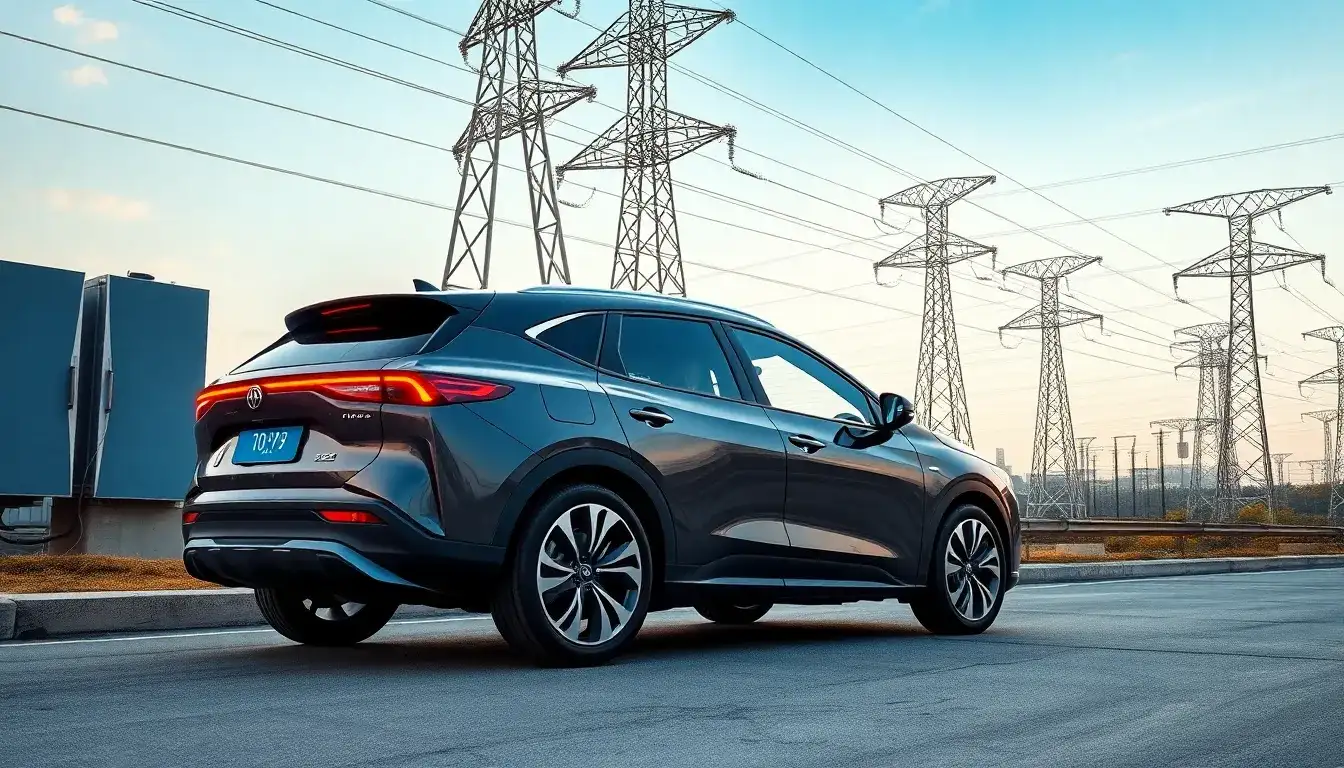
On April 10, 2025, a significant milestone was achieved in Sichuan as electric vehicles successfully discharged power into a 10 kV public grid for the first time. In this instance, a citizen named Zhu Liang utilized a newly operational charging and discharging station in Chengdu’s Shuangliu District to sell 5.2 kWh of electricity from his electric vehicle back to the grid, earning him 5.2 yuan in the process. This event marks the first successful case of an electric vehicle injecting power into the public grid in Sichuan, representing a significant step forward in the large-scale application of vehicle-grid interaction.
Vehicle-grid interaction refers to the energy and information exchange between new energy vehicles and the power grid through charging stations. This interaction primarily includes smart, orderly charging and bi-directional charging and discharging. In simple terms, it allows electric vehicles to adjust their charging based on grid demand and even send energy back to the grid to earn subsidies. The key to achieving this bi-directional interaction is the Vehicle-to-Grid (V2G) technology, which transforms electric vehicles into “mobile power banks,” helping to alleviate pressure on the grid by smoothing peak and off-peak loads.
According to Fu Xiaowei from the State Grid Tianfu New Area Power Supply Company, “Owners can also earn money from the difference in electricity prices through charging and discharging.” But why should electric vehicles be treated as “power banks”? What explorations have been conducted in Chengdu, and what future plans are in place?
Zhu Liang calculated the potential earnings from his electric vehicle: “With a battery capacity of about 40 kWh, if I sell 80% of the power through V2G, I could earn about 25 yuan per transaction, considering electricity prices of approximately 0.2 yuan per kWh during off-peak hours and 1 yuan during peak hours.” He added that vehicle-grid interaction not only benefits vehicle owners financially but also helps save substantial electricity supply costs and relieve grid pressure. Hu Haifeng, the technical director of Chengdu Telai Electric New Energy Co., explained that many regions have seen unprecedented peaks in electricity demand. Addressing this through conventional methods like expanding power transmission channels is costly.
Data indicates that by 2040, the number of electric vehicles in China could reach 300 million. If V2G technology is widely adopted, the overall power support capability for the grid could increase to between 2.9 billion and 3.5 billion kilowatts, effectively balancing surplus and deficit in the grid.
Recently, several government departments, including the National Development and Reform Commission, jointly released a document outlining the implementation opinions on strengthening the integration and interaction of new energy vehicles with the power grid. This initiative aims to establish a two-way interactive system of information and energy flow between new energy vehicles and the power supply network, effectively leveraging the flexibility of power batteries as controllable loads or mobile energy storage to support the efficient and economical operation of a new power system.
Just recently, the Southern Power Grid organized the first cross-province vehicle-grid interaction event in China, covering 63 cities across five provinces: Guangdong, Guangxi, Yunnan, Guizhou, and Hainan. During this event, over 100,000 electric vehicles acted as “mobile power banks,” with interactive energy exceeding 500,000 kWh through various methods, including inviting participation for off-peak charging and V2G reverse discharging.
In Chengdu, three projects have been selected as national pilots for this technology, with plans to establish and upgrade several charging and discharging stations by August 30. The National Development and Reform Commission, the National Energy Administration, the Ministry of Industry and Information Technology, and the State Administration for Market Regulation recently announced the first batch of pilot projects for large-scale vehicle-grid interaction. Chengdu’s projects include the “Smart Vehicle-Grid Interaction Pilot Project,” the “Orderly Control of Virtual Power Plants” project, and the “Mobile Charging Bank” vehicle-grid interaction project.
One of the facilities contributing to the “Smart Vehicle-Grid Interaction Pilot Project” is the Telai Electric & K Speed Electric Airport Xinghui Energy Storage Charging Station in Chengdu. This facility was initiated by Chengdu Telai Electric New Energy Co. and focuses on upgrading intelligent charging stations in residential and office areas, as well as commercial, industrial, and leisure centers throughout Chengdu.
Hu Haifeng mentioned that the pilot project aims to upgrade 50 charging stations across Chengdu by June 30, involving over 300 charging piles. “If multiple vehicles discharge simultaneously, it could meet the electricity needs of over a thousand households,” he added.
In the southern part of Chengdu, a demonstration station for vehicle-grid interaction was also opened in October last year. According to Jia Zhiqiang from Chengdu Jiao Investment Group’s Energy Division, this station is part of the orderly control project for virtual power plants. Currently, it discharges energy for lighting in office towers and underground parking lots. Jia noted that an additional 60 charging and discharging stations will be established in Chengdu before August 30, covering logistics, sanitation trucks, taxis, office parks, and roadside charging applications.
Chengdu’s public transport system, with over 7,000 electric buses, can also function as large-scale “power banks” to provide emergency power when needed. Luo Qing, the manager of the New Energy Division at Chengdu Public Transport Asset Management Co., explained that the project aims to upgrade 52 charging piles at the Jinsan Bus Hub and the Chengdu Jiaozi Public Transport Base before June 30.
Despite these advancements, challenges remain in promoting bi-directional vehicle-grid interaction. Many citizens expressed concerns regarding the potential impact of frequent charging and discharging on battery life. Jia Zhiqiang reassured that lithium iron phosphate batteries can endure around 3,000 cycles. For example, a vehicle with a range of 400 kilometers may only require charging once or twice a week, even if charged daily, which is well within the battery’s lifespan.
Currently, challenges such as standardizing communication protocols between vehicles and charging stations and establishing a unified pricing and settlement mechanism still need to be addressed. Chen Zhuo, from the energy management department of Telai Electric’s Southwest region, highlighted the necessity of creating a comprehensive interconnection mechanism between batteries, vehicles, charging stations, platforms, and the grid to ensure information flow.
According to the implementation opinions from the National Development and Reform Commission, efforts are being made to finalize important technical standards for bi-directional charging and discharging equipment, vehicle communication, grid integration, safety measures, and information security by the end of 2025.
For companies, the investment in hardware for charging and discharging stations can be significant, with current prices for such equipment being roughly double that of standard charging stations. To encourage more companies to participate in vehicle-grid interaction, Chengdu previously introduced ten measures to secure electricity supply during peak summer months, which includes offering additional subsidies to qualifying charging stations based on their performance in the electricity demand response market.
Currently, the State Grid Tianfu New Area Power Supply Company is collaborating with Chengdu Telai Electric New Energy Co. to explore business models for vehicle-grid interaction. Furthermore, the recent policies introduced by Chengdu city aim to enhance the interaction level between electric vehicle charging and discharging facilities and the power grid.
Original article by NenPower, If reposted, please credit the source: https://nenpower.com/blog/sichuan-electric-vehicles-make-history-with-first-power-supply-to-10kv-grid-how-close-are-we-to-cars-as-mobile-power-banks/

