

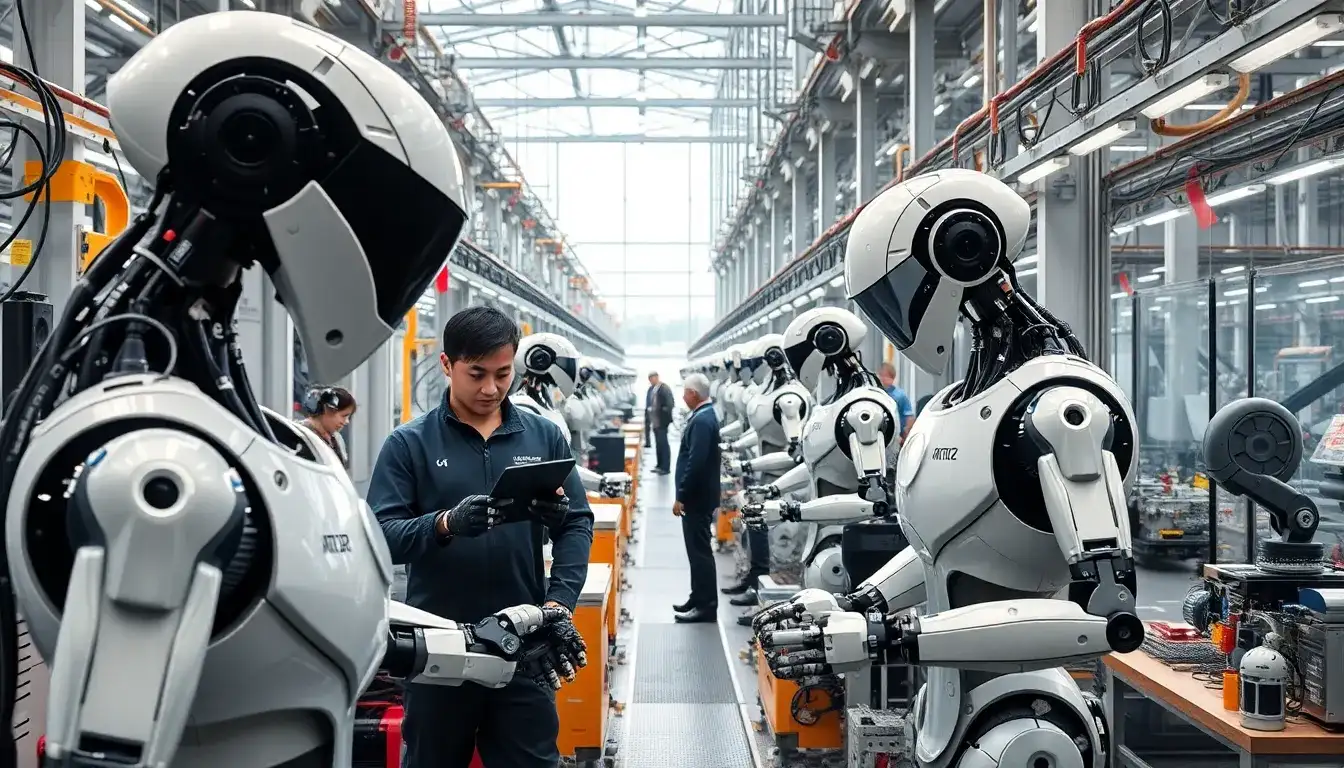
In the eastern region of the Pearl River, by the South China Sea, over 74,000 enterprises related to the robotics industry are distributed throughout Shenzhen, creating a vibrant, layered ecosystem reminiscent of a tropical rainforest. This city, which has its roots in the electronic information manufacturing sector, has keenly seized the historic opportunity presented by the deep integration of new-generation information technology and advanced manufacturing. Thanks to decades of accumulated industrial infrastructure and an active innovation ecosystem, Shenzhen has transformed itself into a fertile ground for the flourishing development of robotics and embodied intelligence.
From a manufacturing powerhouse in electronic information to a global hub for robotic innovation, Shenzhen is clearly charting a new path for productive forces that is grounded in its industrial base, adheres to the laws of industrial development, and is oriented towards global competition.
This year, several Shenzhen robotics companies showcased their latest achievements at the 2026 International Consumer Electronics Show (CES) in Las Vegas. During a live demonstration titled “Delivery Robot,” a robot from Sutonju Chuang completed the entire process—from packaging and shelving to transportation and delivery, even returning empty boxes—captivating the audience. Many of these competing companies are actually neighbors. In the Nanshan District of Shenzhen, a “robot valley” is rapidly emerging between Yangtaishan and Tanglangshan. Huang Qiang, Director of the Shenzhen Municipal Bureau of Industry and Information Technology, noted that companies like UBTECH and Yujian Technology have thrived here, while leading firms in niche sectors such as Kengjing Technology, Yunji Intelligent, and Pudu Technology continue to rise. Nearly ten universities have formed a robust “intellectual core,” and hundreds of enterprises supporting the robotics supply chain are gathering, making Shenzhen’s “robot valley” a notable center for technological innovation and application in the robotics sector.
Shenzhen boasts a comprehensive industrial system covering the entire supply chain, from core upstream components to midstream manufacturing and downstream applications. In the upstream sector, companies like Zhaowei Electromechanical lead with their micro drive systems, Sutonju Chuang excels with laser radar technology, Huichuan Technology is recognized for its servo systems, and Orbbec shines with its 3D vision technology. In midstream manufacturing, notable companies include UBTECH, Leju Robotics, and Zhongqing Robotics. Downstream, Shenzhen encompasses all 31 categories of the manufacturing industry, offering a wide range of application scenarios from industrial manufacturing to public services and specialized operations.
“In Shenzhen, finding a company that can customize a high-precision gear is easy, which not only boosts efficiency by over 50% but also reduces costs by about 30%,” said Zhou Jian, founder of UBTECH, reflecting on the competitive advantages of the “same-day delivery” supply chain efficiency. This comprehensive chain advantage supports Shenzhen’s humanoid robots in becoming globally competitive, achieving several world-firsts. UBTECH has successfully conducted the world’s first collaborative training of multiple humanoid robots across various scenarios at the Zeekr Smart Factory, while Zhongqing Robotics completed the world’s first humanoid robot front flip. Furthermore, the Autonomous Super-Slippery Technology developed by the Institute of Super-Slippery Technology at Tsinghua University in Shenzhen has significantly enhanced the lifespan of robotic dexterous hands to 4,000 hours. According to data, the added value of Shenzhen’s robotics industry reached 5.559 billion yuan in the first three quarters of 2025, representing a year-on-year growth of 31.4% and demonstrating robust development momentum.
From the fragmented management model of “nine dragons managing the water” to a unified governing body, a new unmanned delivery vehicle has successfully completed logistics delivery along newly opened routes in the Shiyan neighborhood of Longgang District, Shenzhen. This shift from “no road available” to “fully open” reflects Shenzhen’s determination to proactively open up scenarios and embrace innovation. The city insists on treating the entire urban area as a testing ground for new technologies. In Futian, humanoid robots are exploring participation in subway security checks; in Nanshan, robots are accompanying police on street patrols; and in Baoan, robots are providing “round-the-clock” government services.
The robotics industry spans multiple stages including research and development, production, application, safety, and data. The traditional management model, akin to “nine dragons managing the water,” often creates barriers that hinder enterprise development. In March 2025, Longgang District established the country’s first Artificial Intelligence (Robotics) Administration. This new government agency aims to “break down departmental barriers.” Yu Xiquan, Secretary of the Longgang District Committee, stated that this agency acts as a “total service platform for the industry,” ensuring that corporate needs are rapidly addressed. Institutional innovations extend from grassroots levels to municipal levels.
Shenzhen has constructed a policy system that precisely empowers and lowers innovation thresholds, tackling core technologies through initiatives such as “project management” and introducing a novel “three-coupon” support system: 500 million yuan in “training coupons” to subsidize the cost of AI model training, 50 million yuan in “corpus coupons” to support enterprises in procuring high-quality training data, and 100 million yuan in “model coupons” to reduce the investment required for basic large model development and utilization. This approach essentially provides companies with “startup funds” from the government, directly addressing the pain points of high R&D costs and significant initial investments.
Liu Zhufu, Deputy General Manager of Yujian Technology, expressed that despite relocating five times over the past decade, the company has remained anchored in the “robot valley” of Nanshan due to the continuous optimization of local industrial support and policy backing.
Now, Shenzhen is moving towards new goals. The “Shenzhen Action Plan for the Innovation and Development of Embodied Intelligent Robot Technology (2025-2027)” aims to achieve an associated industry scale of over 100 billion yuan by 2027. Shenzhen is precisely targeting key technology areas such as high energy density micro motors, multimodal sensors, and bionic dexterous hands, directly confronting the core challenges of the industry. Liu Guohong, Director of the Comprehensive Development Research Institute (China, Shenzhen), stated that Shenzhen’s path to creating new productive forces through revolutionary technological breakthroughs, innovative configurations of production factors, and deep industrial transformation has transcended individual industrial clusters, providing a valuable and insightful “Shenzhen model” for broader industrial transformation and the cultivation of future industries.
Original article by NenPower, If reposted, please credit the source: https://nenpower.com/blog/shenzhens-robot-industry-a-dynamic-hub-for-innovative-production-and-global-leadership/

