

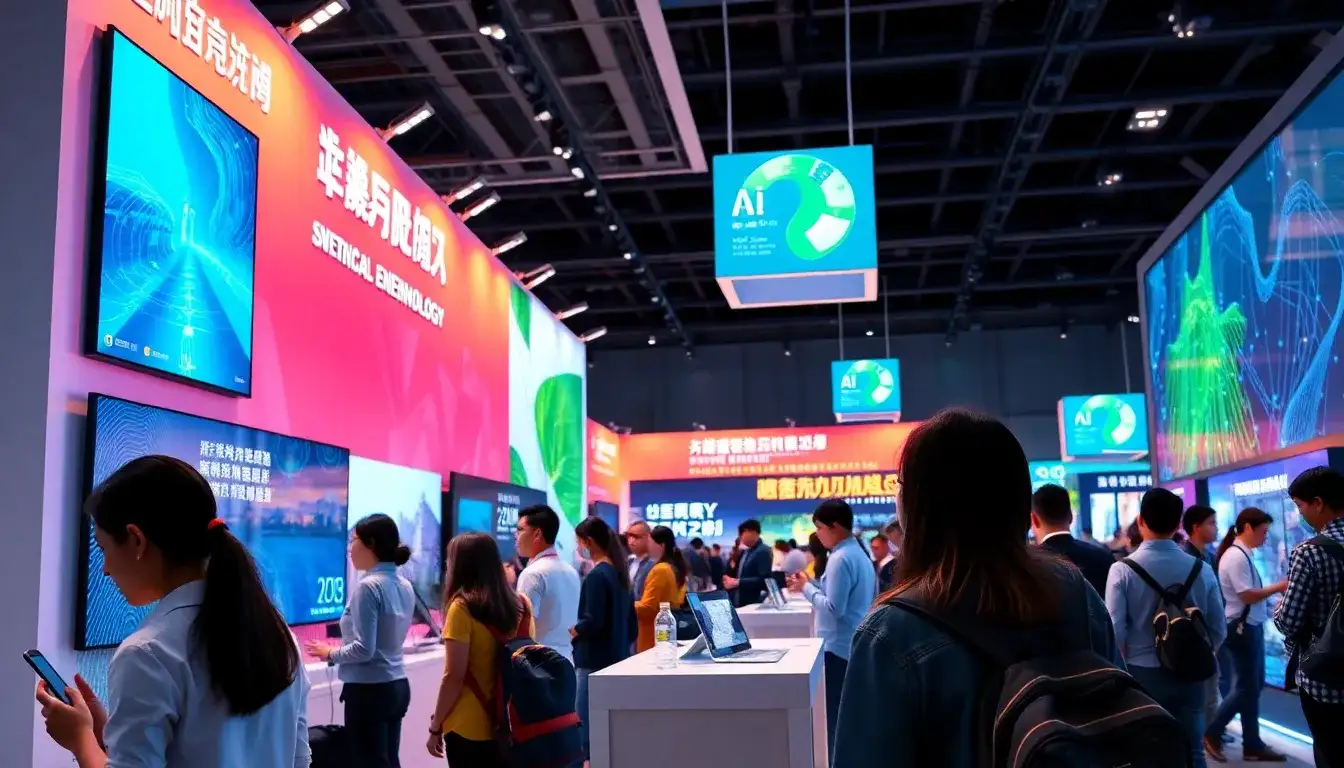
A large number of enterprises from Shenzhen showcased their latest technologies at the 2025 International Digital Energy Exhibition, where the integration of AI and energy unlocked numerous new application scenarios. Innovations such as charging stations that allow for immediate use, a “smart brain” to ensure the orderly operation of high-power supercharging stations, and a simulated model that realistically replicates the operation of virtual power plants were among the highlights. These advancements in digital energy applications are increasingly making life more convenient.
This international event, focusing on the digital transformation of global energy, brought together over 2,000 companies from more than 50 countries, showcasing over 300 cutting-edge technologies. Through a comprehensive perspective on the entire energy chain—covering sources, networks, loads, and storage—a 50,000 square meter innovative ecological platform was created, offering a “Chinese solution” and a “Shenzhen model” for the global energy revolution.
At the Huawei booth, staff were seen meticulously explaining the technical principles of their equipment to international attendees. One of the standout features was the lane-style charging station presented by BYD, which immediately caught the attention of reporters with its bold design. Unlike traditional charging stations that align charging piles with parking spaces, this station adopted a design similar to that of a gas station. It includes six supercharging piles and four lanes, allowing three new energy heavy-duty trucks and one new energy sedan to charge simultaneously. “This is our vision for future supercharging stations, capable of integrating supercharging piles from different brands, enabling charging to be as quick as refueling, allowing for immediate departure,” said Wu Liangqu, a senior engineer for BYD’s commercial vehicle division. The innovative design is supported by BYD’s newly released “megawatt flash charging” technology, which achieves a charging speed of “2 kilometers in 1 second,” allowing for a 400-kilometer range to be replenished in just five minutes.
In another area of the exhibition dedicated to supercharging technologies, a flash charging storage system and a flash charging host were showcased side by side, ensuring high-power charging while preventing stress on the power grid. Huawei also set up a dedicated section highlighting smart charging networks, featuring their latest charging technology. The fully liquid-cooled main unit acts as the “smart brain” of the supercharging pile, effectively managing energy conversion and power distribution. Thanks to the maturation of charging technology, Shenzhen has established a new energy infrastructure pattern where the number of supercharging stations surpasses traditional gas stations, creating the densest urban charging network in the world.
The exhibition, themed “Deep AI Energy, Creating a Digital Future,” opened in Shenzhen, attracting over 2,000 companies from more than 50 countries.
The virtual power plant, which “does not produce electricity but transports it,” relies entirely on sophisticated algorithms for its operations. At the International Digital Energy Exhibition, operators of virtual power plants exhibited their capabilities. A miniature model showcased the role of the virtual power plant dispatch center within the entire power grid system: on the left side of the model were resources from thermal, hydro, wind, and solar power generation, while the right side featured resources for industrial parks and residential areas. Acting as the “smart manager” of the power system, the virtual power plant integrates decentralized solar, wind, and storage resources into a controllable unit through digital technology. “We have 10 peak shaving users with a regulation capacity of 94.7 MW and 1 valley filling user with a regulation capacity of 0.2 MW,” pointed out Zhang Yue, head of development at Tengfei Shuneng, while highlighting their virtual power plant operation platform. Through a monitoring screen, reporters observed the real-time status of aggregators such as business parks and charging stations that respond to grid demands. Zhang noted that their self-developed algorithms, combined with years of experience in energy aggregation, enable them to meet peak shaving and valley filling requirements promptly. “Shenzhen’s virtual power plant has the largest adjustable capacity in the country and the highest precision response frequency, with over 60 operators. We will continue to adhere to the principles of safe and shared diversity, striving to maintain a stable regulation capacity of 5% of the annual peak load, ultimately fostering a high-quality development platform for virtual power plants to support Shenzhen’s construction as a pioneer city in digital energy,” stated the management of Shenzhen’s virtual power plants.
Artificial intelligence is opening new avenues for the development of green energy. With the increasing share of clean energy structures under the “dual carbon” targets, the application of cutting-edge technologies such as AI has become a strong driving force for the further proliferation of green electricity. The AI-enabled exhibition area was a focal point of the event, with companies like Huawei and Xinwangda demonstrating the deep application of AI algorithms in energy forecasting and operational optimization. The clean and low-carbon exhibition area showcased innovations in carbon neutrality pathways, including CCUS technology and carbon asset management tools. The international company exhibition area brought together global energy technology giants, creating a window for close interaction with cutting-edge technologies from around the world.
Operations of new energy power plants, such as wind and solar, are significantly affected by weather conditions, with extreme weather events and unstable energy conversion posing substantial risks to power supply. With the in-depth implementation of the “AI+” initiative, Shenzhen Energy, in collaboration with Huawei, debuted a new energy generation power forecasting system at the exhibition aimed at overcoming barriers to the widespread adoption of green energy. Xu Chenbo, head of the comprehensive research and development project for Shenzhen’s intelligent energy model, stated that the new energy power forecasting system is the world’s first platform based on a meteorological model for predicting renewable energy generation. Leveraging the Pangu model, it deeply integrates AI meteorological algorithms to achieve medium- and short-term forecasts for wind, solar, and hydro power generation, effectively enhancing the economic efficiency of renewable energy generation while ensuring the safe, stable, and economical operation of the power grid. “The application of AI in energy acts like a ‘navigation system’ for power plants and the grid, guiding the efficient and stable integration of clean energy into the grid. By employing multi-level downscaling technology, AI-driven proactive forecasting, precise data governance, and a cloud-edge collaborative training and prediction platform, we achieve high-precision, intelligent, and real-time weather forecasting, playing a significant role in reducing costs and increasing efficiency for new energy power plants,” Xu said.
Original article by NenPower, If reposted, please credit the source: https://nenpower.com/blog/shenzhen-companies-unveil-cutting-edge-ai-and-energy-technologies-at-2025-international-digital-energy-expo/

