

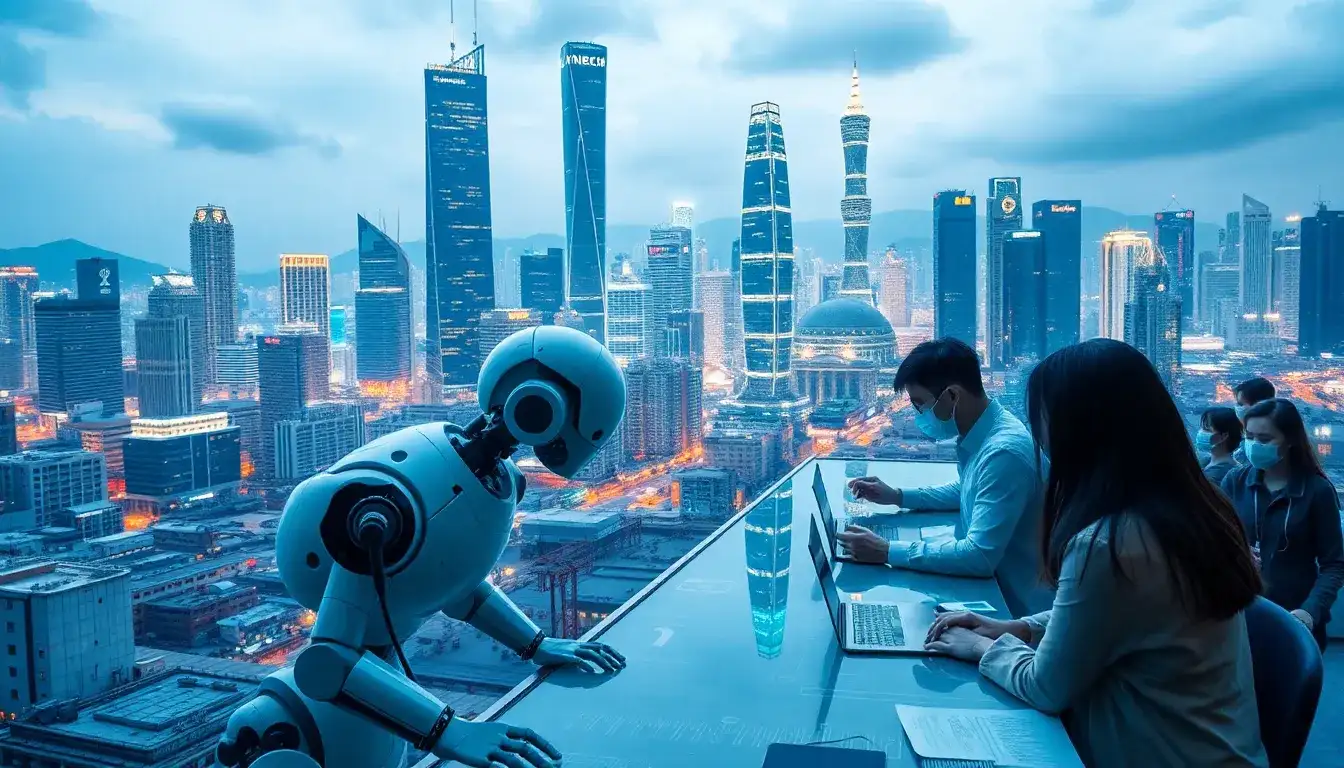
Seizing the High Ground of AI! The leading industrial city in China is taking action.
As a new round of technological revolution and industrial transformation accelerates, significant developments are emerging.
1. What Signals Are Being Released by the “Full Invasion of Robots” at the Spring Festival Gala?
The 2026 CCTV Spring Festival Gala is undoubtedly the one with the highest density of humanoid robots. Numerous intelligent enterprises showcased their talents in martial arts, parkour, dance, and companionship, demonstrating a vivid scene of human-robot collaboration. This event marks the gradual unveiling of a new vision for an intelligent society.
Not only robots but also advanced technologies such as image and video generation models, digital humans, VR, AR, AI glasses, autonomous driving, and quantum technology made their debut, turning the gala into a grand celebration of cultural and technological integration. This event has also become an important highlight of the rapid breakthroughs in national technology.
Coincidentally, just before the Spring Festival, ByteDance launched the Seedance 2.0 model, creating a global buzz, while DeepSeek is expected to unveil its latest large model during the holiday. This scenario echoes last year’s “DeepSeek moment,” marking another milestone in China’s journey from “catching up” to “leading” in AI.
Various signals indicate that the fourth technological revolution, centered around artificial intelligence, is becoming a key focus of international competition, a significant variable in great power dynamics, and a powerful engine for economic development. Emerging industries like artificial intelligence, low-altitude economy, and new energy are reshaping urban competitive landscapes with unprecedented strength.
As “China’s Silicon Valley” and a “national innovative city,” Shenzhen has emerged in the wave of the third technological revolution, becoming a leader in the information age with its advanced manufacturing and digital economy, earning numerous prestigious titles such as “China’s Industrial and Innovation First City.” Now, as the fourth technological revolution accelerates, Shenzhen is poised to lead once again.
During this year’s Two Sessions, Shenzhen included the goal of “seizing the high ground of the AI industry” in its government work report, proposing to accelerate the construction of a global AI pioneer city, aiming to surpass a GDP of 50 trillion yuan by 2030 and achieve global leadership in urban competitiveness by 2035. Founded on manufacturing, Shenzhen has made significant breakthroughs in high-tech industries. Regardless of how times change, innovation remains the constant foundation for Shenzhen, empowering its efforts in the new round of technological revolution.
2. What Makes Shenzhen Aim to Become an AI Pioneer City?
Years ago, as one of the “Shenzhen Robotics Thirteen Heroes,” UBTECH has appeared on the Spring Festival Gala for four consecutive years. After years of development, Shenzhen has gathered over 74,000 enterprises related to the robotics industry chain, giving rise to numerous listed companies and unicorns, earning the reputation of being a “global innovation hub for robotics.”
Robots are merely a reflection of Shenzhen’s pursuit of new AI tracks. Official sources indicate that Shenzhen currently has over 2,600 AI enterprises, with projected revenues from the core AI industry reaching approximately 220 billion yuan by 2025. The value-added growth of AI clusters is expected to achieve double-digit growth, consistently maintaining its position in the national top tier.
When discussing Shenzhen’s AI enterprises, in addition to tech giants like Huawei and Tencent, there are also representatives of the “Thirteen Heroes” such as UBTECH and Kengqi Technology, along with unicorns like Yuanxiang and Yuanrong Qixing, and industry leaders in niche sectors like Yunjing Intelligent and Pudu Technology. This has created a layered development pattern where “large enterprises dominate, while small and medium-sized enterprises thrive.”
In the field of artificial intelligence, Shenzhen stands out as one of the few “all-round contenders.” It is a hub for the three core elements of computing power, algorithms, and data, as well as one of the most complete manufacturing industry chains for robotics and intelligent terminals. Additionally, it is the main battleground for the “AI+” initiative, boasting diverse competitive advantages in technology, industry, scenarios, and ecology.
This advantage is evident through numerous “firsts”: the introduction of the first national policy for the AI terminal industry, hosting the world’s first AI terminal industry exhibition, being approved to co-build the first national AI application pilot base for mobile terminals, and establishing the first robot 6S store and AI 6S store globally.
The reason behind Shenzhen’s versatility can be summarized by a well-known quote from Jensen Huang: “The Greater Bay Area is the only region in the world that combines electromechanical technology and artificial intelligence.” This statement is increasingly being validated. Currently, following the “ChatGPT moment” and the “DeepSeek moment,” the AI revolution has reached its midpoint. Simply relying on computing power, capital expenditure, or “stubbornly pursuing” large models has raised concerns about potential bubbles. The outcome of future competition will depend on applications, particularly the space for “AI industrialization” and “industry AI-ization.”
No matter how advanced technology may be, it must ultimately translate into real productivity, becoming a trillion-yuan or even ten trillion-yuan industry. It cannot be confined to laboratories or merely exist in the “flashy technology” stage. While technology can reach new heights, its application must be widely implemented, and this is especially true for artificial intelligence.
As early as last year, the national level emphasized “application orientation” and “self-reliance” as core principles for developing artificial intelligence, proposing a deep integration between AI technological innovation and industrial innovation, and establishing a collaborative innovation system led by enterprises. This highlights two distinct policy tones in China’s AI strategy: one is application-oriented, and the other is enterprise-led. This aligns closely with Shenzhen’s innovation model, as Shenzhen is a hub for industrial innovation, with enterprises as the main driving force, evidenced by the widely recognized phenomenon where “over 90% of R&D comes from enterprises.”
The mutual promotion of industrial technology is characterized by strong manufacturing advantages and digital economic strengths, coupled with rich opportunities for scenario innovation, positioning Shenzhen to continue leading in the second half of the AI landscape as a technological vanguard.
3. China’s Third Largest Economy, and the First City in Both Industry and Innovation.
By 2025, Shenzhen’s GDP is expected to reach 3.87 trillion yuan, consistently ranking among the top three in the nation and entering the global top ten. According to plans, over the next five years, Shenzhen’s GDP should exceed 5 trillion yuan, striving to advance its position in the global urban landscape.
The designation of “third” in economic terms reflects not so much the limits of Shenzhen’s development but rather a constraint of scale. As the smallest city with a trillion-yuan economy, Shenzhen occupies only 0.02% of the country’s land area while contributing nearly 3% of the GDP, achieving a per-unit GDP of over 1.9 billion yuan per square kilometer, making it one of the most economically dense major cities.
In fact, Shenzhen has set numerous significant “firsts” across various fields. The Shenzhen Municipal People’s Congress revealed that the city has achieved nearly 20 “firsts” in economic and social development, covering areas such as industry, foreign trade, R&D intensity, market entities, and PCT patents. Among these, the most noteworthy are the dual “firsts” in industry and innovation, showcasing its robust manufacturing capabilities and highlighting its status as a “national innovation city.”
Shenzhen’s industrial added value and total output have ranked first in the nation for four consecutive years, with an industrial added value exceeding 1.2 trillion yuan, accounting for over one-third of its GDP—the highest among first-tier cities. The total industrial output has reached 5.4 trillion yuan, making it the first city in China to join the “5 trillion industrial club.”
Unlike cities that break through based on resources and heavy industries, Shenzhen’s strengths lie more in advanced manufacturing and high-tech industries. By 2025, the added value of strategic emerging industries in Shenzhen is expected to account for 43% of GDP, while advanced manufacturing is projected to make up 68.4% of the above-scale industrial added value, significantly exceeding national and provincial averages.
In comparison to its industrial leadership, Shenzhen’s “first” in innovation holds even greater significance. By 2024, Shenzhen’s innovation intensity (R&D investment/GDP) is set to reach 6.67%, historically surpassing Beijing and ranking first among Chinese cities. It is worth noting that Beijing is a hub for universities and research institutions, housing 92 universities, 145 national key laboratories, and over 1,000 research institutes, with a significant number of academicians concentrated there, surpassing the totals of major economic provinces like Guangdong and Jiangsu.
Despite this, Shenzhen, with its over 20,000 high-tech enterprises, continues to catch up, achieving the highest R&D investment for several consecutive years and further establishing itself as the top city for innovation intensity and a global leader in technological innovation.
The dual “first” status in industry and innovation carries profound implications for the AI competition as well as for the development of emerging and future industries. If the title of “industrial first city” represents advantages in scale, clusters, and full industry chains, the title of “innovation intensity first city” reflects technological strength and innovation drive. Therefore, the dual firsts in industry and innovation embody a development pattern of “mutual promotion of industry and technology.”
Looking ahead, Shenzhen aims to achieve a GDP exceeding 5 trillion yuan by 2030, which relies on the combined efforts of “hard power” in technological innovation and “competitiveness” in its industrial system, alongside a need for deeper global market engagement and urban development intensification. By simultaneously focusing on technological innovation and industrial innovation, and promoting mutual strength in industrial technology, Shenzhen is likely to create even more growth “miracles.”
Original article by NenPower, If reposted, please credit the source: https://nenpower.com/blog/shenzhen-aims-to-lead-in-ai-innovation-as-chinas-industrial-powerhouse/

