

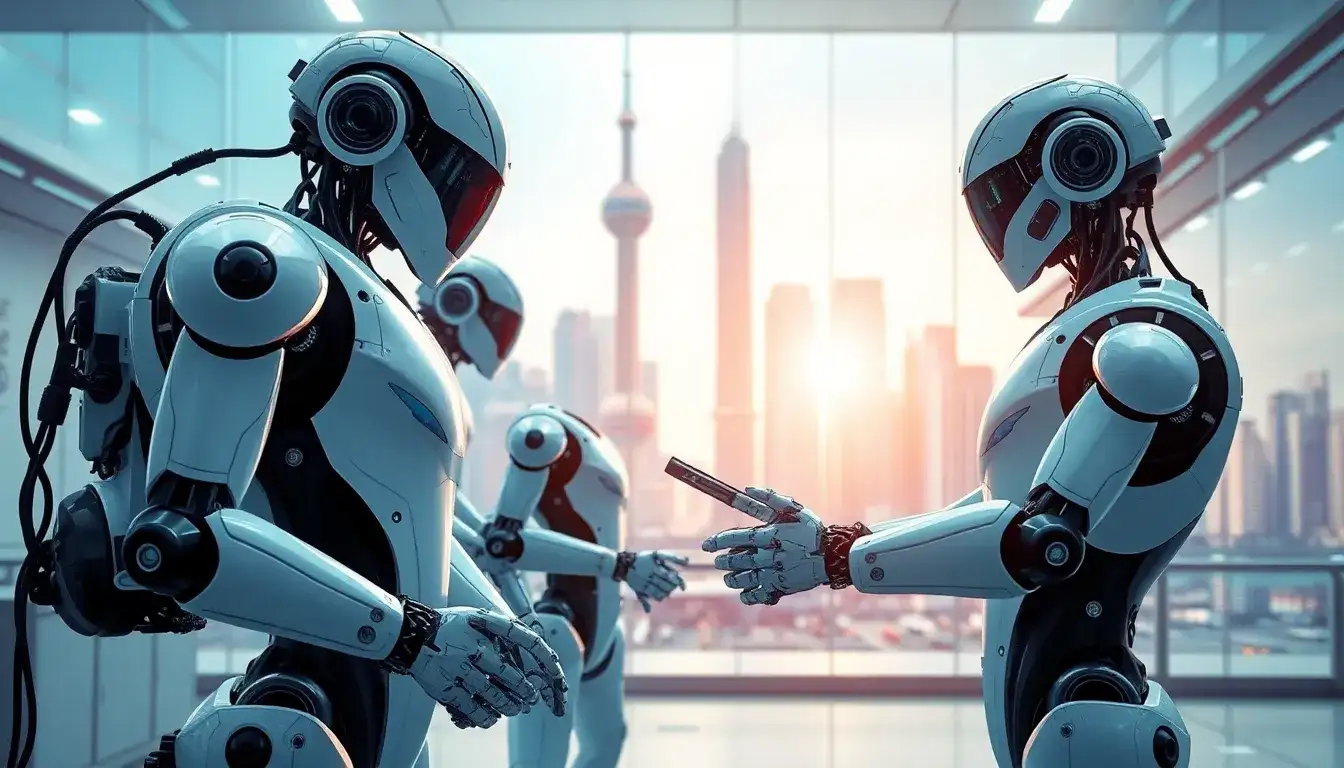
The global embodied intelligence industry is currently undergoing a significant “mid-term assessment,” with distinct gaps emerging among peers in terms of intelligence levels, mass production capabilities, and commercial viability.
As of February 2026, Shanghai has been making remarkable strides in the field of embodied intelligence, showcasing innovations in perception, cognition, and mobility. Local robots are continually challenging industry norms, with a notable “leading goose effect” becoming increasingly apparent.
Continuous Evolution of Robotics
From January 27 to 30, Shanghai’s AntWave Technology unveiled four new embodied intelligence models: the spatial perception model LingBot-Depth, the embodied large model LingBot-VLA, the world model LingBot-World, and the embodied world model LingBot-VA. The first three models represent the robot’s eyes, brain, and imagination, while the last one is the first to apply a world model in embodied intelligence, allowing robots to “act while reasoning.”
According to Shen Yujun, Chief Scientist at AntWave Technology, “The spatial perception model enables robots to ‘see clearly’ through complex optical scenes like glass and reflective objects. The embodied large model (VLA) operates on the logic of ‘see – language – action,’ allowing robots to comprehend instructions and plan tasks. The world model can create interactive and realistic environments from just one picture, while the embodied world model equips robots with the ability to anticipate future scenarios to guide their actions.”
In practical assessments, the LingBot-VA has outperformed industry benchmarks in various challenging tasks. Coincidentally, on the day after the LingBot-VA’s unveiling, Google also announced the launch of its world model, indicating a shift in the industry dynamics traditionally dominated by a few major players.
Advancements in AI and Robotics
At the same time, Shanghai Zhiyuan Robotics has made significant breakthroughs at the “brain” level. On the first day of the 2025 International Consumer Electronics Show, Zhiyuan introduced a new open-source simulation platform that can generate thousands of different simulated scenarios within minutes. They also released a vast open-source dataset comprising tens of thousands of hours of simulation data and an intelligent evaluation system covering over 100,000 different scenarios, further enhancing the R&D ecosystem for embodied intelligence.
In addition to advancements in intelligence, Shanghai’s robotics sector is also witnessing physical evolution, showcasing both soft and robust designs. On January 30, Shanghai Zhuoyide Robotics launched Moya, the world’s first fully bionic embodied intelligent robot. Unlike previous cold and rigid robots, Moya features an eco-friendly silicone skin that mimics human facial micro-expressions and can walk with a similarity to humans of 92%. It even maintains a temperature range of 32-36°C, exhibiting a soft and gentle demeanor.
In contrast, Shanghai Xinshi’s newly released SYNDA R1, an industrial-grade embodied intelligent robot, presents a robust profile. Standing at 1.78 meters tall with an arm span of up to 2.05 meters, it can carry a maximum load of 12 kilograms and perform precision operations with millimeter-level accuracy. This design allows it to fit well in standard workstations and navigate narrow production lines effectively.
Mass Production Capabilities
With technological breakthroughs in place, Shanghai is recognized as the “easiest and fastest city for mass production” in the field of embodied intelligence. Industry supply chain experts have calculated that all essential components for humanoid robots, along with unseen data and control algorithms, can be fully sourced within a 150-kilometer radius of Shanghai.
According to Yang Zhengye, Market System Director at the Shanghai National Local Joint Innovation Center for Humanoid Robots, Shanghai hosts integrated joint suppliers like Yuyou Technology, Tianji, and Taitiger Robotics, while leading companies in areas such as reducers, motors, and visual sensors are already present in the city.
In the midstream of the embodied intelligence supply chain, technologies such as tactile sensing from Qianjue Robotics achieve a density 800 times greater than that of human fingers. Shanghai Qiongche Intelligent’s embodied intelligence brain has challenged tasks that test a robot’s millisecond decision-making ability. The downstream segment is equally robust, featuring leading humanoid robot enterprises such as Zhiyuan, Fourier, and Kepler.
Emerging Trends and Future Prospects
The abundant resources for embodied intelligence in Shanghai instill confidence in industry leaders, resulting in unique local phenomena. For instance, Ant Group has established “AI First” as a core strategy, aiming to integrate its existing strengths in public services, inclusive finance, and health technology with digital and embodied intelligence. After considerable exploration, it was decided to establish “AntWave” in Shanghai as the headquarters for embodied intelligence R&D.
Similarly, leading domestic appliance company Haier has invested in Shanghai’s industrial automation company Xinshi, positioning it as a strategic vehicle for deploying robotic business operations. In December 2025, Xinshi launched the industry’s first industrial-grade embodied intelligence robot, SYNDA R1, defining “industrial-grade” as a core threshold for the commercialization of embodied intelligence.
Moreover, leading companies such as ABB, Fanuc, and Siasun, which traditionally focused on industrial and service robots, have also ventured into the humanoid robot arena in Shanghai.
Significant Milestones in Production
“Producing 5,000 units marks a milestone for embodied intelligence, indicating a shift from the technology validation stage to large-scale commercial usage.” Last year, when Zhiyuan Robotics’ production facility surpassed the 5,000-unit shipment mark, co-founder and CTO Peng Zhihui expressed great optimism.
According to a recent report from the renowned technology research firm Omdia, Chinese humanoid robot manufacturers are leading globally, with the top six positions in overall shipments by 2025 exclusively held by Chinese companies, including Zhiyuan and Fourier from Shanghai, both entering the global top ten.
Furthermore, companies like Taitiger, Kepler, and Zhuoyide in Shanghai are either entering mass production or are in the process of establishing large-scale factories. The significance of mass production lies in laying the groundwork for a leap in intelligence. “Learning the same action requires 1,000 hours for a single robot, while 1,000 interconnected robots only need 1 hour. When thousands of robots are online simultaneously, learning efficiency will increase exponentially,” stated Luo Jianlan, a partner and chief scientist at Zhiyuan.
Fourier’s founder and CEO Gu Jie envisions a “proactive AI Robot,” transitioning from passive execution to active collaboration. Recently, Fourier introduced a new brain-computer interface solution that allows rehabilitation therapy to operate on a closed-loop basis originating from “brain intentions.” “Imagine a stroke patient whose brain intends to reach out; the robot can interpret that intention and assist the patient in moving their hand, completing training driven from the central nervous system to the periphery. This represents a significant leap in clinical value,” Gu Jie explained.
Fourier has been researching the integration of brain-computer interfaces and exoskeletons since 2017, but faced engineering challenges. Now, with brain-computer hardware reaching a pivotal point for large-scale deployment, and large models effectively classifying and interpreting complex electroencephalographic signals, brain-computer interfaces are poised for active interaction.
According to Gu Jie, combining brain-computer interfaces with embodied intelligence rehabilitation solutions will be a primary focus for Fourier in the next one to two years.
Industrial Applications and Future Innovations
In industrial settings, major robotics firms from Shanghai are already operating on the production front lines. The Kepler K2 robot boasts an impressive endurance of “1 hour of charging for 8 hours of continuous operation,” along with dual-arm collaborative handling capabilities for loads up to 30 kilograms. It can navigate complex terrains such as bricks and grass steadily and has been deployed in real manufacturing environments, continuously refining the reliability and versatility of its products.
Last year, Zhiyuan’s two robots, Yuan Expedition and Spirit, began regular operations in logistics warehouses and sorting scenarios. On December 31, 2025, Peng Zhihui showcased the world’s first small-sized humanoid robot, Q1, with full-body force control, once again captivating the audience.
“When robots become smaller, the physical laws of the world also become gentler.” As the 80-centimeter tall robot with a custom 3D-printed shell and modular head design approached Peng Zhihui, the journey of embodied intelligence from Shanghai to the global stage is drawing nearer to every household.
Original article by NenPower, If reposted, please credit the source: https://nenpower.com/blog/shanghai-robotics-kicks-off-2026-with-groundbreaking-models-outpacing-google/

