

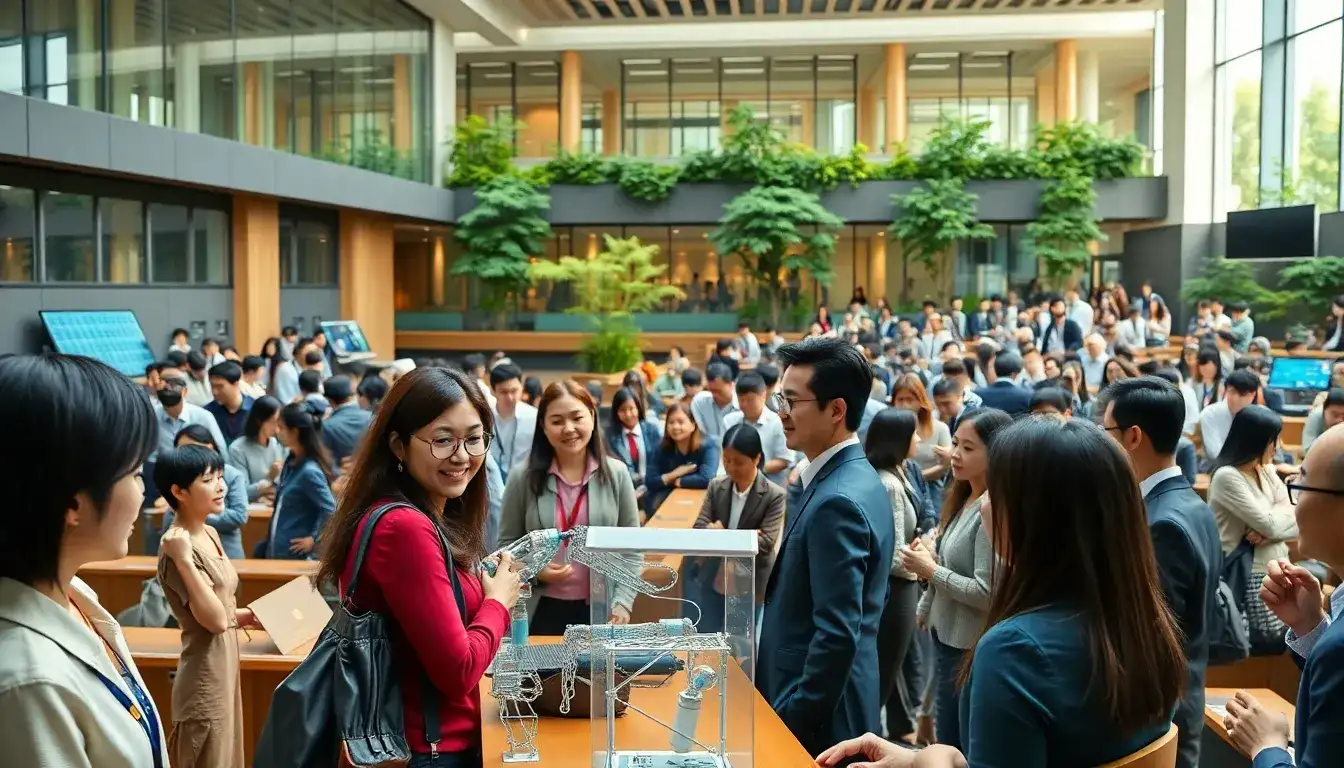
From May 24 to 25, 2025, the “AI + Energy” Academic Seminar for Universities was held at the School of Smart Energy Innovation at Shanghai Jiao Tong University. The seminar focused on cutting-edge topics in three core areas: talent development, scientific research, and engineering applications related to “AI + Energy.” It brought together academicians, industry leaders, young scholars, and business representatives from the fields of energy and artificial intelligence for in-depth discussions on how AI can empower energy innovation.
During the opening ceremony, Huang Zhen, the founding dean of the School of Smart Energy Innovation, delivered a keynote speech. He highlighted the school’s unique development in interdisciplinary studies and industry-education integration since its establishment at the end of 2020. As the first institution in the country focused on smart energy, its mission is to break through traditional disciplinary boundaries by fostering interdisciplinary collaboration and industry-education integration, thus creating an innovative ecosystem that merges energy disciplines with various fields. Currently, AI’s role in the energy sector has transcended its tool-like attributes; it is reshaping education, energy research, and engineering practices. This transformation is profoundly altering knowledge supply models and research innovation paradigms, ultimately redefining thinking patterns and concepts. Education is entering an era where it changes foundational logic, restructures educational ecosystems, shares resources, and reconstructs competencies.
The seminar aimed to explore the challenges and opportunities presented by “AI + Energy” in talent cultivation, scientific research, and engineering application innovation, contributing to the high-quality development of talent in energy disciplines and supporting the green transition and digitalization of the energy sector.
Xi Lifeng, the Executive Vice President of Shanghai Jiao Tong University, emphasized in his address that in response to the changing global energy landscape and the advancement of carbon neutrality goals, the university has established an integrated educational model through the School of Smart Energy Innovation. The seminar focused on the academic frontier of AI + Energy, talent development, and industrial collaborative innovation, aiming to build an open and shared academic platform for exploring new pathways in energy technology development together with various sectors.
Professor Mei Hong, Director of the Department of Information Science and Technology at Peking University, delivered a keynote report titled “Technological Innovation in the Digital and AI Era.” He analyzed the evolution of research paradigms from empirical sciences to data-intensive sciences, emphasizing that “data is the core driving force of scientific research.”
Six universities, including Shanghai Jiao Tong University, Tsinghua University, Zhejiang University, Xi’an Jiaotong University, Tianjin University, and Dalian University of Technology, jointly issued an initiative for an “AI + Energy” extracurricular technology innovation competition for university students. They called on universities nationwide to participate, using the competition as a platform to discover and cultivate a large cohort of students with innovative thinking and proficiency in AI technology, thereby providing intellectual support for the green transition and digitalization of national energy systems and promoting high-quality development in energy-related disciplines.
During the event, He Wangli, Vice Dean of the School of Information Science and Engineering at East China University of Science and Technology, presented a report titled “Artificial Intelligence Empowering Process Manufacturing and Energy Regulation,” analyzing the challenges of energy and industrial structures in the context of China’s carbon neutrality goals. Professor Jin Yaohui, Chief Engineer of the Artificial Intelligence Research Institute at Shanghai Jiao Tong University, discussed the integration of “Mechanism + Data” with large models, presenting a new engine driving AI empowerment in molecular synthesis and its implications for smart energy. Professor Wu Fei, Dean of the Undergraduate School at Zhejiang University, introduced the university’s practices in the field of AI education, including the construction of a theoretical knowledge system, the development of large disciplinary models, and the offering of “AI + X” micro-specialties. Professor Wang Hongdong, Deputy Director of the Academic Affairs Office at Shanghai Jiao Tong University, presented a report on “AI + HI Empowered Educational Reform—Explorations and Practices at Shanghai Jiao Tong University,” emphasizing the need to enhance unique creativity in specialized fields and establish a new collaborative education model of “AI + HI (Human Intelligence).” Li Hui, Deputy Director of the National Energy Storage Industry-Education Integration Platform at Xi’an Jiaotong University, shared reform experiences, including AI resource development and curriculum innovation through “AI + Seven Major Reform Projects,” and introduced a real-time monitoring digital platform for teaching quality that creates a quality feedback loop.
The seminar included a special session on “AI for Energy Education,” where discussions centered on the integration of artificial intelligence with energy education. Professor Liu Yanli from Tianjin University shared insights on cutting-edge explorations in intelligent teaching, presenting a comprehensive AI teaching assistant model designed to facilitate high-quality personalized learning and create an innovative learning community. Professor Liu Xiaojing from Shanghai Jiao Tong University discussed his reflections and practices on “AI + Energy Major Construction,” emphasizing the establishment of a four-dimensional educational ecosystem characterized by interaction among teachers, students, machines, and the environment.
During the “Artificial Intelligence and Educational Reform” roundtable discussion, experts examined the changes in education in the AI era, noting that AI is reshaping traditional teaching models, and educators need to transition from knowledge transmitters to thought guides.
In the “AI for Energy Research & Engineering” session, experts discussed the forefront applications of artificial intelligence technology in the energy engineering field. The meeting focused on the latest research achievements of AI in critical areas such as battery material design, fuel cell optimization, and hydrogen energy system development, showcasing innovative applications of machine learning and deep reinforcement learning in energy system modeling, intelligent control, and performance prediction. Special attention was paid to practical examples of digital twin technology in building open-source energy systems and solutions for energy management in new energy vehicles and optimization of power systems, providing technological support for the intelligent transformation of the energy engineering field.
In the graduate “AI + Energy” session, young scholars from Tsinghua University, Shanghai Jiao Tong University, Zhejiang University, Xi’an Jiaotong University, and Tianjin University engaged in in-depth discussions on cutting-edge research related to artificial intelligence in the energy sector.
Throughout the seminar, Shanghai Jiao Tong University and the State Power Investment Corporation opened the Smart Energy Campus to attendees, showcasing the application of AI technology in energy management and low-carbon campus construction, exemplifying collaboration between academia and industry. The School of Smart Energy Innovation, supported by an independent park, has established a low-carbon park centered on the “3+3+X” model, including photovoltaic systems, heat source pumps, smart energy digital platforms, virtual power plant simulation platforms, DC microgrid systems, and energy squares. This development supports talent cultivation and scientific research in energy disciplines while also generating demonstrative spillover effects in energy storage technology validation and the construction of smart campuses.
Original article by NenPower, If reposted, please credit the source: https://nenpower.com/blog/shanghai-jiao-tong-university-hosts-2025-academic-seminar-on-ai-and-energy/

