

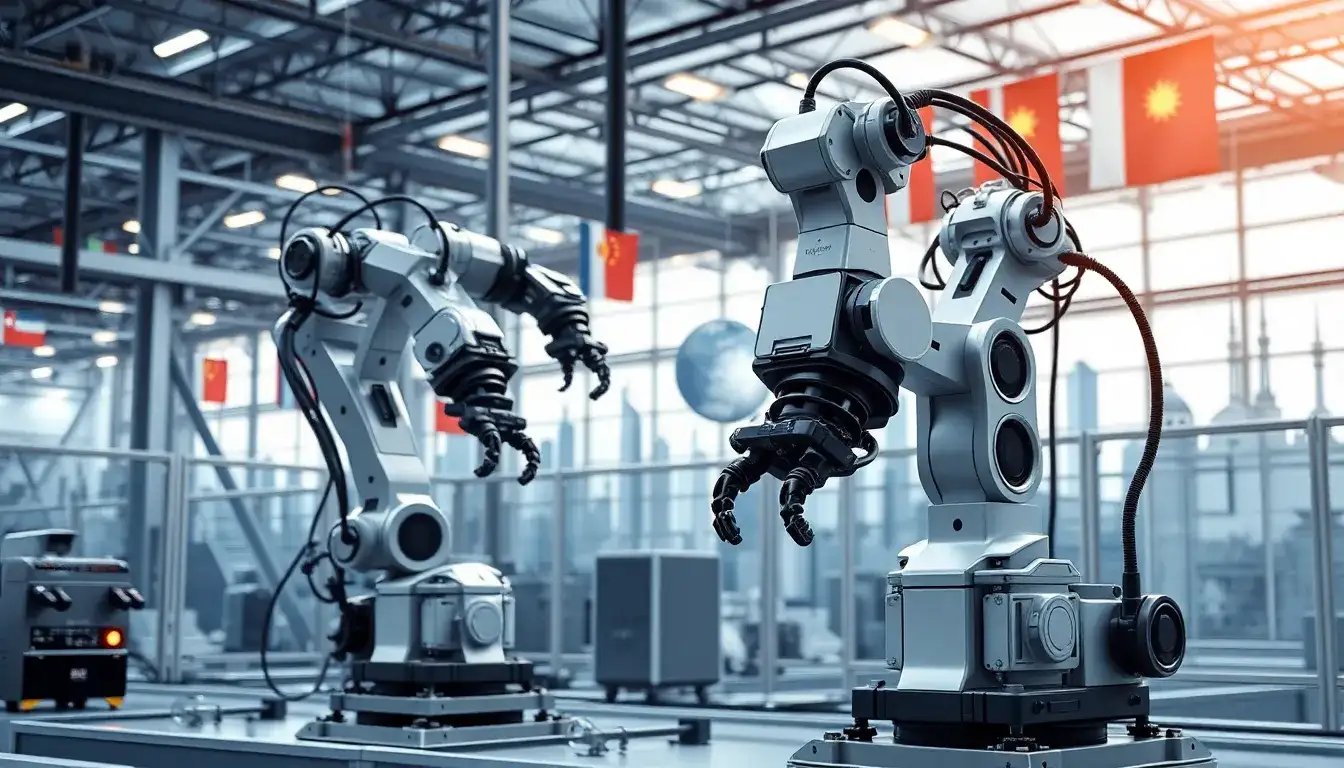
The New Journey of “Iron Man”: Shandong Steel’s Industrial Robots Expand from Domestic Workshops to International Markets
Recently, a laser coding robot developed by Shandong Steel Group’s Laiwu Electronic Company has made its way to the production line of the Dexin Steel Plant in Indonesia.
The steel industry is one of the most traditional sectors in China’s industrial system, long associated with high-temperature molten steel, roaring rolling mills, and manual inspections, often labeled as “big and clumsy.” Industrial robots, often referred to as the “jewel of the manufacturing crown,” have been predominantly exported by countries like Japan and Germany, while China has mainly been the largest consumer market for industrial robots.
Now, Shandong Steel’s industrial robots are moving from the steelmaking workshop to the international arena, creating a fascinating synergy between these seemingly unrelated fields. This transition injects fresh vitality into steel enterprises and subtly rewrites the developmental genes of the steel industry, outlining a clear path for the traditional sector’s transformation towards automation.
From “Repairman” to “Dream Creator”: A Breakthrough Across Industries
The story began in the spring of 2017 with an unexpected encounter. Laiwu Electronic, originally part of Shandong Steel’s automation department, started as the “repairman” behind the steel production line, troubleshooting issues day after day.
By chance, Laiwu Electronic was contracted to program and debug five assembly lines for new energy batteries at CATL in Fujian. Senior engineer Li Ming and several key technicians were sent to the site. Before this, the technical team had no experience with industrial robots. However, stepping into the CATL workshop left them in awe: every production step, from battery cells to finished electric vehicle batteries, was seamlessly connected through robots, motion control, and production execution systems, requiring only periodic inspections by personnel.
“On one side, there’s the steel workshop we know—high temperatures, high noise, and high risks, where many processes still rely on the experience and physical strength of seasoned workers; on the other side is the precision and efficiency of an intelligent production line. This represents a generational gap,” Li Ming reflected, echoing the team’s sentiments.
On the way back, they dared to imagine: “Could we create our own robots?” Once the idea was proposed, company leadership immediately approved: “Support it! Let’s get started!”
In September 2017, a robot innovation research and development lab was established at Laiwu Electronic with an investment of 1.5 million yuan. With five core members, two robots, and one lab, they began their journey.
At that time, many companies were venturing into the robotics field, but Li Ming’s team possessed a unique “steel gene”—all members came from the frontline of steel production, intimately familiar with every process and pain point. “While others approach robotics from technology to application, we transition from application to technology, understanding exactly what equipment is needed on-site,” Li Ming stated.
The initial goal was simple: to develop a visually guided handling robot system with independent intellectual property rights, suited for the steel workshop environment. Thousands of lines of code, extensive data analysis, and numerous experiments followed. By the end of 2017, when the words “Shanxin Software Co., Ltd.” were first displayed by the handling robot, the lab erupted in cheers. “This meant we had mastered the foundational technology for robotics—vision systems and control technologies,” Li Ming said.
This purpose-built handling robot, designed to withstand the high temperatures and dust of the workshop, operates 24/7, accurately grabbing and transporting materials along preset paths, mitigating the risks associated with human labor and significantly enhancing transportation efficiency.
From 0 to 1, Laiwu Electronic’s robot R&D team has gained the technical foundation for system integration.
From Internal Innovation to Industry Benchmark
The journey of the robots began within Shandong Steel’s “own backyard.” Near the number 4 refining furnace at Laiwu Steel’s Yingshan Steel Plant, a white robot was seen moving along a designated track towards the furnace. Its mechanical arm extended, accurately inserting a temperature probe into molten steel at 1600℃. The entire process of temperature measurement, sampling, and probe replacement is automated and seamless.
“Previously, this task required workers to face high-temperature molten steel closely, holding heavy sampling tools, posing significant safety risks and data variability,” said Ni Peiliang, director of the refining workshop. With the robot now handling the task, a single operation takes just 60 seconds, providing stable and reliable data while freeing workers from hazardous conditions.
In the process of transporting molten iron, robots have also proved invaluable. Previously, workers had to manually lift 30-kilogram plugs and insert numerous electrical pins into sockets within five seconds—a daunting challenge for physical strength, eyesight, and dexterity. Now, with just a click of a mouse, the robot can perform the task automatically, liberating workers from strenuous labor.
As technology continues to evolve, the family of robots is expanding, instigating a wave of transformation across various production roles in the steel industry:
- The automatic slagging robot has eliminated the need for personnel to manually add slag in high-temperature environments;
- The marking robot effectively addresses issues of discontinuity, unclear markings, and errors in numbering for plates, strips, and special-shaped steels;
- The laser coding robot achieves high-precision labeling on various steel and casting surfaces while integrating automatic dephosphorization, base coating, and coding functions.
These “Iron Man” robots are stretching their mechanical arms across Shandong Steel’s production lines, resulting in significant leaps in product quality and production efficiency: the error rate for marking information has dropped to 0, with a 100% success rate for weld identification and a 99.5% welding strength.
Expanding Horizons: From Domestic Innovation to Global Markets
In the summer of 2025, a phone call from Indonesia pressed the “accelerator” for Laiwu Electronic’s international robot business. The call came from the Dexin Steel Plant, which stated: “We saw your laser coding robot at a steel plant in Jiangsu, and it performed excellently. We would like to see it in action.”
Laiwu Electronic had developed a laser coding robot for a Jiangsu enterprise, successfully resolving high error rates in continuous casting slab numbering and enabling automatic tracking and coding of cast slabs. This demonstration was fortuitously witnessed by the visiting Indonesian client.
The client arrived prepared. During their visit to Laiwu Electronic, they brought a photo of a robot at Laiwu Special Steel Plant, pointing and saying, “This is what we want!”
“It felt like a proud daughter being courted by a suitor from afar,” recalled Yan Wei, a technical expert from the robot R&D team, with a smile.
However, this “cross-border connection” was far more challenging than anticipated. In August 2025, two technicians flew to Indonesia for on-site measurements. The local conditions were not as expected: the level of automation was low, with much information entered manually; equipment was outdated, relying heavily on human operation. They developed an information processing plugin tailored to local production realities and upgraded the old tracks. After returning home, they completed software design and debugging in two months.
Earlier this year, this robot system, embodying countless efforts, set sail from Weifang Port in Shandong towards Indonesia, marking the first breakthrough for “Shansteel-made” industrial robots in foreign markets.
Today, Laiwu Electronic’s robot family has grown to 205 units, covering more than 20 scenarios including temperature measurement and sampling, laser coding, marking, and unbundling. These robots are not only serving internally but are also being utilized by over 20 steel enterprises across the country and even shipping overseas.
For Shandong Steel Group, however, the vision extends beyond this. “This year, we plan to create the most advanced unmanned steelmaking platform in China, integrating automation, intelligence, and information in the steelmaking area, embedding artificial intelligence,” stated Zhang Baocai, chairman of Shandong Steel Group, upon hearing Laiwu Electronic’s ambitious goal. “But our ambition should be even bigger!”
A larger blueprint is being drawn. “This year, we aim not only to integrate robots throughout the entire steel production process but also to implement ‘AI + Steel’ initiatives, enabling 100 application scenarios to enhance quality and efficiency through intelligent integration across the steel industry and other sectors,” Zhang Baocai added.
Original article by NenPower, If reposted, please credit the source: https://nenpower.com/blog/shan-steels-industrial-robots-make-their-mark-in-international-markets/

