

Researchers at the Solar Energy Research Institute of Singapore (SERIS) have announced a groundbreaking achievement in solar technology with a perovskite-organic tandem solar cell that boasts a record conversion efficiency of 26.4%. This innovative cell design features a newly developed narrow-bandgap organic absorber layer positioned beneath a wide-bandgap perovskite top cell.
The research, led by assistant professor Hou Yi, who heads the Perovskite-based Multijunction Solar Cells Group at SERIS, highlights a significant advancement in near-infrared (NIR) photon harvesting capabilities, which has historically been a limitation in thin-film tandem cells. By utilizing widely tunable bandgaps, the combination of perovskite and organic semiconductors presents the potential for exceptionally high conversion efficiencies.
According to Hou, “The lightweight and flexible characteristics of perovskite-organic tandem solar cells make them particularly suitable for powering devices like drones, wearable electronics, smart fabrics, and other AI-enabled technologies.” However, the lack of efficient NIR thin-film absorbers has previously hindered the performance of perovskite-organic systems compared to other tandem technologies.
In response to this challenge, the research team developed a new absorber layer that features an asymmetric organic acceptor with an extended conjugation structure. This innovation allows for effective absorption deep into the NIR spectrum while ensuring sufficient driving force for efficient charge separation and promoting organized molecular packing. The SERIS team has confirmed through ultrafast spectroscopy and device physics analyses that this design enables high free charge carrier collection with minimal energy loss.
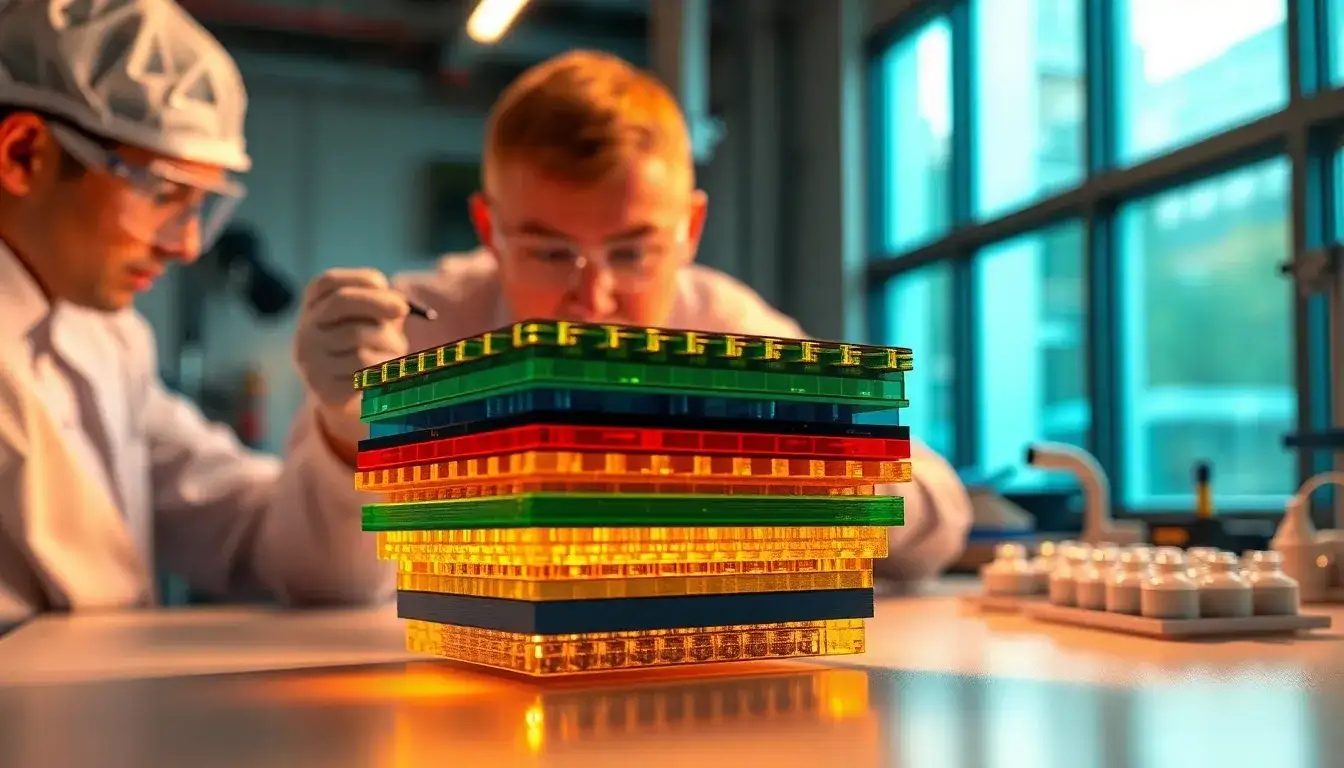
The tandem cell was constructed by stacking the organic subcell beneath a high-efficiency perovskite top cell, connecting the two layers with a transparent conducting oxide-based interconnector. The cell demonstrated a power conversion efficiency of 27.5% on 0.05 cm² samples and 26.7% on 1 cm² devices. SERIS reported that the 26.4% efficiency over a 1 cm² active area has been independently certified, marking it as the highest certified performance among perovskite-organic, perovskite-CIGS, and single-junction perovskite cells of comparable size.
Looking ahead, Hou noted that “With efficiencies expected to surpass 30%, these flexible films are perfect for roll-to-roll production and seamless integration onto curved or fabric substrates. Applications could include self-powered health patches harnessing sunlight to operate onboard sensors or smart textiles that monitor biometrics without bulky batteries.”
The next steps in their research will focus on improving the operational stability of these cells in real-world conditions and advancing towards pilot-line manufacturing. Stability has been a significant barrier to the widespread commercialization of perovskite-based photovoltaic technologies. The findings of this study have been published in the journal Nature.
Original article by NenPower, If reposted, please credit the source: https://nenpower.com/blog/seris-achieves-record-26-4-efficiency-with-innovative-perovskite-organic-tandem-solar-cell/

