“`markdown
Senate GOP Removes Tax on Solar and Wind Energy but Dismantles Climate Law Passed by Democrats
Clean energy advocates expressed profound disappointment with the recent legislative developments.
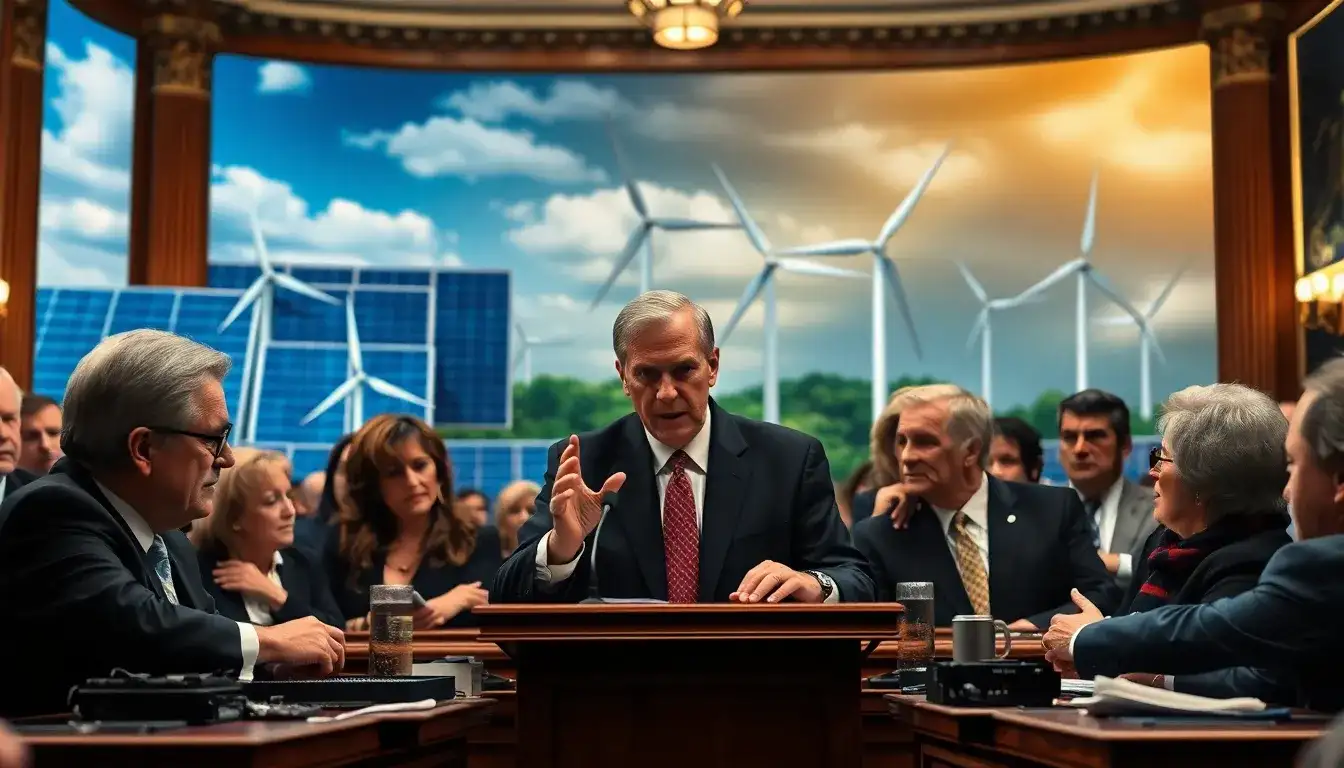
On July 1, 2025, the Senate approved a comprehensive Republican budget bill that eliminates a proposed tax on solar and wind energy projects, yet it expedites the phase-out of tax credits for these and other renewable energy sources. The bill passed with a narrow margin of 51-50, as President Donald Trump and GOP lawmakers work to dismantle the 2022 climate law enacted by Democrats during former President Joe Biden’s administration. Vice President JD Vance cast the deciding vote after three Republican senators opposed the bill. The legislation is now headed to the House for final approval.
Initially, an excise tax on solar and wind generation projects was included in the Senate bill over the weekend, prompting bipartisan backlash from lawmakers, as well as clean energy developers and advocates. Although the final version of the bill removes this tax, it largely adheres to legislative language released late Friday. This version accelerates the termination of incentives for clean energy compared to an earlier draft presented two weeks prior.
Concerns Over Rising Utility Bills
Democrats and environmental organizations argue that the GOP plan will stifle growth in the wind and solar industries, potentially leading to increases in utility bills for Americans. They assert that this measure threatens numerous renewable energy projects that are intended to enhance the nation’s electric grid.
Abigail Ross Hopper, president and CEO of the Solar Energy Industries Association, stated, “Despite limited improvements, this legislation undermines the very foundation of America’s manufacturing comeback and global energy leadership.” She warned that if the bill is enacted, “families will face higher electric bills, factories will shut down, Americans will lose their jobs, and our electric grid will grow weaker.”
Conversely, the American Petroleum Institute, which represents the oil and gas sector, praised the bill’s passage. Mike Sommers, the group’s president and CEO, remarked, “This historic legislation will help usher in a new era of energy dominance by unlocking opportunities for investment, opening lease sales, and expanding access to oil and natural gas development.”
While Democrats criticized the bill for complicating the integration of renewable energy into the electric grid, Republicans contended that the measure signifies substantial savings for taxpayers and bolsters the production of traditional energy sources, including oil, natural gas, coal, and nuclear power, thereby enhancing reliability.
In a last-minute compromise, the bill permits wind and solar projects that commence construction within a year of the law’s enactment to receive a full tax credit without an imposed deadline for when the projects must be operational. However, projects starting later must be operational by the end of 2027 to qualify for the credit. The bill also maintains incentives for advanced nuclear, geothermal, and hydropower technologies through 2032.
Negotiations and Reactions
Changes to the renewable energy provisions—including the removal of the excise tax—were negotiated by a coalition of Republican senators, including Alaska’s Lisa Murkowski and Iowa’s Joni Ernst and Chuck Grassley. Murkowski, who voted for the final bill, described her decision-making process as “agonizing.” She stated, “I had to look on balance, because the people in my state are the ones that I put first. We do not have a perfect bill by any stretch of the imagination.”
Rhode Island Senator Sheldon Whitehouse, the leading Democrat on the Senate Environment and Public Works Committee, characterized the bill as “massively destructive legislation” that “increases costs for everyone by walloping the health care system, making families go hungry, and sending utility bills through the roof.” He criticized the bill for imposing significant debt on future generations, serving the interests of large corporations and wealthy donors.
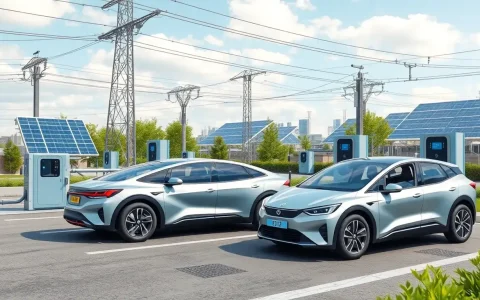
Wyoming Senator John Barrasso, a Republican and former chair of the Senate Energy panel, praised the bill for rolling back many aspects of what he referred to as the Biden administration’s “green new scam.” This includes eliminating electric vehicle tax credits that reduced the purchase price of EVs by $7,500, along with blocking a fee on excess methane emissions from oil and gas production.
Senate Republicans viewed the passage of the bill as a step forward for President Trump’s agenda, with West Virginia Senator Shelley Moore Capito stating, “Today, the Senate moved President Trump’s agenda forward.”
Clean energy advocates were left disheartened by the bill, contending that it significantly undermines the 2022 climate law enacted by Democrats. Nathaniel Keohane, president of the Center for Climate and Energy Solutions, noted, “By eliminating a number of clean energy incentives and slashing others, this bill represents a significant step backward for America’s energy future.” He cautioned that reducing incentives for electricity generated from wind and solar power is particularly shortsighted and will likely increase energy prices for households and businesses while jeopardizing the reliability of the electric grid.
This article was written by Matthew Daly of the Associated Press.
“`
Original article by NenPower, If reposted, please credit the source: https://nenpower.com/blog/senate-gop-eliminates-solar-and-wind-energy-tax-while-repealing-key-climate-legislation/