

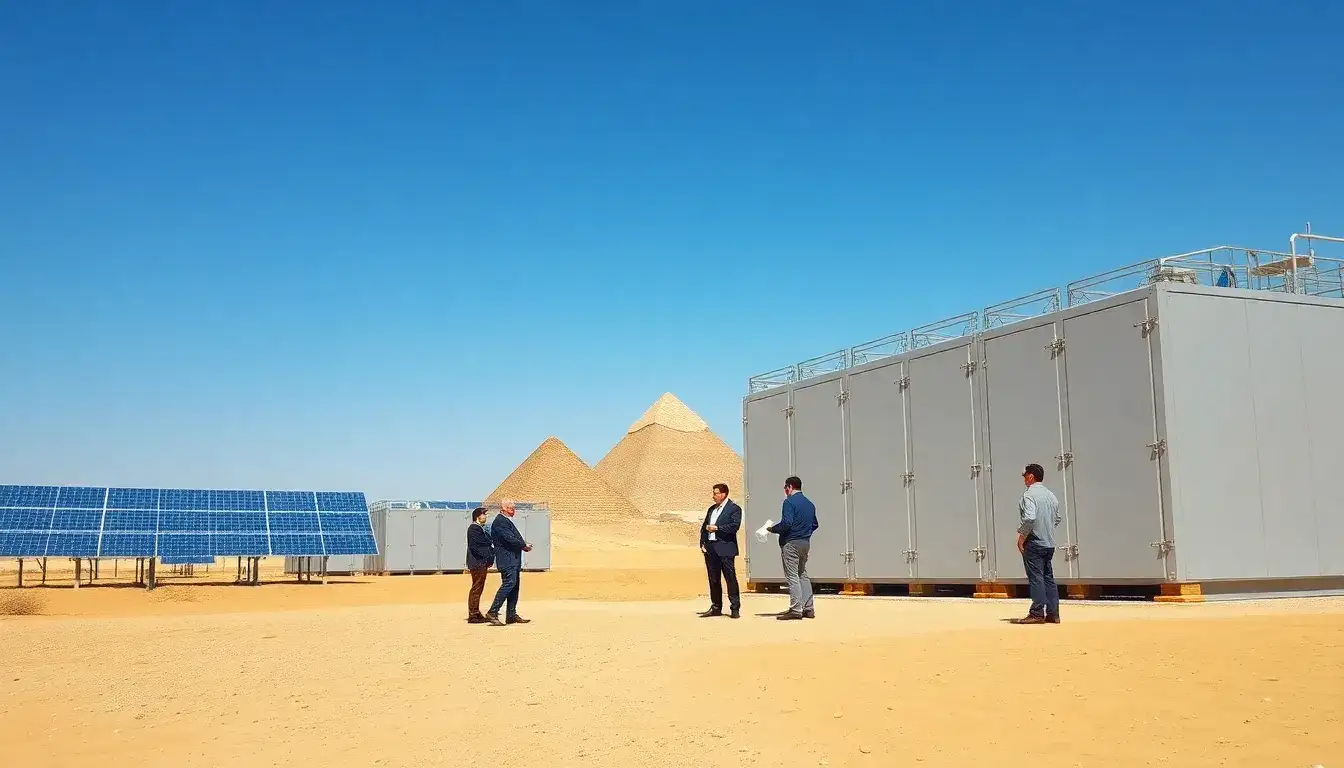
The financial closure of two major large-scale projects in Egypt signifies a promising advance for the country’s emerging energy storage sector. Recently, developers Scatec and AMEA Power reached this critical development milestone for their respective projects.
Norway-based Scatec secured financing for a gigawatt-scale solar PV plant integrated with a battery energy storage system (BESS), while UAE-based AMEA Power finalized funding for the BESS retrofit of an existing solar PV facility.
On June 15, AMEA Power announced via LinkedIn that it had obtained US$72 million from the World Bank’s International Finance Corporation (IFC). This funding will facilitate the integration of a 300MWh BESS into AMEA Power’s 500MW Abydos Solar Project located in Aswan Governorate, approximately 960 kilometers south of Cairo. The financing agreements were signed in a ceremony attended by notable figures, including Egypt’s Prime Minister, Mostafa Madbouly, and the Minister for Electricity and Renewable Energy, Dr. Mahmoud Esmat.
The Abydos solar PV plant was commissioned in December of last year, with both Madbouly and Esmat present for the inauguration. The solar installation was financed by the IFC alongside other development finance institutions, the Dutch Entrepreneurial Development Bank (FMO) and the Japan International Cooperation Agency (JICA). JA Solar provided the solar PV modules utilizing their DeepBlue 3.0 technology, which features a proprietary ‘Gapless Flexible Interconnection’ system. At the same time, AMEA Power announced that the project’s BESS technology would be supplied by Trinasolar, employing their Elementa 2 lithium iron phosphate (LFP) containerized BESS solution. Energy China ZTPC, a subsidiary of the state-owned Energy China Construction Group, is collaborating with Trinasolar on the installation.
In another significant development, Scatec and development finance institutions including the European Bank for Reconstruction and Development (EBRD), African Development Bank (AfDB), and British International Investment (BII) announced the closing of non-recourse financing for the Obelisk solar-plus-storage project. The financing package totals US$479.1 million, which covers 80% of the project’s anticipated US$590 million capital expenditure.
Scatec previously raised US$120 million in equity bridge loans for the project, with further equity injections postponed until construction completion. Scatec is responsible for engineering, procurement, construction (EPC), asset management, and operations and maintenance (O&M). The Obelisk project will be built in two phases: the first phase includes the installation of 561MW of solar PV along with 100MW/200MWh of battery storage, while the second phase will add another 564MW of solar generation capacity. This project is located in the Nagaa Hammadi region, about 360 kilometers north of Aswan Governorate.
The EBRD is providing a US$173 million loan, AfDB US$184.1 million, and BII US$115 million. Phase One is set to commence operations in the first half of 2026, with Phase Two expected to follow in the latter half of the year.
Both developers have signed 25-year power purchase agreements (PPAs) with the Egyptian Electricity Transmission Company (EETC) for their projects, established as a subsidiary of the national utility Egyptian Electricity Holding Company in 1976, tasked with managing power plants and transmission & distribution (T&D).
Additionally, AMEA Power has signed agreements for further large-scale storage projects, including a 1GW solar PV plant with 600MWh of BESS in Aswan Governorate, along with two contracts for standalone BESS projects totaling 1,500MWh, finalized in February of this year. These initiatives represent Egypt’s first forays into large-scale battery storage, aiding in the diversification of the energy mix and the integration of renewable energy resources.
As highlighted by the EBRD, Egypt aims for 42% of its power mix to derive from renewable sources by 2030. Currently, as reported by decarbonization consultancy Ember, the country’s share of clean electricity stands at approximately 11%, with hydroelectric sources contributing the most at 6%. Solar and wind energy together account for around 4.8% of the electricity mix, which is notably lower than the global average of 15%.
Original article by NenPower, If reposted, please credit the source: https://nenpower.com/blog/scatec-and-amea-power-secure-financing-for-major-battery-energy-storage-projects-in-egypt-2/

