

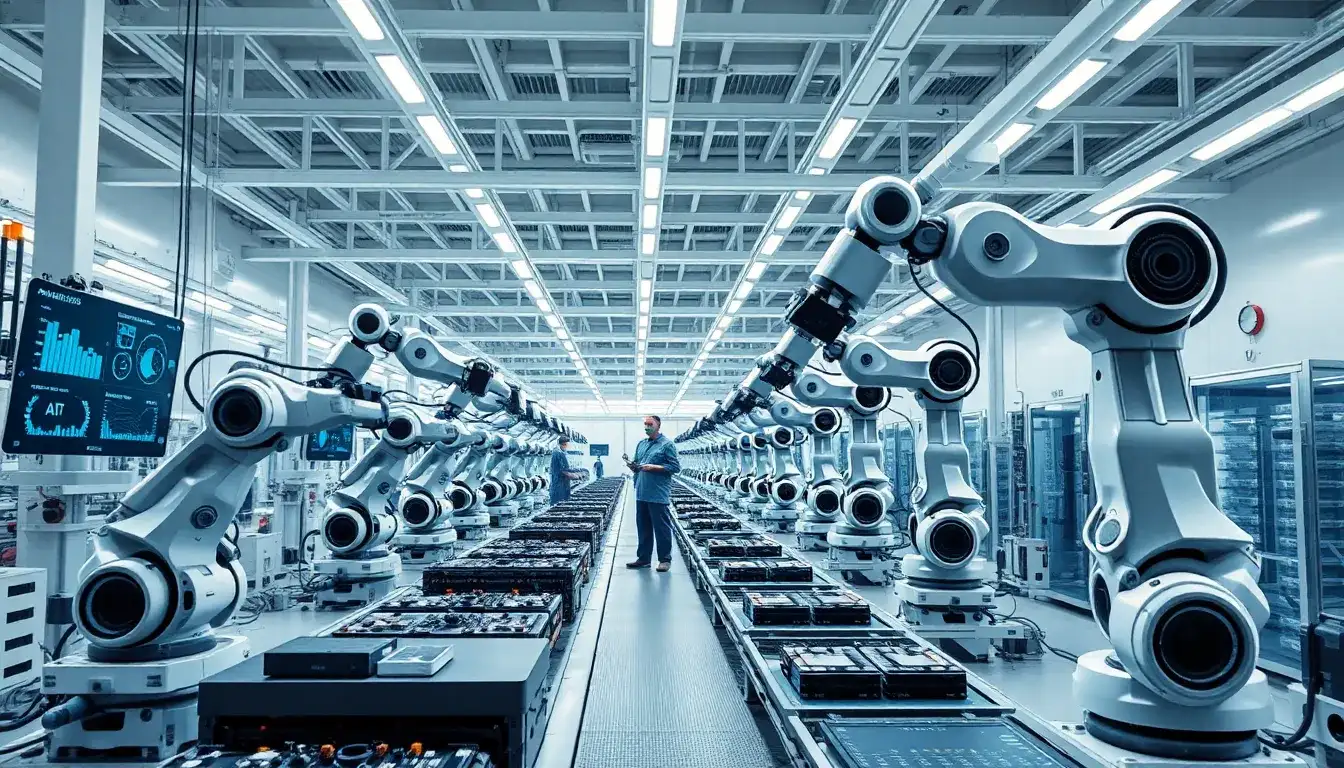
Samsung Electronics has announced an ambitious AI strategy aimed at transforming all of its global manufacturing operations into AI-Driven Factories by the year 2030. This plan seeks to deeply integrate AI across the entire manufacturing value chain, from inbound materials and production to quality inspection and final shipments, thereby creating the next generation of autonomous production environments.
At the heart of this transformation, Samsung will implement digital twin simulation technology throughout its manufacturing processes, along with deploying dedicated AI agents focused on quality control, production, and logistics. By enhancing data-driven analytical capabilities and leveraging pre-validated insights from these agents, Samsung aims to further elevate quality standards, operational efficiency, and production capacity within its global manufacturing network.
Moreover, Samsung plans to extend the application of AI into the areas of environment, health, and safety (EHS) management. By introducing proactive monitoring and automated hazard prevention systems, the company aims to improve onsite safety standards across its global production bases.
Central to this transformation are the AI agents (previously utilized in products such as the Galaxy S26 series), which possess the capability to autonomously plan, execute, and optimize decisions to achieve set objectives. Samsung has already developed advanced AI capabilities in the mobile sector and is now extending this expertise into manufacturing. Through AI agents designed for specific tasks, Samsung will optimize production processes, predictive maintenance, equipment repair, and logistics coordination in factories worldwide to achieve standardized excellence in operations.
To facilitate the transition from automation to advanced autonomy, Samsung is gradually introducing humanoid robots and specialized task robots into its production lines. This includes operational robots for assembly line tasks and facility management, logistics robots for autonomous material handling and transportation, and assembly robots for high-precision manufacturing tasks. In environments that are difficult for humans to access or where dangers exist, the company will also deploy integrated digital twin environmental safety robots to systematically monitor conditions, identify potential risks, and proactively eliminate onsite hazards.
YoungSoo Lee, Executive Vice President and Global Technology Research Head at Samsung Electronics, stated, “The next phase of manufacturing innovation lies in creating autonomous environments that enable AI to understand operational scenarios in real time and independently execute optimal decisions. We are committed to leading this AI-driven global manufacturing innovation transformation.”
Additionally, Samsung will showcase its industrial AI strategy and the vision for manufacturing innovation based on digital twins at the 2026 Mobile World Congress (MWC 2026), demonstrating how industrial AI can enhance safety and efficiency in real-world environments.
Original article by NenPower, If reposted, please credit the source: https://nenpower.com/blog/samsung-electronics-unveils-ambitious-ai-roadmap-for-autonomous-manufacturing-by-2030/

