

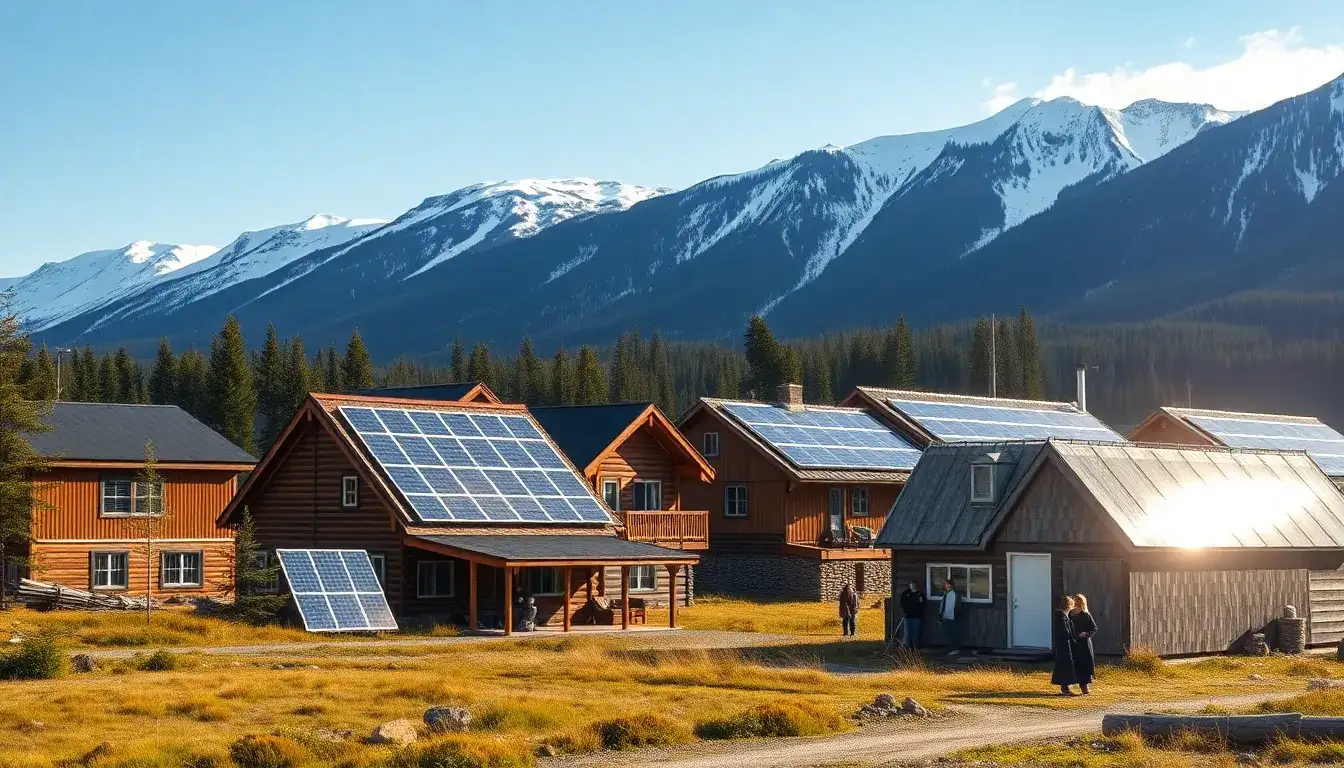
In rural Alaska, a village is embracing solar and biomass energy to reduce its reliance on diesel and cut costs
On a former military base in Galena, Alaska, a school serving about 200 high school students emphasizes sustainability among other subjects.
In Galena, a remote village of 400 residents along the Yukon River, the community is transitioning to clean energy to lessen its dependence on expensive, imported diesel. Local leaders report that the nearly completed solar farm, along with an existing biomass plant, will enhance savings and protect residents from power outages during severe weather. This technology offers the potential for clean backup power in emergencies, strengthens the power grid’s resilience, diversifies energy sources, and creates job opportunities for locals.
These initiatives come at a critical juncture for the renewable energy movement in the United States, particularly as federal support for clean energy projects faces uncertainty. Although the village’s federal grants for the solar array remain unaffected, local leaders are aware of the ongoing risks. Regardless of future public funding, Galena exemplifies how renewable energy can lead to cost savings, enhance reliability during extreme weather, and generate employment.
Once operational, the solar array will provide a backup system for the village’s power grid, according to Tim Kalke, general manager of Sustainable Energy for Galena Alaska (SEGA), a nonprofit managing the project. He noted that power outages could lead to costly repairs, and having reliable heat during extreme cold is essential for the community’s safety and well-being.
### A biomass project supports school heating
In May, dozens of high school students donned navy blue caps and gowns, eagerly awaiting their turn to walk through a festive entrance into a packed auditorium for graduation at Galena Interior Learning Academy. This school attracts around 200 students annually from across Alaska, contributing to the village’s population and energy demands. Students have access to vocational training courses in sustainable energy, aviation, carpentry, and more. However, maintaining comfortable temperatures during the harsh winters is crucial for its operation, which is where the biomass project plays a vital role.
Since 2016, trees, primarily paper birch, have been locally harvested, shredded into wood chips, and used to fuel a large boiler plant on campus. This initiative has reduced the school district’s and the city’s diesel consumption by approximately 100,000 gallons (about 380,000 liters) annually, according to Brad Scotton, a member of the Galena City Council who also serves on SEGA’s board. He highlighted that this project is one of the state’s first large-scale biomass plants and the most rural one.
Cost savings from the biomass initiative have enabled the Galena City School District to hire certified professionals for trade positions and maintain campus facilities, as noted by district superintendent Jason R. Johnson. It has also fostered a local workforce, providing jobs that the village previously lacked. “It’s keeping the money that used to go outside within the community and providing meaningful jobs,” Scotton stated.
### A new solar farm to reduce diesel consumption
In rural Alaska, the cost of goods can be quite high due to transportation challenges. Galena consumes nearly 400,000 gallons (1.5 million liters) of diesel annually for electricity generation, and an energy price spike around 2008 prompted the village to seek alternatives. Scotton recalled a significant increase in diesel prices, jumping from $1.64 to $4.58 per gallon, leading to an annual electricity bill exceeding $1.8 million. “That really got the community assessing whether or not we could continue business as usual,” he remarked.
This realization spurred efforts to secure grants for a solar array. On a cloudy May day, workers in reflective safety vests were seen installing rectangular panels on a metal grid in a field surrounded by boreal forests. The nearly completed 1.5 megawatt solar farm will connect to a battery system, enabling the community to operate on 100% clean, renewable energy during sunny summer days. Any excess energy will be stored in batteries for nighttime use, emergencies, or to heat the local indoor pool. The solar farm is expected to allow the community to switch off diesel operations for 800 to 1,000 hours annually, saving around 100,000 gallons (about 380,000 liters) of diesel.
While the solar farm may not immediately lower residents’ electricity bills, similar to the biomass plant, it is hoped that it will stabilize energy costs, allowing those savings to benefit the community and create job opportunities. Aaren Sommer, a 19-year-old who graduated from the academy last year, is currently assisting with the solar array installation. “That’s going to significantly reduce diesel usage at the power plant, which will be beneficial for us,” he said.
### Tribe members benefit from energy-efficient homes
In addition to the solar farm and biomass project, the Louden Tribe is constructing new energy-efficient homes to decrease members’ dependence on diesel. Some of the siding for these homes is sourced from local timber. In November, the Huntington family moved into a new stilted house equipped with a solar-compatible roof, 13-inch (33-centimeter) walls, and 18 inches (46 centimeters) of insulation to shield against the cold. Previously, the family spent about $7,000 annually on diesel for heating the cabin, a significant portion of their yearly income. The energy-efficient features of their new home have already started saving them money. The 300-gallon (1,130-liter) diesel tank they filled before moving cost approximately $2,400, and six months later, they still have fuel left.
The Huntingtons are among eight families the tribe has moved into sustainable homes, with plans to hand over keys to three more this year. Kalke, SEGA’s general manager, often reflects on the village’s production. While he used to only mention education, he can now proudly say, “Since 2016, we can talk about education, wood chips, and soon, solar energy.”
Original article by NenPower, If reposted, please credit the source: https://nenpower.com/blog/rural-alaskan-village-embraces-solar-and-biomass-energy-to-reduce-diesel-dependence-and-cut-costs/

