

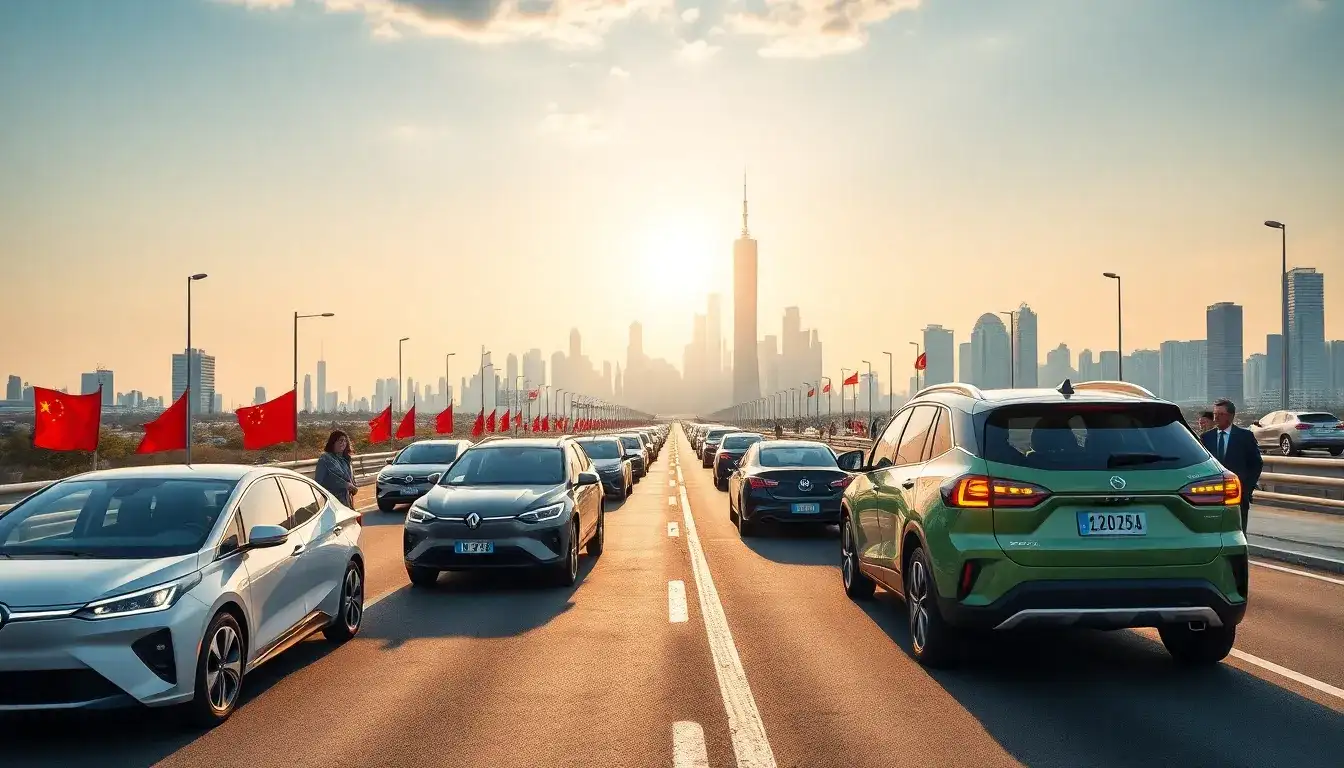
In the first quarter, the automotive market experienced impressive double-digit growth in production and sales. This remarkable start to the year raises the question: what does this “opening red” for the car market signify?
<h2>First Quarter Automotive Market Growth</h2>
According to a report from the China Securities Journal on April 11, the China Association of Automobile Manufacturers (CAAM) revealed that in the first quarter of this year, domestic automobile production and sales reached 7.561 million and 7.47 million units, respectively, marking year-on-year increases of 14.5% and 11.2%. Notably, passenger car production and sales reached 6.513 million and 6.419 million units, with year-on-year growth of 16.1% and 12.9%. Meanwhile, commercial vehicle production and sales totaled 1.048 million and 1.051 million units, with increases of 5.1% and 1.8% year-on-year. This indicates a significant recovery in the commercial vehicle market, particularly in the production and sales of buses and trucks.

In the realm of new energy vehicles, during the first quarter, production and sales reached 3.182 million and 3.075 million units, reflecting year-on-year growth of 50.4% and 47.1%. New energy vehicles accounted for 41.2% of total new car sales. Specifically, sales of pure electric vehicles grew by 47.7% year-on-year, while plug-in hybrid vehicle sales saw a year-on-year increase of 46.1%.

It is noteworthy that the market share of Chinese brand passenger vehicles increased compared to the same period last year, with sales of 4.369 million units, representing a year-on-year growth of 28.8% and a market share of 68.1%, up by 8.4 percentage points.

Chen Shihua, Deputy Secretary-General of the China Automobile Industry Association, stated, "In the first quarter, measures to boost automobile consumption were sustained and accelerated, leading to improved consumer confidence and a vibrant market. This has resulted in double-digit growth in production and sales, marking a strong start for the automotive industry."

<h2>What Does This Opening Red Mean?</h2>
The strong performance of the automotive market in the first quarter serves as a powerful testament to the long-term stability of the Chinese market. Some had previously expressed concerns that policies encouraging trade-ins might lead to a depletion of future market demand. However, the robust performance in the first quarter of 2025 effectively counters this viewpoint. The vast population and improving living standards in China provide a solid foundation for automotive demand.

As urbanization accelerates, more people are seeking larger vehicles, leading to a continued rise in demand. Additionally, as consumers' expectations evolve, they increasingly prioritize quality, performance, and technological advancements in vehicles, which further stimulates market growth.

Moreover, there are disparities in economic development and vehicle ownership across different regions, particularly in lower-tier cities and western areas where significant growth potential remains. These areas are emerging as new engines for market expansion.

Furthermore, the comprehensive rise of domestic brands has become a significant trend. The increasing market share of domestic passenger vehicles, now nearing 70%, marks a significant achievement. Historically, the domestic automotive market was dominated by joint venture and imported brands. However, domestic companies have gained consumer trust through continuous technological innovation and quality improvements.

In terms of product design, domestic brands are increasingly aligning with consumer preferences and aesthetic trends, offering stylish models with high-quality interiors and rich features. This has enhanced consumers' overall quality of life. Notable models such as the Li Auto L7 and L8, as well as the AITO M5, M7, and M9, have received widespread acclaim for their impressive designs and performance.

Additionally, domestic brands are innovating in marketing and services, establishing comprehensive sales networks and after-sales support to enhance the consumer experience. As a result, more consumers are considering domestic brands as their primary choice, reflecting both the improvement in product quality and a growing national brand consciousness.

<h2>Shift in Market Dynamics</h2>
The first quarter also revealed a notable shift in the new energy vehicle market, with pure electric vehicle sales growth outpacing that of plug-in hybrids. Traditionally, plug-in hybrids enjoyed sales advantages due to their extended range and dual operation modes, alleviating range anxiety for consumers. However, advancements in fast-charging infrastructure and battery technology have significantly improved the practicality of pure electric vehicles.

Enhanced charging networks and the introduction of battery swapping models, such as those pioneered by NIO, have made pure electric vehicles more convenient to use, leading to a higher acceptance rate among consumers. Moreover, many mainstream pure electric models now offer ranges exceeding 500 kilometers, with some high-end models surpassing 700 kilometers, effectively meeting consumer travel needs.

As a consequence, pure electric vehicles are becoming increasingly competitive in the market, with their sales growth surpassing that of plug-in hybrids, indicating a gradual shift in the technological landscape of the new energy vehicle market.

<h2>Market Competition Evolution</h2>
Recently, the automotive market has experienced a decline in aggressive price competition. This shift signifies a transformation from a focus solely on price to an emphasis on overall experience, innovation, and service. As the market matures, consumers are prioritizing factors such as quality, performance, safety, and technological sophistication over mere affordability.

This change in consumer behavior has led automakers to focus on product quality and service levels rather than relying solely on price wars. In an increasingly competitive environment, companies are innovating and enhancing their service offerings to attract consumers, promoting a more experience-oriented market.

The cooling of price wars is significant, as it indicates a move towards a more mature and rational automotive market. Automakers are now placing greater emphasis on quality and service, which will facilitate further transformation and high-quality development within the industry.

<h2>Conclusion</h2>
In summary, the "opening red" of the automotive market in the first quarter of 2025 signifies a positive outlook for the industry. This achievement not only highlights the robust demand and potential within the Chinese automotive market but also indicates that the industry is entering a virtuous cycle. The growth of the automotive sector is closely tied to the overall economy, contributing to job creation and economic benefits across related industries.

With ongoing innovation driving the industry, we have reason to believe that the Chinese automotive sector will play an increasingly significant role in the global market and emerge as a key force in advancing the automotive industry worldwide.
Original article by NenPower, If reposted, please credit the source: https://nenpower.com/blog/robust-growth-in-chinas-automotive-market-implications-of-a-strong-start-to-2025/

