

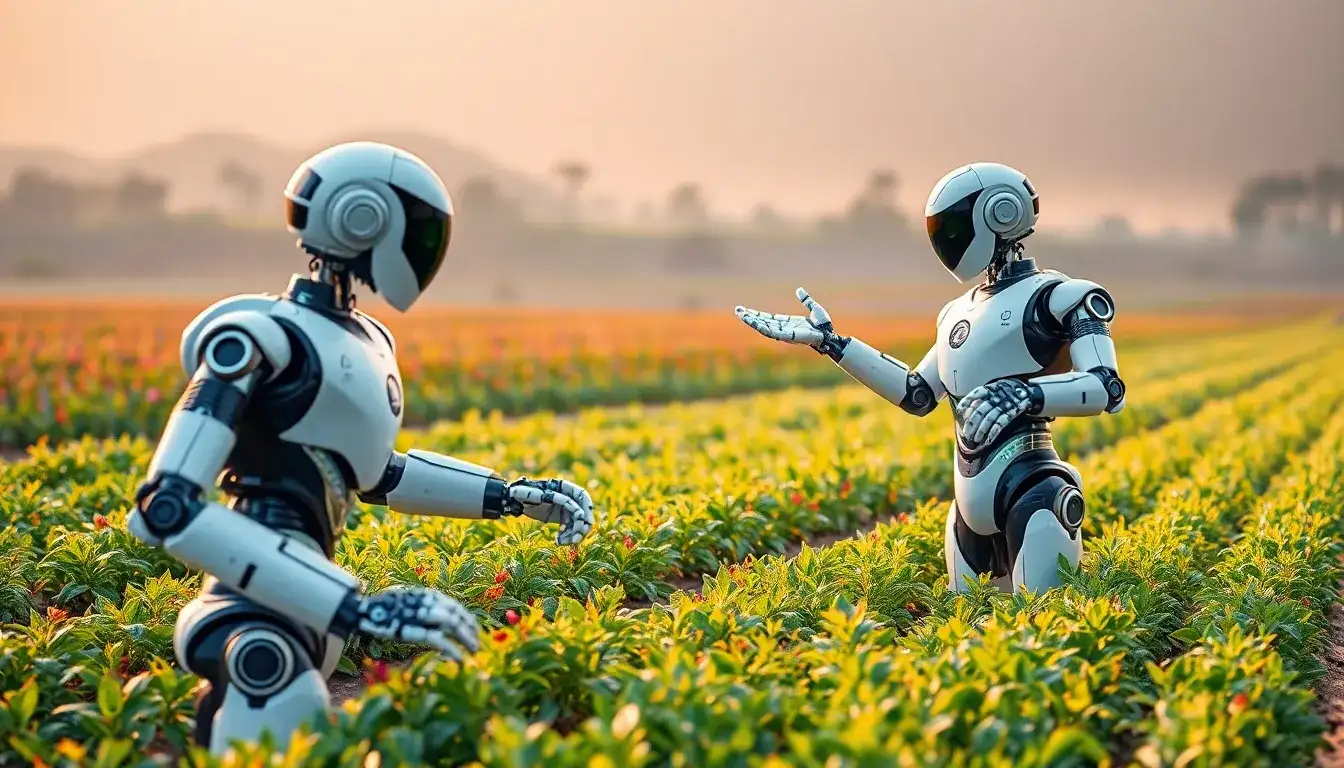
On February 3, 2023, the Central Government’s No. 1 Document explicitly stated the need to promote the integration of artificial intelligence with agricultural development, expanding applications for drones, the Internet of Things, and robots. This marks the first time that robots have been mentioned in this important document.
From autonomous farms on the black soil plains of Northeast China to miniature agricultural machines in the southern hills, and from smart breeding in laboratories to robotic arms picking fruit in orchards, modern technology is continuously transforming agriculture. Advanced technologies such as artificial intelligence and robotics are increasingly being applied where many may not notice, gradually making their way into the fields. Agricultural scientists are now exploring the ethical logic behind these technologies, laying the groundwork for future farms that aspire to thrive between the stars and the sea.
As the Central Government’s No. 1 Document was released, Qian Qian, an academician from the Chinese Academy of Sciences, was interviewed by Beijing News. Qian noted that technological innovations are profoundly changing the development model of modern agriculture. Smart breeding enables humans to obtain superior varieties more accurately and quickly, while unmanned technologies allow for precise and intelligent management of agricultural production, ensuring product quality and safety. “We have ample reason to believe that with technological advancements and continuous innovation, humans will gain a deeper understanding of and better utilize natural laws, achieving a harmonious coexistence with the environment,” he stated.
In the realm of breeding, Qian has been involved in modern scientific breeding work and has utilized new technological advancements such as artificial intelligence and embodied intelligence. He explained, “Many might think agriculture is rustic and unrelated to modern technology. However, agriculture has always been a field sensitive to technological development, from genetic breeding to modern unmanned farms, consistently representing the pinnacle of technology in various eras. Recently, with the explosion of technologies in artificial intelligence and robotics, agriculture has begun to scale up its use of these advancements.”
Qian elaborated that breeding can be divided into five stages, from traditional selection based on experience and phenotype observation to Mendelian hybrid breeding, which established quantifiable selection theories, to molecular marker breeding for precise operations at the molecular level. Today, smart breeding driven by artificial intelligence can integrate multi-omics data and optimize algorithms for autonomous decision-making while connecting with various sensors in the field, automated ground equipment, drones, and satellite remote sensing.
When asked to describe modern scenarios in his work, Qian referred to the current breeding era as “Breeding 5.0,” characterized by a system named “breeding flywheel,” which is a data-driven self-reinforcing system. The flywheel metaphorically illustrates the process from initiation to sustained growth. Initially requiring significant momentum, the system gradually accumulates energy, entering a self-sustaining acceleration phase, ultimately establishing a self-reinforcing growth cycle. This breeding system employs extensive sensors in the field, connecting unmanned aerial vehicles and satellite remote sensing to collect real-time data more accurately and comprehensively than human observation. In laboratories, platforms for high-precision genetic transformation and single-cell separation support high-throughput operations, while AI-driven protein engineering accelerates functional design.
“The breeding model can analyze vast amounts of phenotype data, creating virtual environments to simulate the performance and potential outcomes of various gene pairings under different conditions, allowing us to rapidly pinpoint the desired results among thousands of possibilities,” he added. This modern smart breeding leverages artificial intelligence and various robots to provide quicker and smarter solutions for sustainable food production.
Regarding the application of modern technology in field production, Qian stated that the use of scientific advancements is widespread. For instance, in large-scale production, autonomous navigation devices can execute precise sowing and fertilization tasks, and unmanned machinery is already in practical use. Technologies combining BeiDou navigation with manual operations are being employed for tasks such as spraying and sowing with drones, as well as harvesting with automated machines. In smart greenhouses, agricultural technologies enable closed-loop environmental control, while visually guided harvesting robots can autonomously harvest in controllable greenhouse conditions. Meanwhile, in pioneering experiments, robots have begun to sow and harvest crops in open orchards and vegetable fields, although widespread application is still a work in progress.
When discussing challenges in hilly areas, Qian acknowledged that while fully automated modern smart agricultural machines are better suited for plains, numerous technologies and devices are continually being introduced to hilly regions. For example, in southern terraced fields, drones are frequently used for spraying, and during harvest seasons, they transport agricultural products. Qian emphasized the need to accelerate the development and application of micro agricultural machines suited for hilly terrains, noting that artificial intelligence and embodied intelligence technologies are being integrated with these machines. Inspired by human cognitive biology, algorithm systems carry out complex cognitive functions, while robotic systems serve as effectors analogous to neural signals. Here, “robots” encompass not only humanoid robots but also a range of intelligent automated products such as drones, autonomous driving systems, unmanned ground vehicles, and quadruped robots. These diverse robots hold immense value in breeding and have broad applications in production.
Qian highlighted that China has 200 million acres of terraced fields and 500 million acres of sloped land with the potential for terracing. These areas present complex terrains and fragmented plots, making it difficult for large agricultural machines to operate, and the use of micro agricultural machines is hindered by a lack of skilled personnel. Yet, these lands, particularly traditional terraced fields, are treasures left behind by ancestors who harnessed and transformed nature over centuries. They represent fertile ground, but how can they truly become the foundation for food security and rural revitalization? Qian proposed that various new unmanned devices could be a promising solution, not only liberating labor but also rejuvenating these valuable lands facing numerous challenges.
Looking to the future, Qian shared his vision on how new technologies and innovations can more rapidly transform agricultural production models. He stated, “We need to more broadly explore and establish application scenarios for new technologies and advancements, such as robots changing the production mode in terraced fields. Many fertile lands, especially in hilly areas, are facing severe labor shortages due to harsh production conditions. Unmanned AI technologies and robotics are crucial for modernizing agriculture in these regions. Therefore, it is essential to create more scenarios for exploration, experimentation, and promotion, reducing the costs of machine production through moderate scaling, enabling robots to be deployed more rapidly in these areas.”
Qian also discussed current developmental directions in areas where new technologies have already been widely adopted, stating, “AI and robotics are rapidly changing the modern breeding model. We are contemplating how to achieve greater transparency and interpretability in AI during data processing and decision-making, especially in fields affecting human ethics and well-being. The AI decision-making process must be understandable and traceable to ensure that technological advancements align with social values and ethical principles. In the future, explainable AI technology will play a crucial role, enabling experts and breeders to clarify the basis for AI-driven decisions, thereby enhancing trust in AI systems.”
Furthermore, the rise of unmanned management and vertical farming promises to revolutionize modern agriculture. By utilizing advanced sensor technologies and automated control systems, agricultural production can achieve precise and intelligent management, ensuring product quality and safety. These innovations also significantly reduce water and fertilizer usage, with savings exceeding 90%. Such advancements have profound implications for alleviating global water shortages, reducing environmental pollution, and promoting sustainable agricultural practices. Excitingly, these technological advancements also offer potential agricultural solutions for future human colonization of Mars. Under extreme environmental conditions, deep integration of technology and biological systems could enable the establishment of a self-sustaining agricultural ecosystem on Mars, providing the necessary material foundation for interstellar exploration and colonization, illustrating how terrestrial precision agriculture and closed-loop resource management innovations could adapt to extraterrestrial life support systems.
Looking ahead, we have ample reason to believe that with ongoing technological advancements and innovation, humanity will gain a deeper understanding of and better utilize natural laws, achieving a harmonious coexistence with the environment. We aim to leave future generations a more prosperous, healthy, and sustainable world, guiding them to continue exploring the mysteries of the universe and writing new chapters in human history.
Original article by NenPower, If reposted, please credit the source: https://nenpower.com/blog/robots-make-their-debut-in-the-central-document-as-academician-qian-qian-explains-new-productive-forces-in-agriculture/

