

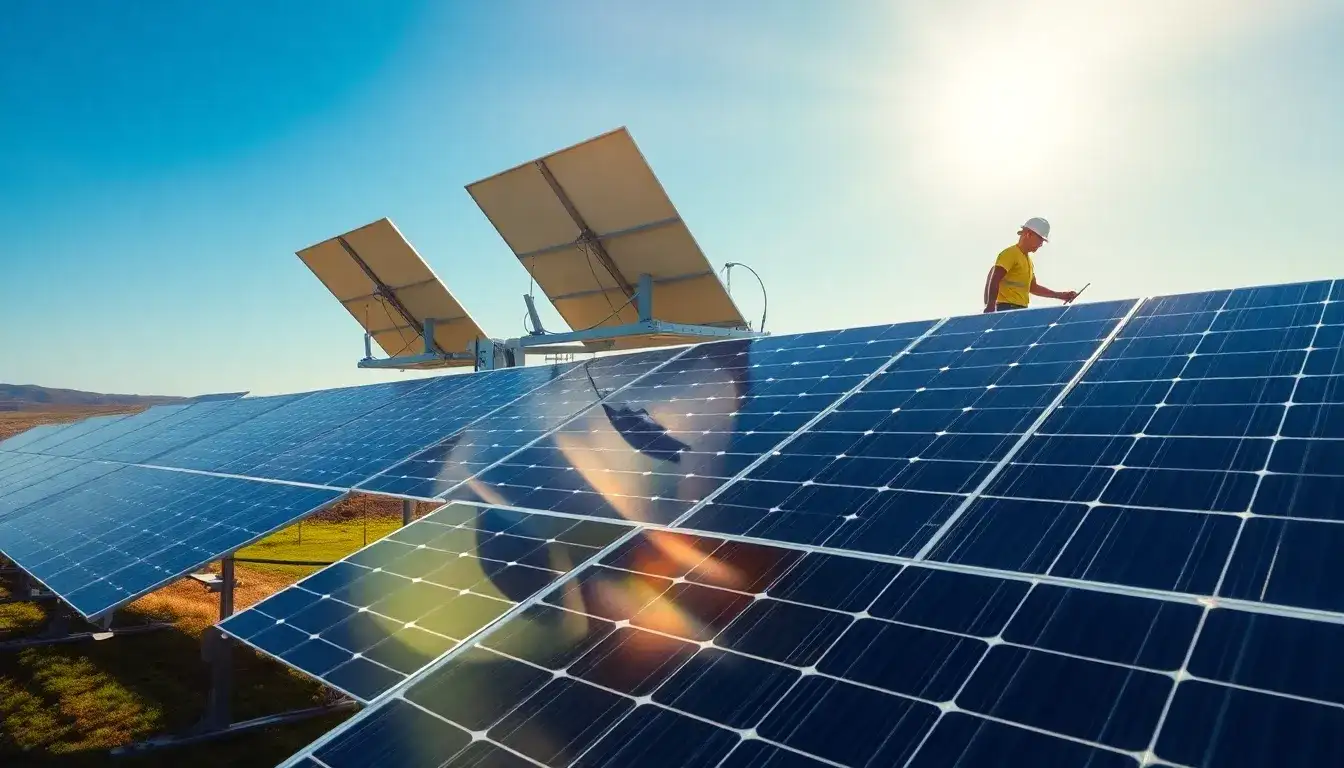
Following the Sun: The Impact of Tracking Systems on Solar Efficiency
====================================================================
By Abdul Ahad Nazakat
Reviewed by Laura Thomson
June 5, 2025
As environmental concerns persist, solar energy has emerged as a cleaner alternative to traditional energy sources. Solar panels harness sunlight to generate electricity, but conventional fixed-tilt systems often operate below their optimal efficiency due to the sun’s changing position throughout the day. Solar tracking systems mitigate this issue by continuously adjusting the panels’ orientation to align with the sun, resulting in an energy output increase of 10–40% compared to fixed installations. This article delves into solar tracking technology, its working principles, system components, and recent advancements in the field.
### Fundamentals of Solar Photovoltaic Technology
Solar photovoltaic (PV) technology converts sunlight into electricity using semiconducting materials such as silicon. When photons strike these materials, they transfer energy to electrons, creating an electric current. The energy output is influenced by the angle at which sunlight strikes the panel, with perpendicular rays yielding optimal results. Solar energy provides numerous advantages as a renewable resource: it produces no emissions during operation, utilizes a widely available energy source, and requires minimal maintenance once installed. However, the efficiency of solar PV systems hinges on maximizing direct sunlight exposure, a challenge that tracking systems effectively address. A 2023 study indicates that single-axis trackers can enhance energy output by 10–20%, while dual-axis systems can achieve boosts of 30–40%. The choice between tracker types depends on geographic location, budget, and project scale.
### How Solar Tracking Systems Work: Components and Design
Solar tracking technology adjusts solar panels to maximize direct sunlight exposure throughout the day. This concept mirrors the heliotropism observed in plants like sunflowers. A solar tracking system comprises software, electronics, and mechanical components to ensure precise panel alignment. A mounting structure, typically made from steel or aluminum, supports the rotation of PV modules. Drive systems—including hydraulic mechanisms, linear actuators, or electric motors—facilitate movement. The system’s controller, often a programmable logic controller (PLC) or microcontroller like Arduino, processes data from various sensors (e.g., light-dependent resistors (LDRs), UV sensors, or GPS modules) to determine the sun’s position. More advanced systems utilize astronomical algorithms or fuzzy logic control (FLC) to predict the sun’s path, thereby reducing dependency on sensors. For instance, a 2023 study revealed that FLC-based trackers could increase power output by up to 96% in variable cloud conditions.
Modern solar trackers frequently implement backtracking algorithms to minimize self-shading in multi-row installations, preventing energy loss. Additionally, features that enhance weather resilience are crucial for ensuring the system’s longevity; many trackers can position the panels horizontally for protection against strong winds or hail.
### Types of Solar Tracking Systems
**Single-axis trackers**: These systems rotate panels around a single axis, typically aligned north-south, following the sun’s path from east to west. They are commonly utilized in large-scale solar projects and can generate approximately 10–20% more energy than fixed-tilt systems. Their straightforward design and maintenance requirements make them a practical choice for installations balancing cost and performance.
**Dual-axis trackers**: These systems adjust solar panels along two rotational axes, allowing them to track both the sun’s daily east-west movement and its seasonal north-south shifts. This capability ensures better alignment with the sun throughout the year, particularly in regions with considerable seasonal variation or in projects prioritizing maximum energy output. Research indicates that dual-axis systems can achieve 30–40% higher annual energy production, with some prototypes reporting gains of up to 58.7% during summer months. However, their higher installation costs and mechanical complexity may limit their suitability for widespread use.
### Comparison of Single-Axis and Dual-Axis Tracking Systems
| Feature | Single-Axis Systems | Dual-Axis Systems |
|———————-|————————————–|————————————|
| Energy Efficiency | 10-20% higher output vs. fixed systems | 30-40% higher output vs. fixed systems |
| Mechanical Complexity | Simpler design with fewer components | More complex with additional actuators |
| Tracking Capability | Adjusts panels in one plane | Adjusts in both horizontal and vertical planes |
| Applications | Suitable for residential installations | Ideal for utility-scale and high-DNI regions |
| Cost Considerations | Lower initial and maintenance costs | Higher investment but greater energy returns |
### Practical Considerations
Tracking systems generally require 25-40% more land area than fixed installations, as the panels need sufficient space to move without casting shadows on each other. Given their mobility, these systems often necessitate robust foundations to maintain stability, especially on soft ground or in earthquake-prone areas. Additional structural support can increase installation costs by 15–30% in high-wind areas. In desert environments, dust mitigation systems are essential, while cold climates necessitate snow-shedding features to maintain efficiency.
### Recent Advancements in Solar Tracking Systems
Recent innovations have focused on enhancing accuracy, durability, and affordability. The integration of the Internet of Things (IoT) and artificial intelligence (AI) allows for real-time performance monitoring and more precise panel positioning. Smart tracking systems can adjust panel movements based on weather forecasts, minimizing unnecessary operations during cloudy conditions to reduce mechanical wear and energy loss. These systems also support remote monitoring and control, providing users with performance data and the capability to make manual adjustments as needed.
Advancements in material science have contributed to lighter and more efficient tracking systems, such as the use of composite frames that reduce overall structural load. Some trackers are now self-powered, utilizing small built-in photovoltaic cells to operate their motors, thus decreasing the need for external power sources. On the software front, hybrid tracking systems that combine GPS data with LDRs have shown promising results, with studies reporting energy yields up to 33.2% higher than fixed-tilt installations.
Comparative studies have clearly shown the advantages of solar tracking systems over fixed-tilt setups. Single-axis trackers increased energy production by approximately 24.4%, while dual-axis systems achieved around 32.2% more output. In terms of cost recovery, single-axis systems reached payback about 0.39 years sooner than fixed systems, and dual-axis systems shortened payback by approximately 18 months. These findings suggest that, despite higher initial costs, tracking systems offer improved efficiency and better economic returns over time.
### Future Prospects of Solar Tracking Systems
With ongoing advancements in materials, control systems, and integration of new technologies, solar tracking systems are expected to become increasingly affordable and efficient. The application of smart technologies such as IoT, AI, and machine learning will likely enhance system performance while reducing operational costs. Overall, solar tracking systems represent a significant leap forward in photovoltaic technology, overcoming the limitations of fixed-tilt installations by following the sun’s path. Single-axis trackers provide a cost-effective option for various applications, while dual-axis systems deliver superior performance when site conditions and budget permit. As technology continues to improve, tracking systems are poised to play a more substantial role in the adoption of renewable energy.
Original article by NenPower, If reposted, please credit the source: https://nenpower.com/blog/revolutionizing-solar-energy-the-role-of-tracking-technology-in-enhancing-efficiency/

